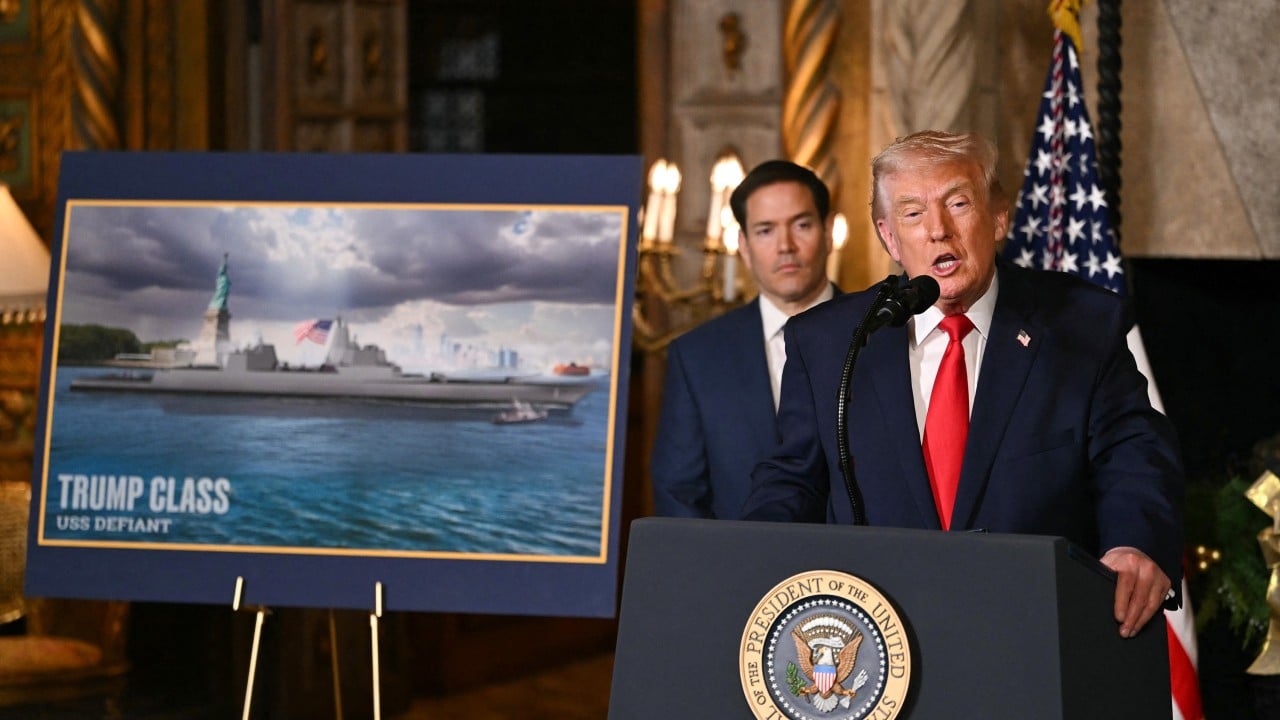
Chinese military scientists have published an unexpected technical assessment endorsing the large-caliber naval guns proposed for the United States Navy's controversial Trump-class warship. While Western defense analysts immediately dismissed the revival of heavy surface gun systems as an expensive nostalgic artifact, researchers at the People's Liberation Army Dalian Naval Academy saw something entirely different. They saw an urgent answer to the modern economic nightmare of drone swarms and missile saturation.
The technical papers emerging from Chinese defense institutes indicate that military planners are studying whether high-calibre kinetic weapons can solve a brutal financial imbalance. Firing a million-dollar interceptor missile at a ten-thousand-dollar drone is a fast track to national bankruptcy. Beijing's naval analysts recognize that the United States might be stumbling toward a functional, if technologically fraught, solution for close-in mass defense.
To understand why Chinese researchers are paying close attention to the heavy armaments of the proposed 35,000-ton nuclear-powered surface combatant, you have to look past the political novelty of the ship's name. The debate is not about recreating World War II line-of-battle tactics. It is about the physics of energy storage, magazine depth, and the hard limits of modern missile inventories.
The Economics of Exhaustion
Modern naval warfare suffers from a profound cost asymmetry. A mass-produced loitering munition or anti-ship cruise missile costs a fraction of the defensive hardware required to shoot it down. When an adversary launches dozens of low-cost aerial threats simultaneously, standard vertical launch systems deplete their cells at an unsustainable rate.
Wang Lei and his research team at the Dalian Naval Academy analyzed the proposed integration of heavy electromagnetic railguns and large-caliber conventional gun systems on the United States Navy blueprint. Their conclusion cuts against conventional Western wisdom. Large guns provide deep magazines filled with inexpensive projectiles. A hyper-velocity projectile or a guided conventional shell costs orders of magnitude less than an active-radar homing surface-to-air missile.
Consider a hypothetical engagement in a contested littoral zone. A formation faces an incoming swarm of fifty unmanned surface vessels and low-tier aerial drones. Expending standard tactical missiles empties the ship's primary cells within minutes. A thirty-two-megajoule railgun or an advanced powder-gun system alters that math completely. It trades expensive rocket fuel for kinetic energy, keeping the high-end missile inventory intact for genuine high-threat targets like hypersonic cruise missiles.
The Weight of Technological Ambition
The Chinese assessment does not amount to uncritical praise. The same military papers point out the severe engineering traps buried within the Trump-class design. Pushing a massive hull through the water with an A1B nuclear reactor while simultaneously powering high-energy lasers, combat radars, and an electromagnetic railgun creates a staggering thermal and electrical management burden.
Naval architects understand that adding unproven, power-hungry weapons to a first-of-class hull invites schedule delays and cost overruns reminiscent of the troubled Zumwalt destroyer program. Railguns demand robust barrel life extensions and advanced pulse-power conditioning that remain difficult to maintain in salt-air marine environments. If the power generation stumbles, the entire defensive ecosystem suffers.
Beijing's analysts note that concentrating this much capability onto a single platform creates an oversized target. A nuclear-powered guided-missile warship displacing over thirty thousand tons is a high-value asset that will draw relentless attention from quiet attack submarines and long-range reconnaissance networks. Survivability through sheer size and thick compartmentalization comes at the steep price of high visibility.
Shifting Doctrines Under the Surface
The sudden interest from Chinese research circles signals a broader evolution in how major military powers view volume over precision. For decades, the dominant philosophy assumed that smart weapons rendered traditional guns obsolete. Every engagement would be settled beyond visual range by software-guided explosives.
That theory broke down against the reality of cheap attrition warfare. When enemies can flood an operational theater with inexpensive autonomous systems, precision alone becomes a vulnerability because you run out of bullets before they run out of targets.
By taking a serious look at the heavy gun provisions on a heavily armed American concept ship, Chinese naval science is hedging its own bets. If the United States manages to solve the thermal and electrical hurdles of heavy electromagnetic and kinetic gun systems, those weapons will provide a distinct tactical cushion in saturated environments.
The fascination from across the Pacific reveals a shared anxiety. Both naval powers recognize that the next major conflict will not be won solely by exclusive clubs of hyper-expensive stealth assets. It will be decided by logistics, magazine depth, and who can afford to keep firing when the electronics start to fail and the skies fill up with iron.