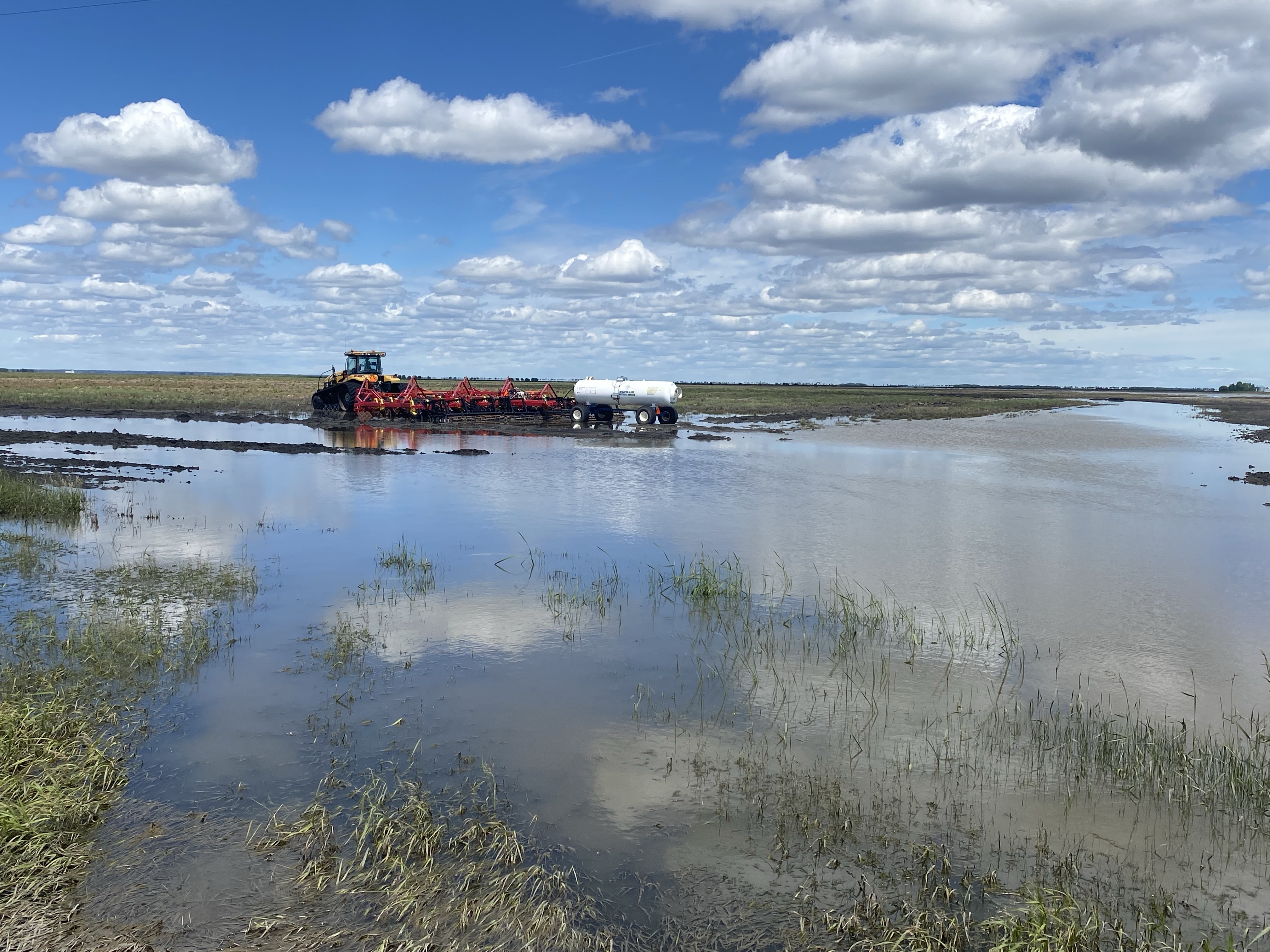
Manitoba farmers are burning through their remaining capital to reseed thousands of ruined acres after early-season storms wiped out their initial crops. While mainstream local reporting frames this as a simple story of agricultural resilience, the reality is a high-stakes financial gamble that many producers are destined to lose. Reseeding isn't a guaranteed second chance. It is a desperate calculation against the calendar, skyrocketing input costs, and rigid insurance deadlines that force farmers to accept lower yields before the seeds even hit the soil.
The immediate aftermath of a severe weather event on the Canadian Prairies usually follows a predictable media narrative. Cameras film washed-out roads, flattened canola fields, and farmers stoically surveying the mud from the cabs of their tractors. But the real crisis happens weeks later in the farm office, where spreadsheets dictate whether a family business survives the winter. For an alternative view, see: this related article.
The Illusion of the Second Chance
When a late spring storm brings severe frost, pounding hail, or torrential rain that crusts over the topsoil, the clock starts ticking. For crops like canola, soybeans, and corn, every day of delay after the optimal May planting window shaves percentage points off the final harvest potential.
Farmers face a brutal choice. They can leave a damaged, patchy crop in the ground and hope it recovers enough to cover expenses, or they can spray it out, disk the soil, and buy entirely new seed and fertilizer to start over. Further reporting regarding this has been shared by Reuters.
The decision is rarely purely agronomic. It is heavily dictated by insurance cutoff dates. In Manitoba, the Manitoba Agricultural Services Corporation (MASC) sets strict deadlines for full coverage. For instance, if a farmer reseeds canola past the early June thresholds, their coverage drops significantly. They are paying full price for inputs while insuring a fraction of the value.
This creates an artificial pressure cooker. Producers rush onto fields that are often still too wet, compacting the soil and setting the stage for poor root development. They buy whatever seed varieties are left at the retail agronomy centers, which are rarely the top-performing, disease-resistant genetics they originally selected in the winter.
The Exploding Input Cost Trap
The financial math of reseeding has fundamentally broken over the last few years. Historically, seed companies offered generous "reseeding rebates" or deep discounts to loyal customers who lost a crop to weather. Those safety nets have worn thin.
Consider the baseline costs. High-yielding, genetically modified canola seed can easily top $80 to $100 per acre. Add the cost of fuel for additional tillage and seeding passes, plus another round of starter fertilizer, and a farmer is looking at an unbudgeted cash outlay of $130 to $150 per acre just to get back to zero.
For a mid-sized Manitoba operation running 4,000 acres, losing a quarter of their farm to a localized hail strip means finding an extra $150,000 in cash or operating credit immediately.
Operating credit isn't cheap anymore. With interest rates hovering far higher than they were during the previous decade, financing a second planting pass on borrowed money introduces a massive layer of risk. If the reseeded crop hits an early autumn frost—a very real danger for crops planted weeks behind schedule—the farmer loses both investments. The math simply stops working.
The Overlooked Agronomic Penalties
Going back into a field for a second time changes the entire ecosystem of that soil for the rest of the summer. The mechanical disruption of reseeding destroys any pre-emergent herbicide barriers that were applied during the first pass. This opens the door for a secondary flush of aggressive weeds like wild oats and kochia, which thrive in warmer June soils.
Furthermore, a late-planted crop flips the biological calendar upside down. Canola planted in early May usually flowers in late June or early July, beating the intense heat of mid-summer. Canola reseeded in June will flower in late July or August.
High temperatures during flowering cause a phenomenon known as heat blast. The blossoms abort, the pods fail to fill, and yield drops off a cliff. A farmer might do everything right during the June reseed, only to have a three-day heatwave in August destroy their yield potential anyway.
Then comes the autumn harvest crunch. Late crops mean a late harvest. In Manitoba, September brings shorter days, heavy morning dews, and the looming threat of a killing frost. Farmers are forced to harvest grain with high moisture content, which requires burning expensive propane in grain dryers just to make the crop stable enough to sit in a bin without rotting.
Regional Supply Chain Bottlenecks
When a major storm hits a region like the Interlake or Westman, thousands of acres require attention simultaneously. This triggers an immediate logistics bottleneck that individual farmers are powerless to solve.
Agronomy retail locations operate on tight inventory timelines. They do not keep massive surpluses of seed and chemical sitting in warehouses in June. When hundreds of farmers call at once demanding specific short-season varieties—which maturity-wise are necessary for late planting—the supply vanishes within hours.
Farmers are left scrambling for scraps. They take longer-season varieties that carry a high risk of frost failure, or they switch crops entirely, moving from canola to ultra-early barley or oats. Switching crops disrupts long-term crop rotations, potentially worsening pest and disease cycles for the next three years.
Equipment availability also becomes a barrier. If a farmer relies on custom seeding operators or needs to rent specialized vertical tillage equipment to dry out waterlogged soil, they join a long waiting list. Every day spent waiting on equipment is another half-bushel per acre lost from the final yield.
The Broken Safety Net
Crop insurance is designed to prevent bankruptcy, not to guarantee profitability. Many observers outside the agricultural sector assume that insurance payouts make farmers whole after a storm. This is a fundamental misunderstanding of how the system operates.
MASC programs provide a reseeding benefit, but it is a flat-rate payment meant to offset a portion of the seed cost. It does not cover the full economic reality of diesel, labor, depreciation, and lost time.
More importantly, crop insurance is tied to historical yield averages. If a farmer takes a massive yield hit on a reseeded crop this year, it drags down their individual ten-year yield average. This reduces their coverage level and increases their premiums for the next decade. A single weather event in 2026 leaves a financial scar that bleeds into the mid-2030s.
The system also fails to account for the emotional and physical toll of the double-shift. Farming families work 18-hour days throughout May to get the crop in the ground, balancing on the edge of exhaustion. Forcing them to immediately repeat that grueling process in June, under a cloud of severe financial stress, leads to mistakes, equipment accidents, and burnout.
The Permanent Shift in Climate Strategy
Relying on traditional reseeding as a primary risk-management strategy is becoming obsolete. The weather patterns hitting Western Canada are showing greater volatility, with intense, localized deluges replacing steady spring rains.
Producers are quietly shifting their strategies away from the traditional panic-and-reseed model. Some are moving toward ultra-low disturbance disc drills that allow them to seed directly into heavy residue without waking up dormant weed seeds or losing precious soil moisture. Others are altering their crop mixes permanently, sacrificing the high upside of canola for the resilience of winter wheat planted the previous autumn.
The farmers who survive the next decade will not be the ones who blindly reseed every time a storm hits. They will be the ones who know how to walk away from a damaged field, cut their losses early, and preserve their working capital for the next season. Reseeding is no longer a sign of resilience. Too often, it is a fast track to financial ruin.

/https://tf-cmsv2-smithsonianmag-media.s3.amazonaws.com/filer/c6/97/c697b065-e0bd-4970-81ea-819779296b91/u765404inp.jpg)
