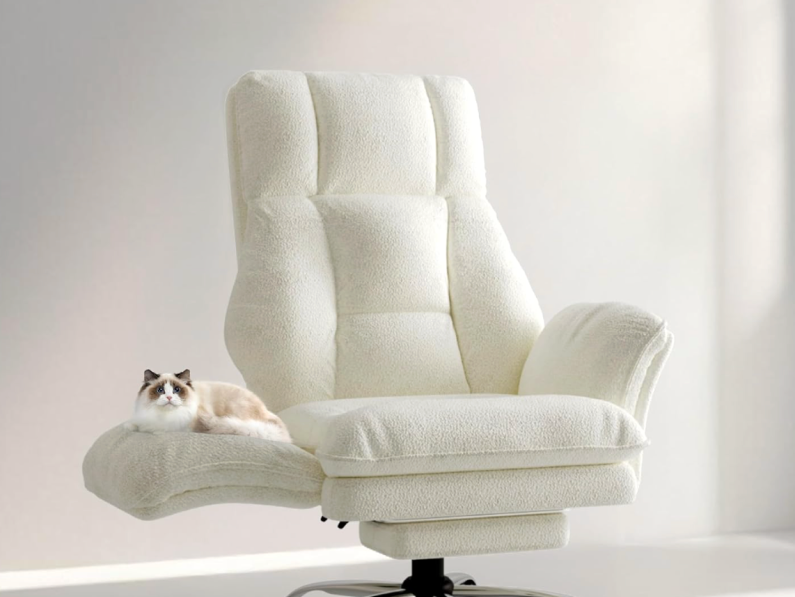
The viral criss-cross office chair promises a cozy, boundary-free alternative to rigid corporate seating by swapping narrow bases and restrictive armrests for a broad, plush cushion that lets you tuck your legs under yourself while you work.
It looks like a stroke of genius on short video feeds. Millions of remote workers, long accustomed to tucking one foot under a thigh or folding both legs into a tailor-style sit, watched creators glide across bouclé fabric and immediately bought in. The marketing narrative was effortless: corporate ergonomics had failed us, and a cheap, oversized chair was the populist fix.
It is an appealing story. It is also an ergonomic nightmare waiting to happen.
Behind the trendy upholstery and thousands of five-star e-commerce reviews lies an unpleasant truth about orthopedic mechanics, disposable furniture design, and viral consumer trends. The criss-cross chair isn't a revolution in workplace comfort. It is a brilliant piece of social media marketing that trades short-term sensory relief for long-term spinal degradation.
The Rebellion Against Corporate Ergonomics
To understand why a wide, armless cushion went viral, you have to look at what traditional office furniture got wrong for decades.
Standard executive and task chairs were engineered under a rigid mid-century philosophy: erect, 90-degree angles, feet flat on the floor, wrists parallel to the desk. This posture, often codified by industrial design standards, assumes human beings are static machines.
Real bodies do not operate this way. People fidget. They shift weight to relieve pressure points, pull up a leg during deep concentration, and naturally seek fidget-friendly postures throughout an eight-hour shift.
When millions of workers transitioned to home offices, the friction between rigid chairs and human habit became intolerable. Traditional ergonomic chairs were expensive, aggressive, and aesthetically cold. They featured hard plastic armrests that hit desk edges, narrow seat pans with raised side bolsters, and stiff lumbar pads that jabbed into the lower back if the sitter shifted even an inch off-center.
Enter the criss-cross chair. By stripping away armrests, widening the seat pan to 25 inches or more, and wrapping the whole unit in soft upholstery, manufacturers created an object that felt less like an appliance and more like a couch. It promised freedom of movement in an era defined by screen-bound confinement.
What Happens to Your Body When You Fold Up
The physical act of sitting cross-legged on a flat surface feels comforting at first because it changes muscle activation patterns. If your hip flexors and lower back are fatigued from static sitting, drawing your legs upward temporarily releases tension in the hamstring origin and alters the angle of the pelvis.
The relief, however, is a biological trick.
When you sit tailor-style on a chair cushion without specialized support, your pelvis undergoes severe posterior rotation. The top of your hip bone tilts backward, flattening the natural inward curve of your lower back, known as the lumbar lordosis.
Standard Ergonomic Sit           Criss-Cross Sitting
   (Neutral Spine)              (Posterior Pelvic Tilt)

       [ Head ]                        [ Head ]
          |                               |
     ( Lumbar )                      ( Slouched )
     ( Curve  )                      ( Spine    )
        / \                             / \
       /   \                           /   \
   [Pelvis Neutral]             [Pelvis Rotated Back]
     |       |                       //         \\
  (Thighs) (Knees)              (Knees Wide, Ankles Tucked)
Without an upright lumbar arch, the structural load of your upper torso shifts away from your skeletal framework and dumps directly onto the intervertebral discs and passive spinal ligaments. Over time, this rounded-back posture forces your neck to hyper-extend forward so your eyes can remain level with your monitor, creating the exact upper-back strain and neck tension that desk workers spend hundreds of dollars trying to avoid.
The lower limbs fair no better. Crossing the legs for extended periods compresses the popliteal fossa—the space behind the knee—and places static pressure on the peroneal nerve near the outer knee joint.
If you have ever stood up from a criss-cross chair with pins and needles shooting through your calf, or felt a dead weight in your foot, you have experienced transient nerve ischemia. Doing this once will not cause permanent damage. Doing it for six hours a day, five days a week, leads to chronic joint imbalance, uneven pelvic loading, and hip tightener strain.
The Economics of Disposable Comfort
If these structural flaws are obvious to any physical therapist, why are these chairs everywhere?
Follow the manufacturing supply chain. A legitimate ergonomic task chair is a complex piece of physical engineering. It requires a synchronous tilt mechanism, multi-directional adjustable armrests, pneumatic gas lifts capable of fine-tuned tension control, and high-density molded foam that maintains its elasticity over millions of compression cycles.
A criss-cross chair requires none of this.
By eliminating armrests, manufacturers cut out a major cost center and hardware failure point. By using a basic tilt-and-swivel plate instead of a recline mechanism, they reduce the steel component weight by half. The wide seat pan is rarely constructed from contoured, cold-cured foam; instead, it is typically cheap cut-polyurethane wrapped around a flat plywood base, occasionally topped with a layer of polyfill to give it that soft, initial "sink-in" feeling on camera.
The math for e-commerce brands is irresistible. A traditional high-performance office chair might cost $120 to manufacture and ship due to heavy mechanics and bulky packaging. A flat-packed, armless criss-cross chair can be manufactured for a fraction of that, boxed compactly, and sold directly to consumers through social commerce platforms for anywhere between $100 and $200.
The profit margins are substantial, leaving ample budget for affiliate marketing campaigns. Thousands of influencers receive free units or high commission rates for posting short videos demonstrating how easily they can curl their legs into the extra-wide seat.
The consumer sees a low price point and a chic aesthetic that blends into a bedroom or living room corner. What they do not see is the degradation timeline. Within three to six months of daily use, low-density polyurethane foam breaks down. The soft cushion flattens into a hard pad, leaving the user sitting cross-legged directly on top of a hard sheet of plywood with zero lumbar engagement.
Navigating the Ergonomic Gray Area
Abandoning the criss-cross chair trend does not mean returning to the torture racks of 1990s cubicles. The instinct that drove people toward these chairs—the deep human need for movement and posture variation—is entirely valid.
The solution isn't to force yourself into a static 90-degree posture all day. Static posture is the enemy, regardless of how "correct" the angle might look on paper.
If you insist on sitting cross-legged while working, a standard task chair is admittedly frustrating. But buying an armless plush bucket is not the answer. You need a setup that allows movement without sacrificing spinal support.
A modern executive chair with a wide, flat seat pan—devoid of aggressive side bolsters—can accommodate leg folding while retaining a real, adjustable lumbar mechanism. Look for chairs with flip-up armrests or 4D armrests that slide far enough backward to clear your knees when drawn up.
For those who want to fix their setup without buying new furniture, simple behavioral adjustments offer a way forward.
Use a Dynamic Footrest
If you find yourself pulling your legs up onto your chair, it is often a sign that your feet are dangling slightly, or that your chair height is set too high for your desk surface. A semi-cylindrical foam footrest or an adjustable tilt platform under your desk reduces pressure on the back of your thighs, keeping your pelvis in a neutral position without requiring you to fold your knees.
Set a Movement Clock
The body tolerates almost any posture if it is held briefly. If you want to sit criss-cross, do it for 15 to 20 minutes to break up the monotony of the day. Then, place both feet flat on the floor or stand up. The danger is not the posture itself; it is the static hours spent locked inside it.
Introduce an Active Lumbar Cushion
If your current wide chair lacks lumbar depth, do not rely on standard throw pillows. They compress unevenly and push your middle back forward while leaving your lower spine unsupported. A firm, high-density memory foam roll placed directly in the small of your back can help maintain lumbar lordosis even when your legs are drawn upward.
The Verdict on Social Media Furniture Trends
The viral criss-cross chair is a masterclass in modern product positioning: it solves a real aesthetic and emotional problem while quietly exacerbating a physical one. It appeals to our desire for domestic comfort in an era where the line between rest and labor has blurred entirely.
Good design does not demand that you compromise your spine for the sake of a cozy afternoon. As home office trends continue to be driven by short-form video algorithms rather than biomechanical testing, consumers must learn to distinguish between furniture engineered for a camera lens and furniture built for the human body.
If a chair's primary selling point is that it lets you sit like a child on a rug, do not be surprised when your back starts aging at double speed.
The trend will eventually fade as millions of flattened, worn-out bouclé chairs hit suburban landfills, replaced by whatever new aesthetic capture mechanism dominates social feeds next. The underlying reality of human spinal mechanics, however, remains entirely unchanged.


