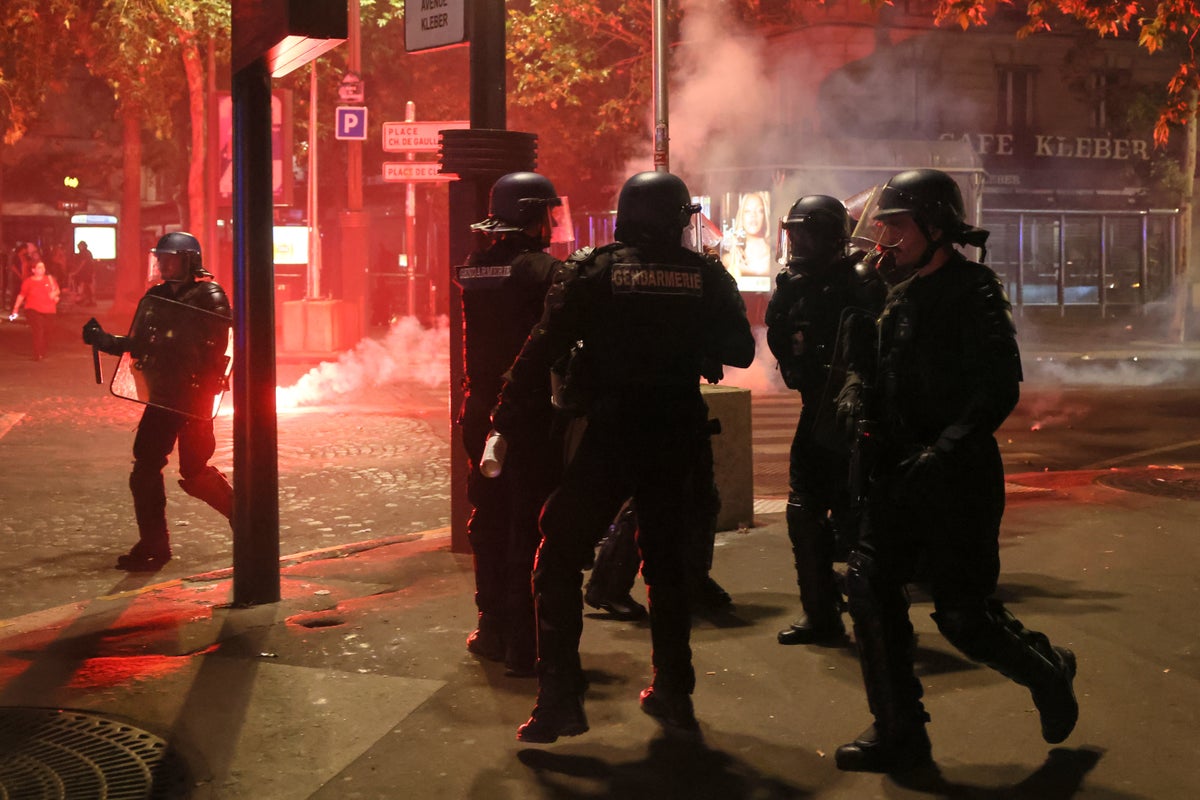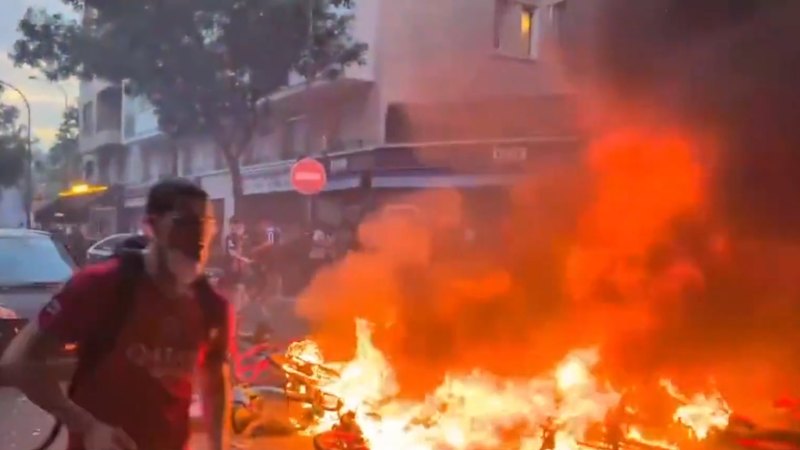
French authorities deployed 22,000 police officers nationwide on Saturday night to prevent football celebrations from turning into urban warfare. They failed. Following Paris Saint-Germain’s Champions League victory over Arsenal, Paris erupted into a familiar cadence of tear gas, burning infrastructure, and baton charges. The final tally stands at 780 detentions nationwide, with 480 in the capital alone, and 57 officers injured. This was not an unpredictable flashpoint. It was a structural failure of a domestic policing strategy that treats sports fans as enemy combatants.
The conventional media narrative frames these events as a simple tale of sports hooliganism running amok in the streets of Paris. Wire services churn out standard updates focusing entirely on the number of smashed shop windows on the Champs-Elysees or the tally of burned rental bikes near the Parc des Princes.
This surface-level reporting ignores the underlying mechanics of French crowd management. By analyzing the structural choices made by the Paris police prefecture, a more troubling reality comes into view. The violence that marred Saturday’s victory is the direct result of a heavy-handed, militarized containment strategy that systematically escalates tension rather than defusing it.
The Architecture of Escalation
French law enforcement operates under a philosophy of strict containment and overwhelming force. For the Champions League final, the interior ministry did not just deploy personnel; they effectively placed the center of Paris under a security lockdown. Public transit networks including trams, subways, and buses were aggressively restricted hours before the final whistle in Budapest.
This restriction created immediate logistical bottlenecks. Tens of thousands of fans who gathered to watch the match on giant screens inside the Parc des Princes or in local bars found themselves stranded. They were cut off from public transport and penned into specific geographic zones by lines of riot police.
When thousands of emotional, adrenaline-fueled people are packed into tight urban spaces with no clear dispersal route, friction becomes inevitable. Instead of facilitating a smooth exit from the stadium district, the police preference for cordoning off massive areas created high-pressure enclosures.
A tiny minority of individuals began launching fireworks at police lines. Rather than deploying targeted interventions to isolate these specific bad actors, the response from the prefecture was collective punishment.
Riot units instantly deployed clouds of tear gas into dense crowds. This classic tactical error triggers immediate panic. Innocent supporters, families, and casual onlookers suddenly found themselves choking on chemical irritants, forced into a fight-or-flight response. The resulting chaos scattered smaller, angry factions across adjacent neighborhoods like Avenue Foch, where the real destruction of property began.
A Legacy of Failure From Saint Denis to the Champs Elysees
To understand why this happens every time a major football match occurs in France, one must look at the institutional memory of the French police. The current strategy is deeply defensive, shaped by years of high-profile security embarrassments.
The most notable predecessor was the 2022 Champions League final at the Stade de France, where administrative incompetence led to fans being funneled into dangerous bottlenecks, pepper-sprayed, and robbed by local youth. The subsequent institutional reaction was not to adopt modern, dialogue-based crowd communication, but to double down on raw physical deterrence.
Look at the numbers from recent years to see the pattern. During the 2025 Champions League celebrations, similar riots resulted in two fatalities and over 500 arrests across France. The response for 2026 was simply to scale up the number of boots on the ground to 22,000.
This numerical escalation relies on a flawed premise. The idea that visible, heavily armed riot police act as a deterrent to an ecstatic or frustrated crowd is incorrect. In reality, the presence of officers in full tactical gear, shields raised, acts as a visual provocation for the radical fringe elements of a fanbase.
The Contrast of Modern European Policing
France remains an outlier in Western Europe for its refusal to adopt progressive crowd control methodologies. Countries like Germany, the Netherlands, and the United Kingdom have spent two decades refining policing models based on the Euro 2004 security recommendations. These strategies prioritize de-escalation, low-profile visibility, and the utilization of specialized liaison officers who imbed within fan groups to gauge temperament.
In a modern European model, police remain largely out of sight in transport hubs, moving in soft caps rather than helmets. They allow crowds to move freely, establishing communication channels with fan leaders to facilitate self-policing within the group. Force is utilized only as a surgical, final resort against verified violent actors.
The French system rejects this approach entirely. The prefecture views any unauthorized gathering of football fans as an existential threat to public order. By treating the entire crowd as a monolithic criminal entity from the outset, they create a self-fulfilling prophecy. Supporters who expect aggression from law enforcement behave defensively, while officers who expect a riot react with immediate force at the first sign of non-compliance.
Political figures quickly capitalized on Saturday's predictable fallout to serve domestic agendas. Marine Le Pen, floor leader of the far-right National Rally, stated on social media that France may be the only country where a football victory routinely leads to riots. While politically motivated, the statement highlights a structural reality that the current government cannot ignore. The issue is not the sport of football itself, but the specific domestic environment in which these celebrations occur.
The Real Cost of Containment
The material damage from Saturday night is quantifiable. Shops were vandalized, vehicles were torched, and transit infrastructure was disrupted. The financial burden will be borne by local business owners and municipal taxpayers.
The more significant damage is the total erosion of trust between the public and the state apparatus tasked with protecting them. When a major sporting achievement is universally expected to end in chemical deployment and street combat, the civic fabric has broken down.
The interior ministry will likely point to the 780 arrests as evidence of a decisive, successful operation against lawlessness. A deeper analysis reveals those numbers are a metric of policy failure. Mass arrests do not indicate prevention; they indicate an inability to maintain order without resorting to wholesale detentions. Many of those taken into custody face charges of general public disorder or non-violent non-compliance, swept up in the dragnet of indiscriminate containment lines.
France cannot continue to police its cultural and sporting events through the lens of counter-insurgency. Until the police prefecture abandons its reliance on tear gas, preemptive transit shutdowns, and collective containment, the streets of Paris will continue to burn every time a trophy is won. The solution requires a fundamental shift toward communication, mobility, and de-escalation. Until that operational shift occurs, 22,000 officers will never be enough to keep the peace.