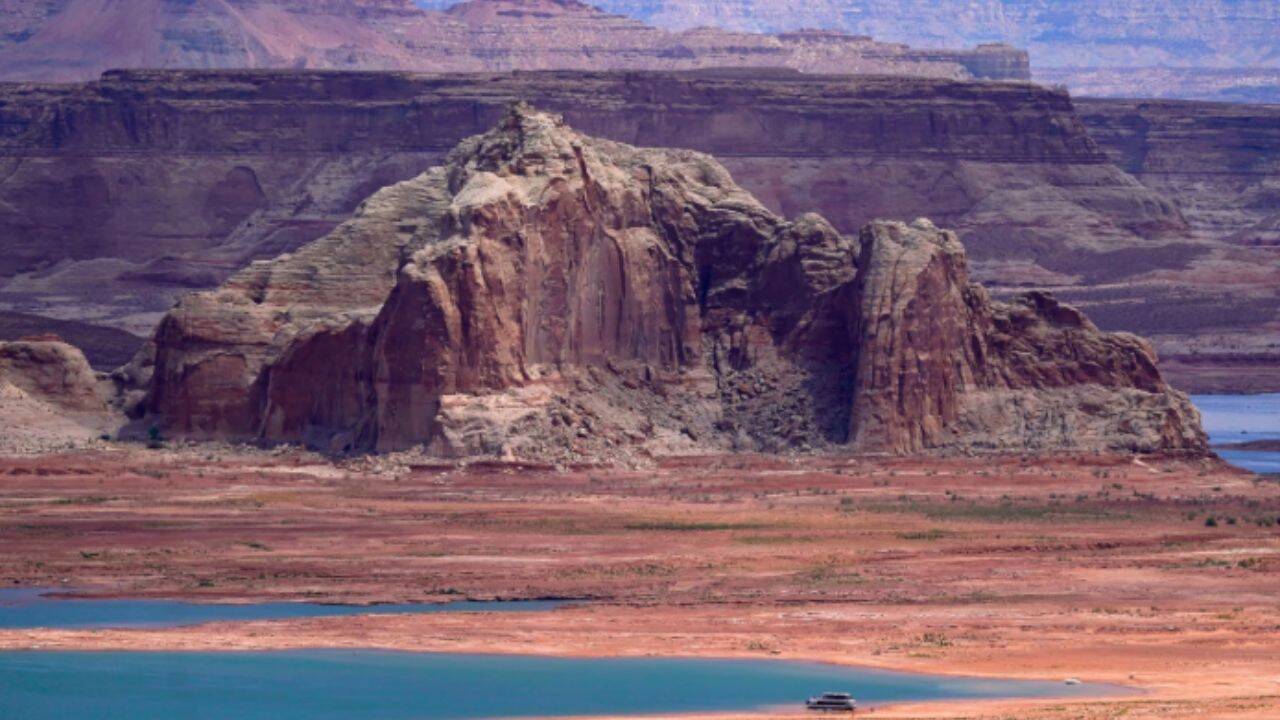
The Colorado River system is facing an unprecedented structural collapse, forcing water managers to consider a radical solution: decommissioning Lake Powell and moving its remaining water downstream to Lake Mead. This concept, known among hydrologists as the "Fill Mead First" proposal, aims to stop massive water losses caused by evaporation and underground seepage in Glen Canyon. By consolidating the storage of the Southwest’s two largest reservoirs into one, the region could save hundreds of thousands of acre-feet of water annually. It is a desperate play for a river system pushed to its absolute limits by over-allocation and chronic drought.
For decades, the Bureau of Reclamation operated under the assumption that the Colorado River could reliably supply 15 million acre-feet of water per year to the seven basin states and Mexico. That assumption was wrong from the start. Tree-ring data and modern hydrological modeling have proven that the mid-20th century, when the foundational legal frameworks were signed, was an anomaly of high rainfall. The river simply does not hold that much water. Today, the system is breaking. Lake Powell and Lake Mead, the twin anchors of Western water security, routinely hover near dead pool status—the point at which water can no longer flow through the dams to generate power or supply downstream users.
The Dual Reservoir Failure Mechanics
To understand why draining Lake Powell makes sense, one must look at the physical reality of the desert. Lake Powell is held back by the Glen Canyon Dam, sitting on the border of Utah and Arizona. Hundreds of miles downstream sits Hoover Dam, holding back Lake Mead.
Operating two massive, half-empty reservoirs in the middle of an arid desert is an engineering failure by modern standards. When water is spread out over two sprawling surface areas, it is exposed to intense desert heat and wind. The result is massive, avoidable evaporation.
Furthermore, the geology of Glen Canyon is working against us. The Navajo sandstone that forms the basin of Lake Powell is highly porous. It acts like a giant sponge, absorbing millions of gallons of water into the bank storage, never to be recovered. Lake Mead, sitting in a different geological formation, does not suffer from the same level of subsurface leakage.
Consolidating the water into a single reservoir reduces the total surface area exposed to the sun. Basic physics dictates that a deeper, more consolidated body of water evaporates far slower than two shallow, spread-out pools.
Counting the Saved Acre-Feet
How much water would this actually save? Independent hydrological studies suggest that draining Lake Powell and storing its contents in Lake Mead would preserve roughly 300,000 to 500,000 acre-feet of water every single year.
To put that into perspective, 300,000 acre-feet is roughly the entire annual water allocation for the state of Nevada. In a system where cities like Las Vegas, Phoenix, and Los Angeles are fighting over single percentage points of their allocations, finding a half-million acre-feet of "new" water without cutting off a single farmer is the closest thing to a miracle the West can hope for.
The mechanism is straightforward. Glen Canyon Dam would modify its bypass tubes to allow the Colorado River to flow through unimpeded. Lake Powell would slowly recede, returning Glen Canyon to its natural state. The water would flow directly into the Grand Canyon and collect behind Hoover Dam in Lake Mead.
Mead, which currently sits at less than 40 percent capacity, has more than enough room to absorb Powell's entire volume. Instead of two dying reservoirs, the West would have one functional, healthy water bank.
The Hydropower Conundrum
The primary argument against the Fill Mead First initiative is the loss of clean energy. Glen Canyon Dam produces billions of kilowatt-hours of electricity annually, supplying power to millions of homes across Wyoming, Utah, Colorado, New Mexico, and Arizona. If you drain the reservoir, the turbines stop spinning.
This is a valid economic and environmental concern, but the argument is losing its teeth.
As water levels in Lake Powell have dropped over the last decade, the water pressure spinning the turbines has plummeted. The dam's power generation capacity has already been severely degraded. On multiple occasions, water levels have dropped perilously close to the minimum power pool elevation of 3,490 feet. If the water drops below that line, the turbines cannot run anyway, regardless of whether the dam is decommissioned intentionally or by nature.
Replacing that power grid capacity is an engineering challenge, but not an insurmountable one. The Southwest is the premier region in North America for solar and geothermal energy development. The financial investment required to build out replacement solar arrays and battery storage facilities is substantial, but it is a fixed, predictable cost. You cannot build your way out of a dry river. Water is a non-negotiable requirement for human habitability in the West; electricity can be sourced from alternative means.
Silt, Sediment, and Legal Gridlock
If the engineering makes sense on paper, the legal and physical realities on the ground are treacherous. The first major roadblock is the sediment problem.
For sixty years, the Colorado River has been dumping millions of tons of mud, silt, and debris into the upper end of Lake Powell. If the reservoir is drained rapidly, that accumulated sediment will not just sit there. The river will cut through the mud, carrying decades of toxic, concentrated agricultural runoff and heavy metals down through the Grand Canyon and straight into Lake Mead.
Managing that sediment release requires a meticulous, multi-phase engineering strategy. It cannot be done overnight without destroying the fragile ecology of the Grand Canyon river corridor downstream.
Then there is the legal nightmare. The Law of the River—the complex web of compacts, federal statutes, court decrees, and international treaties governing the Colorado River—is built entirely around the existence of both reservoirs.
The 1922 Colorado River Compact splits the river arbitrarily into Upper and Lower Basins, with Lee Ferry, Arizona, acting as the dividing line. Lake Powell was constructed specifically to allow the Upper Basin states (Colorado, Wyoming, Utah, and New Mexico) to fulfill their legal obligation to deliver a set amount of water to the Lower Basin states (California, Arizona, and Nevada) during dry years.
Draining Lake Powell effectively erases the physical buffer between the two basins. The Upper Basin states fear that without Powell, they will be left completely vulnerable to a "compact call," a legal scenario where California and Arizona can force upstream users to shut off their water taps to satisfy historical water rights. Convincing four state legislatures and the federal government to rewrite a century of water law is a task that makes moving mountains look easy.
The Reality of a Shrinking West
The debate over draining Lake Powell is no longer an academic exercise confined to environmental fringe groups. It is a reflection of a brutal reality that politicians and water managers have avoided for a generation. The old ways of managing the West are dead.
We can no longer afford the luxury of pretending the Colorado River can fill two massive artificial lakes in a warming climate. The river is shrinking, and the infrastructure must shrink along with it. If water managers do not choose to consolidate the reservoirs through a controlled, engineered process, nature will eventually make the choice for them through catastrophic systemic failure.
Every year spent maintaining the status quo is a year spent evaporating hundreds of thousands of acre-feet of water into the desert air, water that towns and farms desperately need to survive. The physical structures of the twentieth century are simply incompatible with the hydrological realities of the twenty-first.



