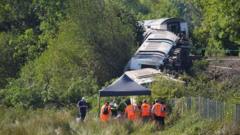
The narrative writes itself every single time steel leaves timber. A train comes off the tracks near East Sussex, weekend services dissolve into chaos, and the mob forms instantly. Social media floods with outrage directed at greedy executives, underfunded maintenance crews, and a broken infrastructure system. Everyone demands heads on spikes and billions in immediate upgrades.
It feels righteous. It feels correct. It is also entirely intellectually bankrupt.
I have spent years watching transit authorities and infrastructure planners dance this exact same tired tango. The knee-jerk reaction to every disruption is to scream for more funding or point fingers at operational negligence. We treat complex mechanical and geotechnical failures as moral failings. That is not analysis; it is emotional venting disguised as critique.
The Comforting Lie of Absolute Control
The lazy consensus relies on a comforting fiction. The fiction states that if management just cared enough and spent enough money, iron wheels would never fight iron rails. Perfect safety and zero disruption are marketed as achievable goals if only corporate greed did not stand in the way.
Physics does not care about your operational budgets.
Rail networks operate under brutal environmental and mechanical constraints. Ground shifts, extreme temperature spikes warp continuous welded rail, and hidden subsurface anomalies exist entirely outside the immediate oversight of any dispatch center. When an incident occurs, the immediate rush to assign blame to human error or corporate neglect ignores the probabilistic reality of running heavy machinery across aging topography.
I have seen organizations waste millions chasing the ghost of absolute reliability, throwing cash at superficial fixes while ignoring the fundamental truth of heavy engineering: wear and tear is continuous, linear, and indifferent to public relations.
Why More Money Does Not Fix Ground Movement
Let us dismantle the core premise driving public outrage. People assume that service cancellations after a derailment represent a failure of willpower. If the tracks were modern, the argument goes, disruptions would not happen.
This ignores how structural degradation actually manifests. You can pour infinite capital into rolling stock and signaling software, but you cannot legislate away the earth beneath the ballast. Embankments fail because soil mechanics are chaotic. Heavy rainfall saturates clay foundations, leading to slow-motion slips that telemetry sensors often catch only after the safety margin has already narrowed.
When operators pull the plug on weekend services after an incident, they are not acting out of malice or corporate cowardice. They are engaging in risk mitigation under extreme uncertainty. Stopping trains is economically painful, which means operators do not do it lightly. If a route is shut down, it is because the alternative—guessing wrong about track integrity—carries a catastrophic downside that no balance sheet can absorb.
The Real Systemic Failure Nobody Wants to Discuss
The true scandal is not that infrastructure occasionally fails. The scandal is our collective insistence on pretending that a sprawling, century-old rail network can be managed like a software platform with zero downtime.
We have conditioned the traveling public to expect airline-level predictability from a steel-wheel-on-rail network built during the Victorian era. When reality intrudes—when a bogie drops or an embankment drops three inches in the night—the system experiences shock because our expectations are detached from physical reality.
Operators contribute to this delusion by offering smooth-sounding corporate apologies that frame every weather-related delay or mechanical anomaly as an isolated aberration rather than an inherent feature of managing legacy infrastructure. They coddle the public with promises of a fast fix, knowing full well that geology does not care about their quarterly performance metrics.
Stop demanding corporate accountability for things that belong to the realm of geophysics. Start demanding honesty about what it actually takes to keep heavy trains moving across a shifting island without pretending that engineering is magic.
The next time a weekend timetable implodes because steel met earth the wrong way, save your outrage for the politicians and pundits who sell you the fantasy that perfection is just a budget increase away.
The tracks will buckle again. Gravity remains undefeated.