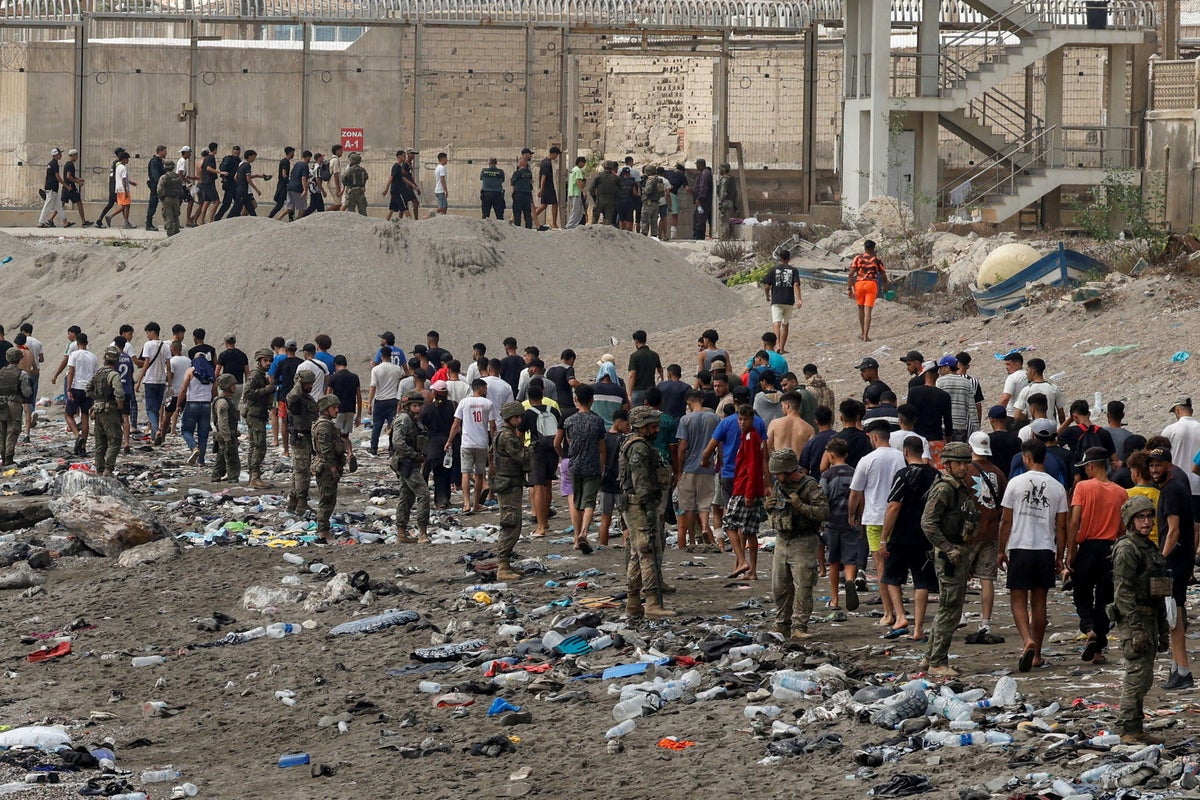
The internet is currently saturated with a predictable refrain. When tens of thousands of people overwhelm a border fence or swim around a barrier in a matter of hours, political opportunists on both sides of the Atlantic rush to grab their favorite script.
The narrative is always the same. Right-leaning pundits point to the chaotic scenes in the Spanish North African enclave of Ceuta and scream about radical left-wing globalism, open borders, and weak administrative laws. They warn that any deviation from absolute containment results directly in immediate societal collapse. Also making headlines in this space: Why India and Benin Are Quietly Building a Massive Trade and Diplomatic Alliance.
It is loud. It is dramatic. And it is fundamentally lazy.
Blaming a localized maritime and land border breach entirely on abstract ideological terms like "left-wing policies" misses the mechanical realities of how sovereign borders actually function, break, and get exploited. If you want to understand why thousands of young men successfully crossed from Morocco into a tiny European Union territory overnight, you have to stop listening to talking heads scoring domestic political points and start looking at statecraft, geography, and leverage. Additional insights on this are detailed by The Guardian.
Ceuta is not a metaphor for an American political party's platform. It is a pressurized geopolitical valve.
To buy into the mainstream talking point, you have to ignore the actual friction points between Madrid and Rabat. Spain and Morocco share a complex, transactional relationship where migration is frequently used as a diplomatic currency. When bilateral tensions flare over territorial claims, fishing rights, or diplomatic slights involving Western Sahara or regional alliances, border enforcement on the Moroccan side has a curious habit of fluctuating.
Calling this a simple failure of progressive idealism ignores the reality of state-sponsored pressure valves. Morocco knows precisely how much leverage the enclave provides. When domestic or foreign policy disputes heat up, the Moroccan gendarmerie's oversight at the perimeter softens. Human smuggling networks do not operate in a vacuum of European municipal laws; they operate where state tolerance permits them to gather, stage, and move.
Furthermore, attributing the breach purely to domestic political philosophy misunderstands the physical layout of the frontier. Ceuta is a 7-square-mile enclave bordered by a double-fenced perimeter on land and the open Mediterranean on either side. When a critical mass of people converges simultaneously on a coastal boundary, no amount of statutory rhetoric stops them without a massive, pre-positioned military deterrent or an active arrangement with the neighboring transit state. Spain's administrative regularizations or legal frameworks did not pull those swimmers into the water. Economic desperation combined with tactical state neglect across the fence line did.
The lazy consensus also assumes that total deterrence is purely a matter of political will. It is not. Hard physical borders are engineering problems constrained by human rights treaties, maritime law, and international treaties. When thousands of individuals decide to swim around a breakwater at the same time, security forces face immediate tactical limits. You cannot shoot swimmers, and you cannot instantly deport sixty thousand people without collapsing local infrastructure.
Using foreign humanitarian emergencies as a prop for domestic midterm elections treats voters like children who cannot comprehend foreign policy. Painting a complex North African security flashpoint as a cautionary tale about local municipal governance strips away the agency of regional actors and reduces international relations to a cartoon.
Stop accepting the neat, pre-packaged partisan explanation for every global crisis. Real borders do not break because of a speech or a progressive policy paper. They break when neighboring states lose alignment, when leverage is weaponized, and when geography beats logistics.
Look past the theater. The border is not a canvas for your domestic political arguments. It is a battleground of competing national interests.
Trump warns Ceuta scenes will happen in US if Democrats get reelected
The linked video provides context on how political figures utilize footage from the border crossing in Spain to frame domestic security debates.