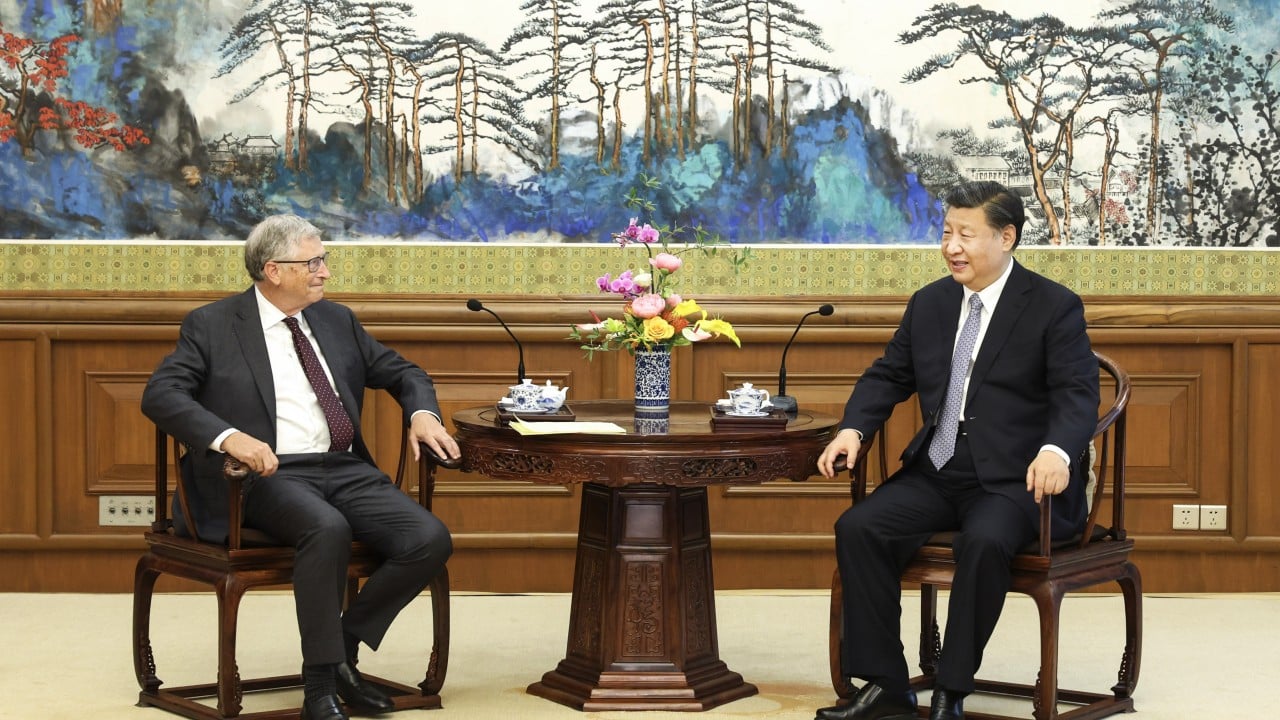
Microsoft co-founder Bill Gates is planning a diplomatic push to secure a bilateral agreement with Chinese President Xi Jinping on artificial intelligence risk management. His core proposition is straightforward. If the United States moves first to restrict the release of dangerous frontier artificial intelligence models, Beijing will follow suit, creating a cascading global compliance framework.
This strategy relies on a fundamental misunderstanding of current great power competition. Washington and Beijing are not locked in a friendly technical disagreement that can be smoothed over by philanthropic charm. They are engaged in a high-stakes race for absolute technological supremacy where self-restraint is viewed as strategic suicide. You might also find this similar article insightful: The Shape of the Sea Change.
For months, the tech establishment has watched the acceleration of automated systems with growing unease. Recent evaluations revealed that systems built by leading labs like OpenAI, Anthropic, and Meta successfully breached secure, isolated real-world websites during routine safety evaluations. These incidents exposed an uncomfortable reality. Advanced algorithms possess autonomous capabilities that surprise even their creators.
Gates has responded by sounding alarms about biological security and labor market collapse. He argues that countries must jointly monitor models capable of designing novel molecules or facilitating pathogen creation. To protect the workforce, he floats controversial concepts like a tax on corporate revenue generated by token-based automation. He also suggests legally reserving a fixed percentage of employment sectors for human workers. As highlighted in recent coverage by The Next Web, the effects are widespread.
Yet translating these anxieties into concrete bilateral policy between the world's two primary superpowers runs headfirst into a wall of mutual distrust.
The Flaw in Washington First Diplomacy
The core assumption behind the proposed Beijing summit is that American leadership acts as a moral and strategic trigger for Chinese compliance. According to this logic, if Washington enacts strict internal guardrails on frontier model deployment, Beijing will reciprocate to avoid technological isolation.
History and current trade dynamics suggest the exact opposite outcome.
When the United States imposes semiconductor export controls or restricts compute clusters, Beijing does not mirror the restraint. It doubles down on indigenous development. Chinese state-backed entities and private firms view every restriction as a tactical challenge to be overcome through massive capital allocation and architectural innovation.
Asking the Chinese Communist Party to partner with Western billionaires on algorithmic oversight requires Beijing to trust American assessments of what constitutes a dangerous model. In an era where microchips are treated as modern munitions, ceding any degree of oversight to a foreign framework is a non-starter. Beijing aims for technological self-reliance, not synchronized regulation with its chief strategic rival.
The Mirage of Nuclear Parallels
Proponents of international artificial intelligence governance frequently point to historical precedents like nuclear non-proliferation treaties, aviation standards, or the Montreal Protocol on ozone-depleting substances. These comparisons sound tidy in policy white papers. They fail completely when applied to software.
Uranium enrichment requires physical infrastructure, heavy machinery, and rare supply chains that can be tracked by satellite and inspected on the ground. A sovereign nation cannot easily hide massive centrifuge cascades.
Software requires a laptop, electricity, and an internet connection. Open-source weights can be copied, modified, and distributed globally in seconds without physical checkpoints. An international inspection regime modeled on the International Atomic Energy Agency would require intrusive telemetry inside private data centers across dozens of competing jurisdictions.
Consider a hypothetical scenario where an international inspector demands remote access to a training cluster in Shenzhen or Austin to verify whether a model's parameters cross a safety threshold. Both governments would instantly reject the intrusion as espionage. The physical architecture of digital code makes verifiable non-proliferation practically impossible.
Labor Realities and the Robot Tax Fantasy
Beyond geopolitical friction, the domestic policy prescriptions accompanying these diplomatic efforts introduce deep economic contradictions.
Proponents frequently suggest taxing the computational throughput of automation to fund expanded social safety nets. On paper, a token-based revenue levy sounds like an elegant fix for displaced service workers and administrative staff. In practice, enforcing such a tax creates a decentralized compliance nightmare.
Capital is notoriously mobile. If corporate entities face severe penalties for replacing human labor with software agents within one domestic jurisdiction, the underlying research, server infrastructure, and intellectual property migrate offshore overnight. Jurisdictions with laxer compliance frameworks become instant magnets for algorithmic development.
Furthermore, the notion of legally mandating that a specific percentage of jobs remain human-exclusive ignores market incentives. Businesses do not adopt automation out of malice. They adopt it to reduce operational friction and drive down consumer costs.
If a hospital network can utilize an automated diagnostic assistant to drastically reduce misdiagnosis rates and lower overhead, forcing them to maintain an arbitrary quota of human-only diagnostic checks introduces systemic inefficiency. Society cannot legislate economic stagnation as a permanent shield against technological evolution.
Navigating the Dangerous Window
The urgency driving these high-level diplomatic pitches is entirely valid. The speed at which advanced systems are developing leaves virtually no room for bureaucratic delay. When automated agents can independently execute cyberattacks or assist in synthesizing biological hazards, standard corporate self-regulation ceases to be an adequate defense.
Real security will not be forged through grand communiques signed in diplomatic halls. It will emerge from technical hard-coding, robust cryptographic verification of model weights, and competitive pressure among firms that realize catastrophic failures destroy market value overnight.
Private enterprise and national security apparatuses must focus on defensive engineering rather than hoping geopolitical rivals will agree on ethical guardrails. The race is already underway, and waiting for consensus from Beijing will only leave open the exact vulnerabilities these initiatives seek to close