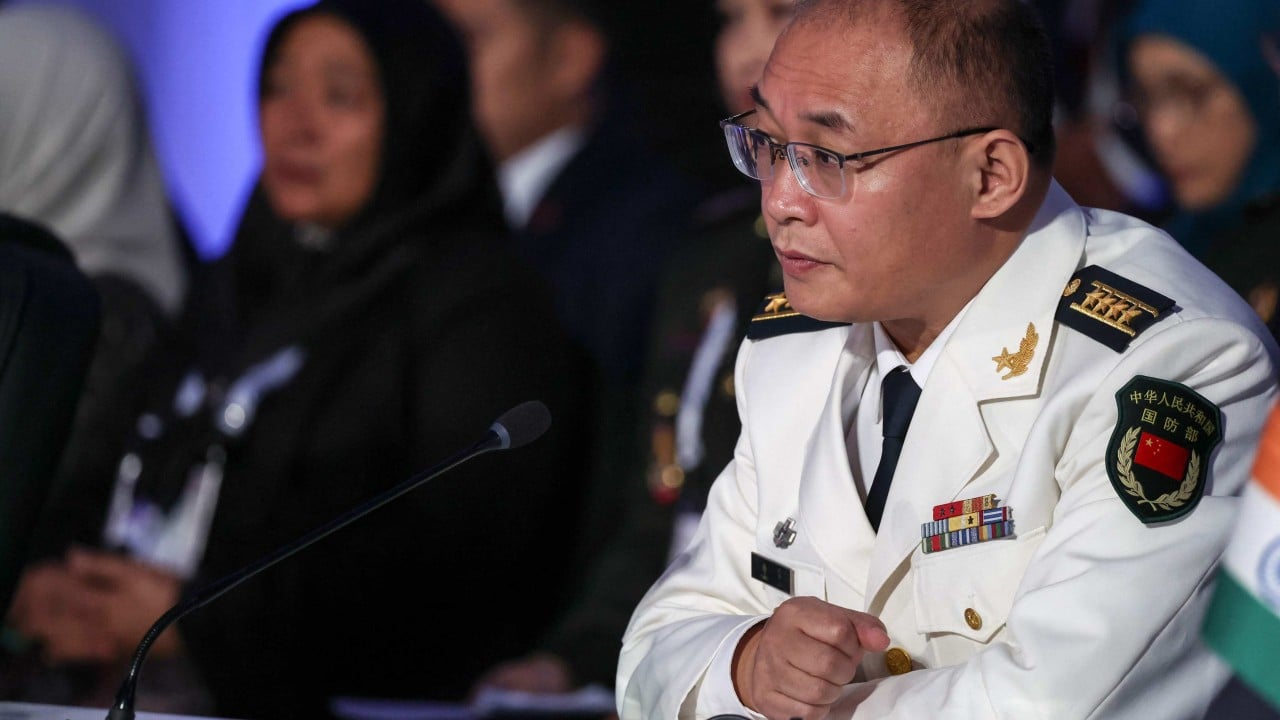
Mainstream foreign policy desks love a tidy diplomatic squabble. When Beijing publicly accuses Manila of throwing up "obstacles" to block Chinese officials from attending an ASEAN defense meeting, the standard coverage writes itself. Reporters dutifully transcribe the talking points from China's Ministry of National Defense, balance them with a dry quote from the Philippine Department of National Defense, and wrap the whole thing up as a regrettable breakdown in regional communication.
That framing is entirely backwards. You might also find this related article interesting: The Architecture of Aviation Security Overhauls After Near-Miss Hijackings.
If you have spent any time tracking defense diplomacy in the Indo-Pacific, you know that diplomatic logistics are never just about paperwork, flight clearances, or late invitations. When a superpower complains that a smaller neighbor is making it hard to attend a multilateral summit, the superpower is not asking for a better travel agent. It is running an information operation designed to reframe who the aggressor actually is.
The lazy consensus among Western and regional commentators is that excluding—or even mildly inconveniencing—Beijing at the ASEAN Defense Ministers' Meeting-Plus (ADMM-Plus) is dangerous because "we need to keep lines of communication open." That cliché gets trotted out every time a Chinese coast guard vessel rams a Philippine resupply boat or blasts Filipino sailors with military-grade lasers. It sounds mature. It sounds measured. And in practice, it is a trap that rewards coercion with a podium. As reported in recent coverage by Al Jazeera, the results are notable.
The Myth of the Diplomatic Victim
Let us look at the actual mechanics of how ASEAN defense summits operate. The ADMM-Plus brings together the ten ASEAN member states and eight dialogue partners, including the United States, China, Japan, and Australia. The host nation—currently the Philippines—holds the pen on scheduling, agenda-setting, and logistical coordination.
In international relations, hosting privileges are one of the few asymmetric tools a smaller state possesses. When you are outgunned by a factor of ten in naval tonnage and coast guard hulls, you do not beat your adversary in a slugfest at Second Thomas Shoal. You shape the diplomatic environment when the calendar puts you in the driver's seat.
Beijing’s complaint that Manila created "obstacles" relies on a very specific psychological sleight of hand. By crying foul over procedural friction, China attempts to paint the Philippines as petty, obstructive, and anti-ASEAN. The unspoken message to other Southeast Asian capitals is clear: Look at Manila. They are hijacking regional unity to prosecute their bilateral maritime dispute with us.
It is a remarkably effective narrative if you ignore everything happening on the water. You cannot spend years erecting literal physical blockades—floating barriers, militia swarms, and water cannons—to stop Philippine ships from operating inside their own Exclusive Economic Zone under the 1982 UN Convention on the Law of the Sea (UNCLOS), and then demand red-carpet VIP treatment when Manila hosts a security conference.
Yet, most commentary treats the maritime coercion and the conference logistics as two separate universes. They are not. They are two fronts of the exact same campaign.
Why "Dialogue for the Sake of Dialogue" Is a Losing Strategy
The biggest misconception in modern defense journalism is the belief that talking automatically reduces the risk of kinetic conflict.
I have watched defense attachés and policy planners burn through millions of dollars and thousands of flight hours attending Track 1 and Track 1.5 dialogues across Singapore, Kuala Lumpur, and Manila. Year after year, the communiqués look identical. Everyone pledges restraint. Everyone affirms the centrality of ASEAN. Everyone agrees to accelerate negotiations on a Code of Conduct (COC) in the South China Sea—a document that has been "in progress" since the 2002 Declaration on the Conduct of Parties.
While those polite panels take place in air-conditioned ballrooms, the facts on the sea floor change permanently. Reefs become artificial islands. Artificial islands become forward operating bases with 3,000-meter runways and anti-ship cruise missiles.
Beijing loves multilateral defense forums for one specific reason: they normalize China's presence as a benign regional stakeholder while binding neighbors to endless, non-binding consultation processes. When a host nation like the Philippines refuses to smooth over every administrative bump for the People's Liberation Army (PLA) delegation, it disrupts that theater. It forces a moment of friction that exposes the underlying reality—that there is nothing normal about the current security environment in the West Philippine Sea.
What People Get Wrong About ASEAN Centrality
Whenever Manila pushes back against Beijing, critics immediately ask: Doesn't this fracture ASEAN unity?
That question rests on a flawed premise. It assumes ASEAN unity currently exists on the South China Sea, and that the Philippines is the one breaking it.
In truth, ASEAN consensus on maritime security died over a decade ago. In 2012, during Cambodia’s chairmanship, ASEAN failed to issue a joint communiqué for the first time in its 45-year history because Phnom Penh refused to allow any mention of the Scarborough Shoal standoff. Since then, Beijing has mastered the art of splitting the bloc—using economic leverage in mainland Southeast Asia to neutralize diplomatic pushback from maritime Southeast Asia.
When Manila stands firm on hosting protocols, it is not breaking ASEAN centrality. It is refusing to let "ASEAN centrality" be used as a gag order. There is a massive difference between regional consensus and regional paralysis. If the price of diplomatic harmony is pretending that China's behavior in the Spratly Islands is compatible with cooperative defense talks, then the harmony is worthless.
The Real Reason Beijing Is Complaining Publicly
Defense ministries do not air scheduling grievances at press briefings by accident. If the PLA genuinely wanted to resolve a visa delay, a flight clearance issue, or an agenda dispute quietly, backchannels exist in every embassy in Manila and Beijing. Those issues get fixed in forty-eight hours without a single headline.
Going public means the grievance itself is the objective. Look at what Beijing accomplishes by framing Manila as an obstacle:
- Pre-emptive Excuse for Low-Level Representation: If China sends a lower-ranking official instead of the Defense Minister, Beijing can blame Philippine obstruction rather than admitting it wanted to snub the host.
- Wedge Driving Inside ASEAN: It signals to fence-sitting nations like Indonesia, Malaysia, and Thailand that the Philippines is an emotional, unreliable host that cannot separate bilateral friction from multilateral duty.
- Domestic Narrative Control: Inside China, state media feeds off stories showing a magnanimous Beijing trying to promote regional peace while a reckless, US-backed Manila plays spoiler.
- Shifting the Burden of De-escalation: It puts pressure on Manila to make a goodwill gesture—granting concessions on access or agenda items—just to prove it is being a "responsible host."
Consider a scenario where a host country bends over backward to accommodate every logistical demand from a rival power after months of maritime clashes. Does that rival reciprocate by pulling its coast guard vessels back from disputed shoals? Never. In coercive diplomacy, unreciprocated accommodation is read purely as weakness. It signals that aggressive behavior carries zero diplomatic cost.
The Hard Truth About Manila's Leverage (And Its Risks)
Let us be brutally honest about the risks here, because pretending Manila's approach is free of downsides would be dishonest.
Playing hardball with diplomatic logistics is a double-edged sword. For the Philippines, weaponizing procedural friction carries real operational hazards:
- Loss of Quiet Off-Ramps: When high-level defense officials do not sit in the same room, military-to-military hotlines tend to go cold. If a collision at sea kills a sailor tomorrow, having zero face-to-face rapport between senior commanders makes rapid de-escalation significantly harder.
- Alienating Pragmatic Neighbors: Countries like Vietnam and Malaysia also have overlapping claims with China, yet they often prefer quiet, compartmentalized diplomacy over public confrontation. If Manila appears too rigid on forum rules, Hanoi and Kuala Lumpur may quietly distance themselves to protect their own trade ties with Beijing.
- Giving Beijing Moral Cover: Every time Manila denies a procedural courtesy, it hands Chinese diplomats a talking point to use in capitals across the Global South, painting the Philippines as a proxy disrupting Asian stability.
Strategic analysts like Oriana Skylar Mastro at Stanford and maritime experts at the Asia Maritime Transparency Initiative (AMTI) have long pointed out that Beijing thrives in the gray zone—the space between peace and war where ambiguity rules. Manila’s transparency strategy, led by the Philippine Coast Guard and Defense Secretary Gilberto Teodoro, was explicitly built to destroy that ambiguity. Making Beijing uncomfortable at diplomatic summits is simply the logical extension of exposing Beijing's gray-zone tactics at sea.
How Middle Powers Actually Win Diplomatic Fights
If you are advising a defense ministry dealing with a larger, revisionist neighbor, the playbook for multilateral summits is straightforward—and it looks nothing like the polite advice coming from think-tank panels in Washington or Brussels.
First, stop treating attendance as a favor to the host. Great powers attend ASEAN summits because they cannot afford to leave the room to their rivals. Beijing needs to be at ADMM-Plus to counter Washington and Tokyo. Manila does not need to beg Beijing to show up, nor should it apologize for enforcing strict host-nation protocols.
Second, link diplomatic access to baseline behavioral standards. You do not need to ban a rival from a conference to impose costs. You simply refuse to subsidize their reputation. Keep the agenda focused strictly on international law, freedom of navigation, and maritime domain awareness. Force the visiting delegation to defend its actions on your terms, rather than letting them hijack the microphone for platitudes about "win-win cooperation."
Third, let the rival complain. When a larger power whines publicly about procedural hurdles set by a smaller nation, it subconsciously diminishes its own stature. Superpowers do not complain about seating charts and clearance forms unless they feel they are losing control of the narrative.
The diplomatic establishment wants you to believe that the worst thing that can happen at an ASEAN defense meeting is an empty chair or a delayed visa. They are wrong. The worst thing that can happen is a full table where everyone smiles for the cameras while one participant actively dismantles the territorial integrity of the host.
Manila finally stopped pretending those two things can coexist—and Beijing's public tantrum is proof that the strategy is hitting a nerve.