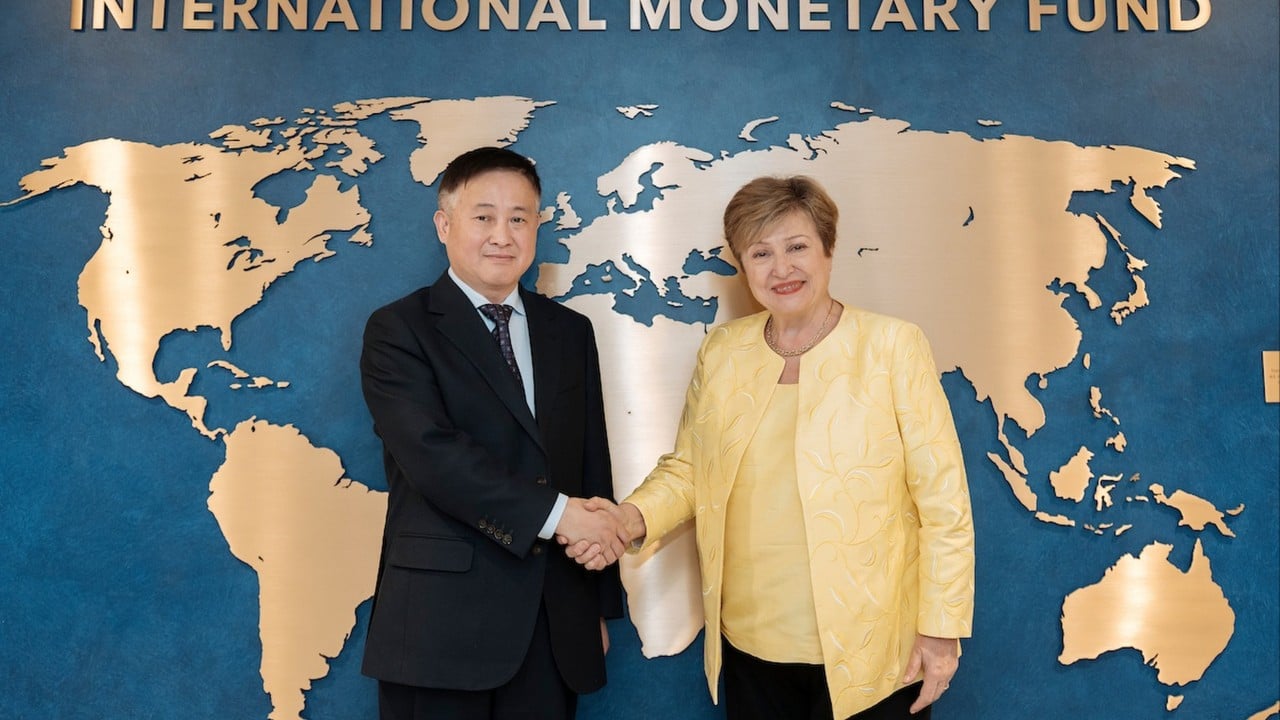
The International Monetary Fund stands at a historic crossroads. For decades, the fund has operated as a bastion of Western financial influence, anchored by the voting weight of the United States and its European allies. Now, China is mounting an aggressive, coordinated campaign to force a fundamental redistribution of quota shares. This is not merely a bureaucratic dispute over arithmetic. It is a direct assault on the post-World War II financial order. Beijing argues that current voting structures fail to reflect the modern global economic reality, where emerging markets provide the engine for growth while remaining handcuffed by outdated governance.
The quota system dictates more than voting power. It determines a member country's financial contribution to the fund and its borrowing capacity. When the IMF was conceived in 1944, the distribution of power was straightforward, prioritizing the reconstruction of war-torn Europe and the economic hegemony of the United States. Today, that arrangement looks increasingly like a relic. China contributes significantly to global GDP, yet its influence within the fund remains capped by agreements made long before its rise to superpower status.
Beijing’s demand for reform centers on a simple premise. If the IMF wants to maintain its relevance as the ultimate lender of last resort, it must stop functioning as a regional club. The Chinese delegation has repeatedly pushed for a formula that accounts for trade volume and economic output more accurately. They want the table rearranged.
Behind the scenes, the friction is palpable. Washington has historically resisted any shift that would dilute its veto power over major fund decisions. The United States holds enough shares to effectively block any significant change to the articles of agreement. This creates a stalemate that limits the fund’s credibility in the eyes of the Global South. Developing nations, many of whom feel the IMF’s conditional lending programs often impose austerity measures that stifle growth, watch this power struggle with high stakes.
The Architecture of Control
Understanding why this reform struggle matters requires looking at how the IMF actually moves money. Quotas are the fuel of the institution. They are essentially the membership dues that countries pay into the collective pool. These pools provide the emergency liquidity that keeps global markets from spiraling during crises.
The system is weighted. Large economies contribute more and therefore hold more votes. However, the formula used to calculate these contributions is notoriously opaque. It relies on a blend of variables including GDP, openness to trade, economic variability, and international reserves. Critics point out that these variables can be massaged to preserve the status quo.
When a country like China pushes for change, it is targeting the very math that keeps Washington in the driver's seat. If the formula were updated to reflect today’s trade dynamics without political interference, the voting power of the United States would likely drop, while China and India would see their influence rise significantly.
The Surveillance Double Standard
A secondary but equally aggressive front in this conflict is the demand for better surveillance of advanced economies. For years, the IMF has deployed teams of economists to emerging nations to audit their books, demand structural changes, and monitor their debt-to-GDP ratios. It is a rigorous process that often feels intrusive.
Beijing’s stance is blunt. They observe that the fund frequently turns a blind eye to the fiscal imbalances of major Western powers. The argument is that the IMF is quick to criticize a developing nation for high debt levels while ignoring the massive deficits or monetary policy experiments conducted by central banks in the United States or the Eurozone.
This perception of a double standard undermines the fund’s authority. If the IMF cannot apply its rigorous standards equally to all participants, it loses the moral high ground. China’s push for "even-handed surveillance" is a challenge to the institution to either reform its oversight methods or accept that it has become a geopolitical tool rather than a neutral arbiter of global financial stability.
Geopolitical Realignment
The urgency of this demand is driven by the rise of alternative financial structures. China has already helped establish the Asian Infrastructure Investment Bank and the BRICS-led New Development Bank. These institutions are specifically designed to operate outside the traditional Washington-based framework. They offer capital without the stringent, often controversial, policy conditions that the IMF typically mandates.
If the IMF remains rigid, it risks pushing more countries toward these alternatives. This would create a fragmented financial world, where different regions operate under different sets of rules and loyalty networks. The fund knows this. The leadership in Washington, however, remains cautious. They fear that granting too much power to Beijing would allow China to influence the types of economic policies the IMF enforces globally.
There is a fear that China might use increased influence to push for different types of development goals, ones that prioritize infrastructure state-led models over the liberal market reforms the IMF has championed since the 1980s. This is the core of the standoff. It is not just about numbers on a ledger. It is about which economic philosophy will define the next century of global trade.
The Cost of Inaction
What happens if the stalemate continues? The most immediate result is a slow erosion of the IMF’s legitimacy. If the world’s largest emerging economies feel they have no seat at the table, they will simply build their own tables. We are already seeing the early stages of this. Currency swaps and regional lending arrangements are becoming more common, bypassing the IMF’s traditional dollar-denominated facilities.
This transition will not be overnight. The US dollar remains the bedrock of global finance, and the IMF remains the only institution with the capacity to handle truly massive, systemic crises. But the buffer is thinning. A, say, hypothetical scenario involving a debt crisis in a mid-sized economy that decides to look toward the New Development Bank for a bailout instead of the IMF would be a watershed moment.
The fund’s capacity to prevent global shocks relies on trust. When members believe the game is rigged, that trust evaporates. The ongoing push by China is a warning. It is a signal that the era of Western-dominated financial oversight is coming to an end, regardless of whether the current leadership at the IMF chooses to acknowledge it.
The Reality of Reform
Real change within the IMF requires a supermajority vote. This means that the United States effectively holds the keys to the entire process. Without American approval, nothing changes. The current political climate in Washington makes any concession to China highly unlikely. There is strong bipartisan support for maintaining financial superiority, which views any dilution of IMF voting power as a strategic loss.
So, the IMF is effectively locked in a holding pattern. They acknowledge the need for reform in official reports but delay implementation indefinitely. This tactic serves as a pressure valve, giving the appearance of progress while protecting the existing order.
Yet, external pressures are mounting. The global economy is far more interconnected than it was in 1944. A shock in Shanghai now hits London and New York in seconds. The financial systems are too integrated for a fractured governance model to hold forever.
The eventual outcome is not a binary choice between Western dominance and Chinese control. It is a movement toward a more multipolar financial environment. The IMF will either adapt by integrating these new power centers into a more transparent, rules-based system, or it will slowly lose its position as the central pillar of international finance.
The next few rounds of quota negotiations will be the final test of the institution’s ability to survive in a world where it can no longer dictate the rules of the game to everyone else. The participants know that if they do not find a compromise, they will eventually have to confront a global economy that has simply moved on without them.