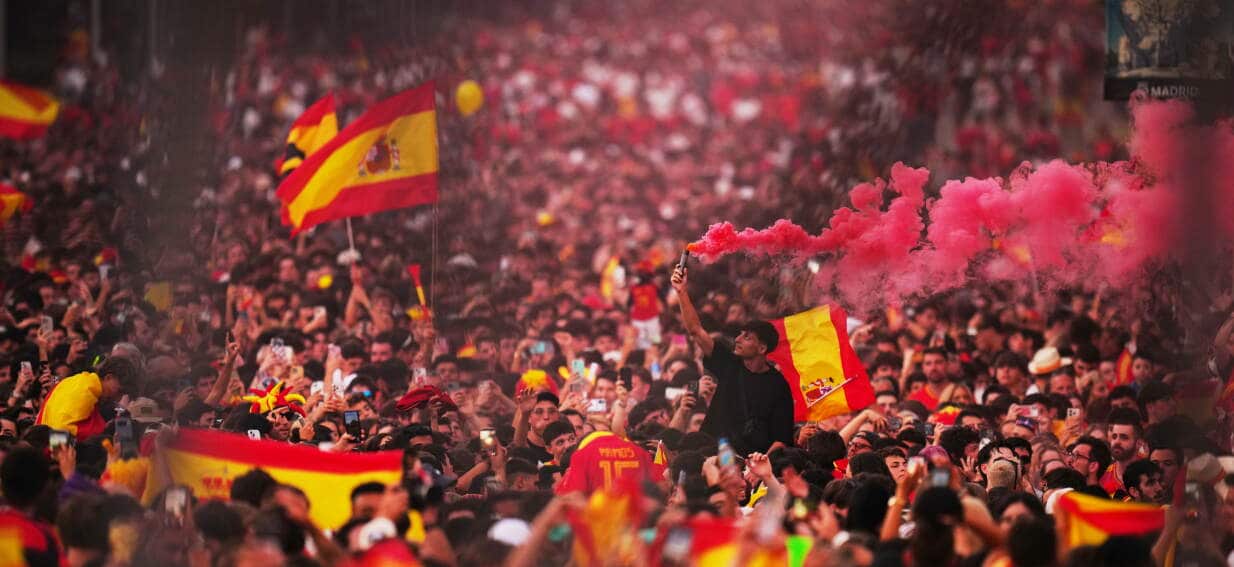
The floorboards under a FIBA World Cup final do not sound like ordinary wood. They creak under the weight of five hundred million collective gasps, echoing through an arena that feels less like a stadium and more like a pressure cooker painted in red and gold.
On September 15, 2019, inside the Wukesong Sport Center in Beijing, two nations stood on the hardwood to settle an old debt. On one side stood Argentina: raw, emotional, fueled by the relentless ghost of the 2004 Golden Generation and driven by a 39-year-old Luis Scola who seemed to have struck a pact with time itself. On the other side stood Spain: disciplined, methodical, possessing a cold, surgical precision that made basketball look less like a sport and more like chess played at terminal velocity.
Forty minutes later, the scoreboard read 95-75. Spain had captured their second World Cup title, thirteen years after their first in Japan. But those numbers are just cold ink on paper. They tell you who won. They tell you nothing about how it felt to watch a empire rebuild itself in real time.
The Phantom of 2006
To understand what happened in Beijing, you have to rewind to Saitama, Japan, in 2006.
Back then, Spain was the young, hungry challenger. They had Pau Gasol anchoring the paint, a fiery young playmaker named Ricky Rubio waiting in the wings, and a culture built on rapid ball movement and unselfishness. They won their first global gold that year, announcing to the world that international basketball was no longer an exclusive American playground.
Then came the long, grueling decade of near-misses. Olympic silvers in 2008 and 2012 after epic, heart-wrenching battles against Team USA. A bronze in Rio. Key legends aging out. The narrative surrounding Spanish basketball began to turn sour. Critics called them past their prime, an aging squad holding onto memories while a new wave of global talent passed them by.
When the 2019 tournament began, nobody picked Spain. The media turned its spotlight toward a star-studded Serbian team and an American roster loaded with NBA talent. Spain was viewed as the reliable veteran who would make a respectable quarterfinal exit before quietly heading home.
They took that disrespect and swallowed it whole.
The Maestro with the Haunted Eyes
Basketball games are often won in the quiet spaces between plays—the split-second pass before the defender rotates, the subtle shift in footwork that clears an inch of space. In 2019, Spain’s maestro was Ricky Rubio.
To watch Rubio during that tournament was to watch a man who had finally made peace with his own journey. Once the child prodigy with floppy hair who entered the professional ranks at fourteen, Rubio had endured years of crushing expectations, shooting struggles, and profound personal tragedy, including the loss of his mother to cancer in 2016.
In Beijing, he did not play like a man trying to prove his critics wrong. He played like a man who simply understood the game better than anyone else on the planet.
During the final against Argentina, Rubio was everywhere. He scored 20 points, dished out 7 assists, grabbed 3 rebounds, and picked pockets on defense with the calm efficiency of a master locksmith. Every time Argentina threatened to spark one of their signature, chaotic runs, Rubio would step up, hit a mid-range jumper, or deliver a crisp, needle-threading pass to Marc Gasol to kill the momentum.
When the final buzzer sounded, Rubio was named the World Cup Most Valuable Player. The boy wonder had finally become the undisputed King of Spain.
The Wall Built of Red Jersey Threads
Argentina did not go down easily. How could they? This was a team that had stunned the world in the quarterfinals by knocking off Serbia, then annihilated France in the semis. They played with a ferocious, chaotic energy, driven by Facundo Campazzo’s lightning-quick drives and Scola’s eternal footwork in the post.
But Spain did not try to match Argentina’s fire with fire. They used water. They suffocated them.
Coach Sergio Scariolo drew up a defensive masterpiece. Spain threw double-teams at Campazzo before he could cross half-court, forcing the ball out of the playmaker’s hands. They denied Scola his favorite spots on the block, forcing Argentina into tough, contested perimeter shots.
Imagine trying to sprint through a heavy fog while holding a basketball. That was Argentina’s offense in the first half. Every drive met a wall of red jerseys. Marc Gasol, coming off an NBA championship with the Toronto Raptors just three months earlier, anchored the backline like an iron gate. He didn't just block shots; he altered the trajectory of Argentina's entire game plan. Gasol finished with 14 points, 7 rebounds, and 7 assists, becoming only the second player in history to win an NBA ring and a World Cup title in the same calendar year.
By halftime, Spain held a 14-point cushion. Argentina looked exhausted, their magic running out against a machine that simply refused to break down.
The Inheritance of Greatness
There is a moment near the end of every great championship match where the noise of the arena fades away for the players on the court. It happens right around the two-minute mark, when the lead is too large, the clock is too short, and the reality of victory settles in.
On the Spanish bench, players began to lock arms. Rudy Fernandez, one of the last remaining pillars of that 2006 squad, squeezed his eyes shut. Tears spilled down his cheeks before the final horn even sounded. Beside him, younger players like Willy and Juancho Hernangomez were jumping, screaming, already reaching for the championship caps.
This was more than just a victory for twelve men on a court in China. It was the validation of a culture. Spain proved that success was not tied to a single generation or one dominant superstar like Pau Gasol. It was a philosophy—a way of passing the ball, trusting the extra pass, and playing for the name on the front of the jersey rather than the back.
When the confetti finally fell, turning the hardwood into a glittering sea of gold, Sergio Scariolo stood near center court, watching his team pile on top of one another.
"We weren't the most athletic team, we weren't the tallest team, and we certainly weren't the favorites," Scariolo said quietly in the post-game fog. "But we were a team."
Long after the lights in the Wukesong Center were shut down and the fans spilled out into the cool Beijing night, a single piece of red and yellow confetti remained stuck to the center court logo. A quiet, physical reminder of the night Spain proved that while talent wins games, a shared soul wins worlds.