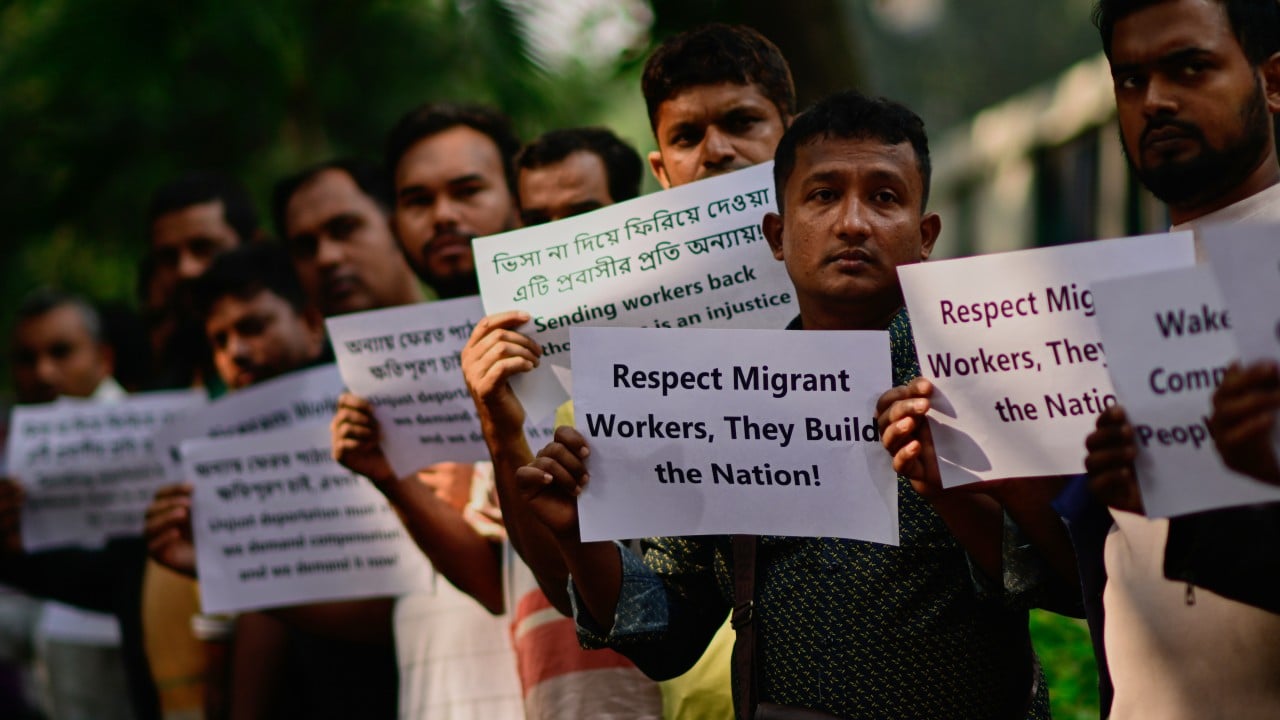
Sending money home shouldn't cost a man his life savings before he even steps onto an airplane. Yet, for hundreds of thousands of Bangladeshi labourers looking for work in Malaysia, that is the exact gamble they take.
The relationship between the two nations reached a critical juncture on June 22, 2026, when Bangladesh Prime Minister Tarique Rahman met with Malaysian Prime Minister Datuk Seri Anwar Ibrahim in Putrajaya. Rahman made an expected move. He urged Malaysia to lift its current restrictions on hiring Bangladeshi workers and reopen the labour market as fast as possible. But here is the problem. You can't just open the floodgates when the plumbing underneath is completely rotten.
Malaysia remains one of the most vital economic destinations for Bangladeshi manpower, but the corridor is heavily compromised by human trafficking syndicates, deep debt bondage, and outright deception. While both leaders publicly agreed that exploitation cannot be tolerated, the real challenge lies in dismantling a highly profitable, corrupt system that has trapped thousands of vulnerable people.
The Massive Gap Between Official Fees and Reality
When you look at the official paperwork, the cost of migrating from Dhaka to Kuala Lumpur looks reasonable. The government-approved migration fee sits around Tk 78,990. That is what the policy says.
Now look at the real world. According to data highlighted by the Migrant Welfare Network and United Nations human rights experts, Bangladeshi workers frequently pay up to Tk 600,000 (roughly $5,000 to $6,600) to secure a simple manual labour job. To put that in perspective, that is the equivalent of an average American spending over $140,000 just to secure an entry-level position.
How does a low-income worker raise that kind of cash? They don't have it sitting in a bank.
- They take out high-interest loans from local loan sharks.
- They mortgage their family’s ancestral farming land.
- They sell off their wives' wedding gold.
By the time a worker boards his flight, he is already drowning in debt. This creates immediate debt bondage. He cannot walk away from a bad employer, he cannot complain about hazardous working conditions, and he cannot return home because doing so would financially ruin his entire extended family.
Why Bangladeshis Pay More Than Anyone Else
Malaysia recruits foreign labour from 14 different source countries, including Indonesia, Nepal, and Myanmar. Yet, Bangladeshi workers systematically face the highest recruitment costs. This isn't an accident. It is the direct result of a restrictive, cartel-like recruitment model.
For years, the recruitment pipeline has been dominated by a closed syndicate of selected manpower agencies. Instead of a free, competitive market where agencies compete on fairness and efficiency, this select group holds a monopoly. They charge massive "syndicate fees" at every stage of the pipeline, from local sub-agents in rural villages to medical screening centers and visa processors.
The International Labour Organization (ILO) and UN agencies have pointed out that this structure directly rewards corruption. In late 2025, UN experts sounded an alarm, explicitly stating that these fraudulent practices operate as a systematic criminal syndicate. Prime Minister Anwar Ibrahim has openly pressured Dhaka to slash these hiring costs, recognizing that high fees compromise worker welfare and tarnish Malaysia's international standing.
The Nightmare of the Stranded Worker
What happens when these workers actually arrive in Malaysia? For many, the promised job simply does not exist.
Throughout 2024 and 2025, reports surged of thousands of Bangladeshi men arriving in Kuala Lumpur only to find themselves completely abandoned. Dishonest employers and agents apply for massive hiring quotas, bring the workers over to collect their lucrative recruitment cuts, and then provide zero employment.
Instead of working in manufacturing or construction, these men are hoarded in overcrowded, unsanitary warehouses or hidden away in remote hostels. Passports are routinely confiscated by employers upon arrival, stripping the workers of their freedom of movement. If they try to escape or look for alternative employment, they instantly become "undocumented" under Malaysia's strict immigration laws, making them targets for sudden immigration raids, detention, and deportation.
This has created massive legal headaches for global brands operating in Malaysia. Major manufacturers, particularly in the rubber glove and electronics sectors, have faced severe export sanctions from the United States and face incoming European Union Forced Labour Regulations due to these exact supply chain abuses.
Concrete Steps to Fix a Broken Pipeline
If Prime Minister Rahman wants Malaysia to permanently ease its labour hiring curbs, piecemeal promises won't cut it. Both governments need to fundamentally restructure how people move between these two borders.
First, the existing loophole-ridden Memorandum of Understanding (MoU) must be scrapped. It needs to be replaced by a legally binding Bilateral Labour Agreement that establishes strict, enforceable legal consequences for rogue agencies.
Second, the monopoly of the elite recruitment syndicate must be broken. Recruitment should be run through a transparent, centralized government job portal that connects verified Malaysian employers directly with Bangladeshi workers, cutting out the greedy middlemen entirely.
Finally, there must be a clear pathway to regularize the status of the undocumented Bangladeshi workers who are already inside Malaysia. Punishing the victims of human trafficking via detention camps doesn't solve the labor shortage. Registering them, returning their passports, and placing them into legitimate jobs where they can pay off their debts is the only pragmatic way forward.