Mainstream coverage of Bangladesh treats the country like a simple binary switch. Flip it to Sheikh Hasina, and you get authoritarian stability. Flip it to Muhammad Yunus, and you get a fragile democratic transition threatened by street violence.
That framing misses the structural reality on the ground.
Following the August 2024 uprising that ended Sheikh Hasina’s 15-year tenure as prime minister, international commentators largely reduced Bangladesh's political turmoil to a clash of personalities between Hasina and Chief Adviser Muhammad Yunus. When protests erupt near Yunus's residence or rumors swirl about Hasina's political return from exile in India, headlines immediately frame the unrest as a direct tug-of-war between the Awami League and the interim administration.
According to political analysts and regional observers, framing Bangladesh's unrest purely around Hasina and Yunus obscures deeper institutional fractures. The country is not merely reacting to one leader's possible return or another leader's residency security; it is experiencing the predictable friction of a state attempting to rebuild its judiciary, police force, and economic model simultaneously while competing political factions jockey for dominance.
The Myth of the Two-Person Narrative
Western and regional media love a clean protagonist-versus-antagonist arc. It fits neatly into short news cycles. On one side stands Sheikh Hasina, whose Awami League government oversaw rapid GDP growth alongside documented crackdowns on dissent, enforced disappearances, and disputed elections in 2014, 2018, and 2024. On the other stands Muhammad Yunus, the Nobel Peace Prize laureate tapped by student leaders to head the interim government after Hasina fled to New Delhi.
When protesters gather outside Jamuna, the state guest house serving as Yunus's official residence, quick-hit journalism connects the dots directly to Hasina's rhetoric from exile.
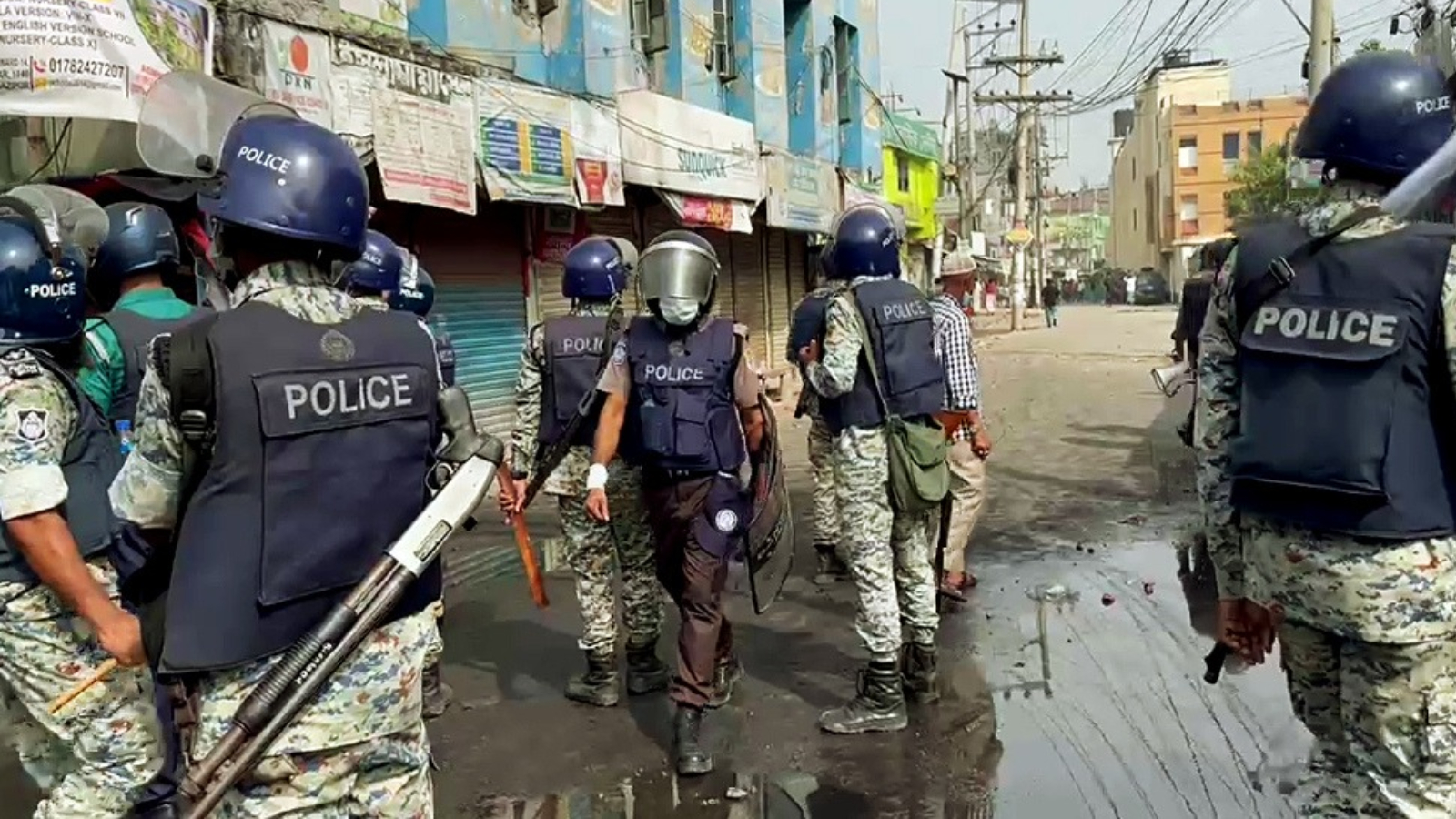
Yet reports from Dhaka indicate that demonstrations around Yunus's residence and key government intersections have involved a wide spectrum of groups with entirely different grievances. At various points since late 2024, the streets around Jamuna have been occupied by:
- Battery-powered rickshaw drivers protesting High Court bans on their vehicles in Dhaka.
- Public university students demanding the establishment of independent university commissions or specific administrative reforms.
- Primary school teachers and government employees demanding pay scale revisions and job regularization.
- Relatives of victims from the July-August 2024 protests demanding faster medical compensation and legal prosecution.
- Political activists aligned with either the Bangladesh Nationalist Party (BNP), Jamaat-e-Islami, or residual Awami League networks.
Grouping every security breach or protest near Yunus's compound under the banner of "Sheikh Hasina's planned return" flattens distinct socio-economic disputes into a single partisan storyline.
What the "Planned Return" Actually Represents
Discussions surrounding Sheikh Hasina’s return are less about an imminent flight landing at Hazrat Shahjalal International Airport and more about legal, diplomatic, and political leverage.
Under Bangladesh's International Crimes Tribunal (ICT), prosecutors have issued arrest warrants for Hasina and dozens of former cabinet ministers on charges related to the hundreds of deaths during the July 2024 student-led protests. Meanwhile, the interim government formally requested her extradition from India under the bilateral extradition treaty signed in 2013.
Political scientists point out that New Delhi faces a complex strategic calculation. India viewed Hasina's administration as a reliable partner on regional security and connectivity in Northeast India. Handing her over would alienate long-standing political allies in South Asia, while keeping her in India complicates diplomatic relations with Dhaka's interim leadership.
For Awami League supporters inside Bangladesh, talk of Hasina's return functions as a morale-building tool to keep grassroots networks intact while the party's top leadership remains scattered, jailed, or in exile. Conversely, for student leaders and rival parties like the BNP, warnings about a "counter-revolution" serve to keep their own bases mobilized and justify strict security measures against Awami League gatherings.
The Institutional Vacuum Nobody Wants to Talk About
When a political system relies heavily on centralized executive authority for over a decade, removing the top executive does not automatically create functioning institutions. It creates a vacuum.
Observers of South Asian governance note three structural challenges driving the ongoing volatility in Bangladesh:
- The Policing Deficit: During the July 2024 uprising, police stations across the country were attacked, and hundreds of officers were killed or went into hiding. Rebuilding law enforcement morale and public trust takes years, not months. When street protests erupt today, security forces often hesitate to use force for fear of triggering public backlash, or they rely on military units deployed with magistracy powers to maintain order.
- Economic Strain: Before the August 2024 transition, Bangladesh was already grappling with high inflation, declining foreign exchange reserves, and non-performing loans in the banking sector. Political uncertainty has disrupted ready-made garment (RMG) factories through labor strikes, putting pressure on an industry that accounts for over 80 percent of the country's export earnings.
- The Election Timeline Dispute: While the interim government formed multiple commissions to reform the constitution, judiciary, and electoral system before holding national polls, major political parties—most notably the BNP—have repeatedly pushed for an earlier election date. An unelected interim administration inherently loses political capital the longer it stays in power without a clear electoral mandate.
Answering the Wrong Questions
If you search for news on Bangladesh today, the most common questions revolve around immediate triggers: Will Sheikh Hasina return to power? Can Muhammad Yunus survive the protests?
According to regional analysts, those questions miss the underlying trajectory of Bangladeshi politics.
Is Sheikh Hasina returning to lead a counter-revolution?
Legal and political realities make an immediate return to power highly improbable. Facing domestic arrest warrants, banking restrictions, and widespread public anger over the 2024 crackdown, Hasina lacks a clear path back to Dhaka without triggering mass resistance from the same student networks and opposition parties that forced her exit. However, the Awami League retains significant organizational roots and voter loyalty across rural districts, meaning the party cannot simply be erased from Bangladesh's political equation.
Why are protesters targeting Muhammad Yunus's residence?
Jamuna has become the de facto complaint desk of the nation. Because parliament is dissolved and local government bodies were largely replaced by administrators, citizens with economic or administrative grievances view the Chief Adviser's residence as the only address with decision-making power. While security incidents near the compound raise legitimate questions about intelligence and crowd control, most gatherings reflect pent-up demands suppressed during the previous administration rather than a coordinated coup attempt.
The Nuance Missing From the Headlines
Imagine a scenario where a company runs for 15 years under a single CEO who personally approves every major contract, hires every department head, and suppresses internal audits. When that CEO suddenly leaves, the interim manager does not just inherit a leadership title; they inherit broken accounting, demoralized staff, and vendors demanding unpaid invoices at the front gate.
That is the operational reality in Dhaka.
International observers, including the International Crisis Group, have emphasized that Bangladesh's transition faces dual risks: moving too slowly on reforms risks entrenching an unelected administration and alienating political parties, while rushing into elections without institutional safeguards risks repeating the winner-take-all politics that defined the country since 1991.
For decades, Bangladeshi politics oscillated between the Awami League and the BNP, with each winning party using state machinery to sideline the opposition. Student leaders from the Anti-Discrimination Student Movement explicitly stated that their goal in 2024 was to break that cycle—not simply swap one party for another.
Yet dismantling an entrenched political culture requires more than changing the occupant of the Chief Adviser's office. It requires judicial independence, campaign finance transparency, and depoliticized civil administration—none of which can be achieved overnight while inflation hovers near double digits.
The Real Battleground
The noise around protests at Muhammad Yunus's residence and rumors of Sheikh Hasina's return are symptoms, not the disease.
The real struggle in Bangladesh is happening behind closed doors in reform commissions, central bank boardrooms, and party headquarters in Dhaka. It is a contest over whether the country will establish rules that bind whoever wins the next election, or whether the next elected government will simply inherit the same unchecked powers that brought Bangladesh to a boiling point in the first place.


