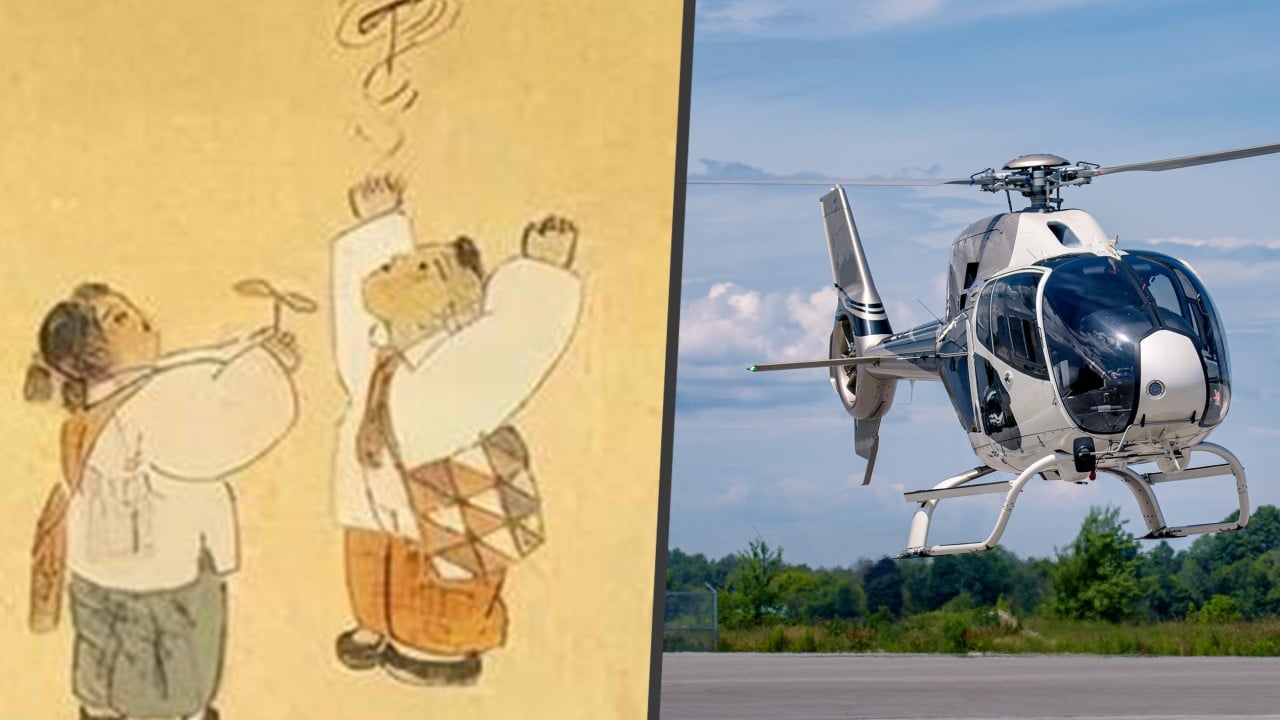
The bamboo-copter is fundamentally a simple object. A carved stick featuring an angled rotor blade at its tip, when spun rapidly between human palms and released into the air, climbs vertically before fluttering down.
Long before engine blocks, carburetors, or complex aeronautical mathematics existed, this device demonstrated that spinning aerofoils could generate lift. Originating during the Jin Dynasty in China around 320 AD—known historically as the Chinese top or bamboo dragonfly, and later adopted in Japan as the taketombo—the object spent centuries categorized strictly as a children's amusement. Yet this modest toy crossed cultural boundaries, migrated into European sketchbooks, and ultimately handed early Western engineers the mechanical blueprint for the modern helicopter rotor and airplane propeller.
The trajectory of vertical flight did not begin with massive industrial machinery. It began with scraps of wood and juvenile curiosity.
Tracing the Roots from the Jin Dynasty to Japanese Craftsmanship
Historical records place the earliest documented description of the bamboo-copter in the Baopuzi, written by the Chinese Daoist philosopher Ge Hong around 317 AD. Within its text lies a passage detailing flying cars constructed from jujube wood with ox-leather straps used to set returning blades into motion. While scholars continue to debate whether Ge Hong described literal machinery or metaphorical mythology, subsequent centuries produced physical proof: the spinning top toy.
Makers fashioned the device from lightweight bamboo. They split a small section of the stalk to form angled blades, shaved a central shaft, and relied on manual friction to translate hand speed into rotational kinetic energy.
When the toy traveled eastward to Japan, it became the taketombo, translating directly to "bamboo dragonfly". Japanese artisans refined the balance of the wooden blades, turning the construction into a staple of regional craftsmanship.
Across both nations, the object remained localized to the playground. Neither Chinese nor Japanese inventors scaled the physics of the toy into human-carrying aircraft. Cultural frameworks prioritized other technological vectors, leaving the aerodynamic principle locked inside a wooden plaything.
The European Migration and the Birth of Aeronautical Science
The transition from Asian toy to European engineering milestone occurred through quiet observation and trade routes. By the Renaissance, illustrations of the bamboo-copter began appearing in Western art. A stained-glass window in London from the 1500s and paintings by Pieter Brueghel the Elder depicted the rotating wing device, signaling that merchants and travelers had successfully carried the concept across continents.
European scientists did not view the object merely as a child's toy. They recognized an unsolved mechanical puzzle.
In 1743, Russian polymath Mikhail Lomonosov constructed a spring-driven coaxial rotor model directly inspired by the design. Decades later, French naturalist Christian de Launoy utilized a bow drill apparatus to spin feather-made propellers upward, proving that mechanical energy could replace human hands.
The most significant breakthrough belonged to Sir George Cayley. Often styled as the father of modern aeronautics, Cayley encountered the Chinese top and recognized its immense structural implications. In 1792, he began active experimentation with what he termed "rotary wafts".
Cayley replaced cork and feather configurations with whalebone bow drills, scaling up the dimensions. By 1835, his iterations could clear heights exceeding ninety feet. Cayley documented these mechanics in his foundational 1809 treatise, On Aerial Navigation, directly bridging the gap between ancient Asian craftsmanship and Western aerospace development.
Translating Toy Physics into Heavy Machinery
Understanding why the bamboo-copter worked required breaking down its primary aerodynamic components. The device operates on the exact same aerodynamic principles that allow modern helicopters to hover.
When a user spins the central shaft, the angled blades cut through the air. This rotational velocity creates a pressure differential. Lower pressure forms above the blade while higher pressure builds underneath, generating vertical lift.
For a hypothetical illustration, consider an industrial wind turbine operating in reverse. Instead of wind turning the blades to create electricity, the blades spin rapidly to push air downward, forcing the body upward in equal and opposite reaction.
The toy possessed inherent limitations. It lacked cyclic pitch control, directional thrust, or a tail rotor to counteract torque. Once the stored energy from the user's hands dissipated, the toy fell back to earth.
However, nineteenth-century inventors used these exact structural constraints to design solutions. Enrico Forlanini applied steam power to a counter-rotating coaxial helicopter model in 1878, achieving short unassisted flights. Alphonse Pénaud introduced rubber-band powered helicopter models in 1870, establishing the elasticity ratios required for sustained torque.
Every milestone in rotary-wing aviation traces its ancestry back to the simple act of rolling a bamboo stick between two palms.
Modern Cultural Resonance and the Pop Culture Echo
Centuries after its conception, the legacy of the device persists in both high-end engineering labs and popular culture. In Japan, the toy remains an enduring symbol of traditional craft. In global media, the concept found its most famous modern iteration within Japanese manga and anime.
Introduced in 1970 within the iconic franchise Doraemon, the take-copter (a futuristic, battery-powered electronic headband version of the bamboo dragonfly) became a cornerstone of modern pop culture imagination. It reimagined ancient physics as personal flight gear for a robotic cat and a young boy, cementing the shape in the global consciousness.
Engineers building modern urban air mobility vehicles and drone swarms rarely acknowledge the ancient origins of their blade angles. Yet the math remains unchanged.
Air treats a carbon-composite drone blade the exact same way it treated a shaved piece of bamboo carved during the Jin Dynasty. The materials changed, the power sources evolved from human palms to lithium-ion batteries, but the physics of vertical flight remain tethered to an invention born from a simple piece of wood.

(mh=zBXkz9ZRQ7nTRvbU)15.jpg)