Australia war-gaming nuclear-powered subs in a conflict with China isn't a hypothetical parlor trick anymore. It's a hard-nosed shift in how Canberra thinks about deterrence, survival, and who actually holds the cards in the Indo-Pacific.
For years, defense planners treated nuclear-powered submarines as a distant prize tied to the AUKUS pact. Something for the 2030s or 2040s. War games don't wait for delivery schedules. They test how a small navy with huge geography behaves when crisis hits right now, using what it has today alongside what it hopes to field tomorrow.
Honestly, a lot of armchair commentators miss what war-gaming actually does. It isn't a crystal ball. It's a stress test for assumptions, logistics, and nerve. When defense analysts run simulated crises involving China in the South China Sea, the Taiwan Strait, or northern approaches closer to home, submarines sit right near the top of the board. Quiet, hard to find, and capable of staying on station far longer than diesel-electric boats.
Why War-Gaming Nuclear Subs Matters Right Now
Let's get real about Australia's military math. You've got a massive coastline, a relatively small population, and thousands of kilometers of open ocean separating your ports from the main flashpoints in East Asia.
Diesel-electric submarines—like the aging Collins-class boats Australia currently operates—have real limits. They have to snorkel near the surface periodically to recharge batteries, which makes them louder and more vulnerable to detection in contested waters. Transit times from Western Australia up toward the South China Sea eat up days or weeks of a patrol.
Nuclear-powered attack submarines (SSNs) flip that equation. Because their reactors generate power without air, they can stay submerged almost indefinitely, limited mainly by crew endurance and food supplies. They sprint faster over long distances and hold patrol stations longer.
When Australian strategists war-game a clash with China, they aren't pretending a handful of boats will single-handedly defeat the People's Liberation Army Navy. That would be fantasy. Instead, they test how nuclear submarines complicate Beijing's planning. If Chinese commanders can't be sure where quiet SSNs are operating—or whether they're tracking surface combatants, protecting sea lanes, or holding high-value targets at risk—every operational plan gets messier and riskier.
You can see how the AUKUS security partnership frames this whole conversation around industrial capacity and strategic balance, though paper agreements and simulated crises are two very different things.
What War Games Actually Expose About AUKUS and Readiness
Here's the uncomfortable part nobody loves talking about. War-gaming doesn't just show what nuclear subs can do. It exposes every gap between ambition and reality.
One glaring issue is timing. Australia doesn't have an active nuclear submarine fleet operating under its own flag right now. Even under AUKUS plans, acquiring conventionally armed, nuclear-powered submarines takes years of shipyard work, workforce training, nuclear safety regulation, and supply-chain alignment with the United States and the United Kingdom.
When a war game sets a scenario in the near term, planners have to wrestle with a bridge problem. How do you deter or respond in the meantime? Relying on aging hulls while waiting for future capabilities creates tension between today's operational risks and tomorrow's force structure.
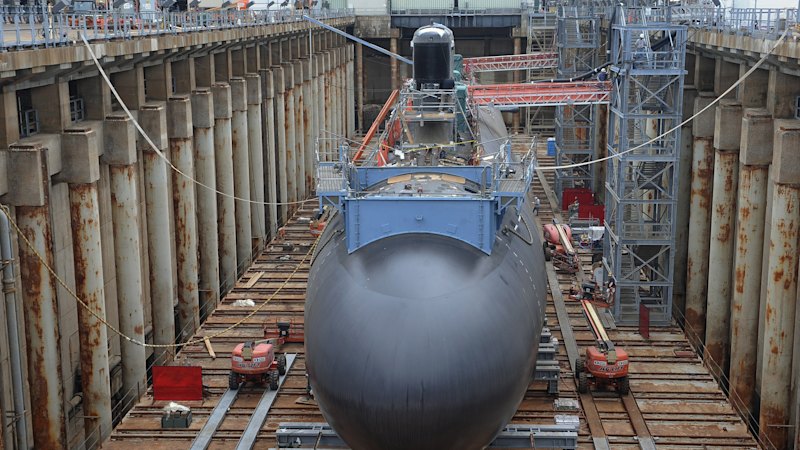
Logistics is another headache. A nuclear submarine isn't just a hull in the water. It needs trained engineers, radiation safety oversight, specialized maintenance yards, shore power and support infrastructure, and tight intelligence sharing. In a simulated conflict, supply lines and port access become prime targets or bottlenecks. If a single base or support node gets strained, tempo drops fast.
Escalation is the thorniest question of all. Nuclear-powered does not mean nuclear-armed—Australia's planned boats are conventionally armed. Still, in a high-stakes crisis with China, miscalculation is a constant threat. How do forces signal restraint while still demonstrating capability? How do rules of engagement hold up under electronic warfare, contested communications, and fog of war?
War games force defense officials to confront those friction points before a real crisis leaves zero margin for error.
Common Misconceptions About Submarines in a China Conflict
People love neat stories about modern warfare. Submarines rarely fit neat stories.
Myth One: A Few Subs Control the Entire Ocean
Not even close. The Indo-Pacific is vast, noisy in places, complex in others, and full of competing sensors, aircraft, surface ships, and undersea monitoring networks. A submarine is a high-value, stealthy asset, not an invisible wand that locks down millions of square kilometers on its own.
Myth Two: Nuclear Power Makes a Sub Invincible
Wrong again. Quieter is better, not invulnerable. Anti-submarine warfare has evolved, too. Maritime patrol aircraft, sonar arrays, seabed sensors, and coordinated surface groups all work to find what doesn't want to be found. A nuclear reactor gives endurance and speed, not magic armor.
Myth Three: War-Gaming Means War Is Inevitable
That's a lazy take. Militaries war-game contingencies all the time—including scenarios they desperately want to avoid. Simulating a conflict with China is part of deterrence and risk management. If you don't test your blind spots in peacetime simulations, you discover them for the first time when shots are fired.
As the Australian Strategic Policy Institute regularly highlights in its defense analysis, serious strategic planning requires looking squarely at capability gaps and regional power shifts rather than wishing away hard trade-offs.
The Strategic Trade-Offs Australia Can't Duck
Every defense choice has a price tag, and Australia's isn't small. Pouring enormous money, industrial focus, and diplomatic capital into nuclear submarines shapes the rest of the force.
Does funding long-term submarine programs squeeze near-term needs like air defense, long-range strike, munitions stockpiles, or logistics resilience? That debate is real and ongoing inside defense circles. You can't spend the same dollar twice, and defense budgets always face competing priorities.
There's also the diplomatic balancing act. China is a major trading partner for Australia, while strategic rivalry and friction over regional security, trade pressures, and military activity have sharpened tensions. War-gaming a conflict doesn't mean Canberra wants one, yet it underscores how seriously defense planners treat the possibility that diplomatic guardrails could fail.
From my perspective watching defense debates over the years, the biggest mistake is treating submarine war games either as pure hawkish posturing or as proof that everything is already solved. Neither is true. War games are diagnostic tools. They tell you where the engine knocks before you take the car onto a rough highway.
How to Read News About Nuclear Sub War Games Smartly
Next time a headline pops up about Australia war-gaming nuclear-powered submarines against China, don't stop at the catchy hook. Look closer at what's actually being tested.
- Check the timeframe of the scenario. Is it testing near-term realities or future force structures? Those are completely different conversations.
- Look for constraints, not just capabilities. Logistics, crew endurance, intelligence links, and escalation rules usually tell you more than top speed or dive depth.
- Separate capability from outcome. A simulation showing submarines complicating Chinese operations is very different from claiming a decisive victory.
- Watch budget and workforce talk. Real defense readiness lives in shipyard schedules, training pipelines, and sustained funding—not just press briefings.
Keep tracking official defense releases, independent policy analyses, and parliamentary scrutiny on submarine timelines and costs so you can judge claims against actual progress rather than hype.