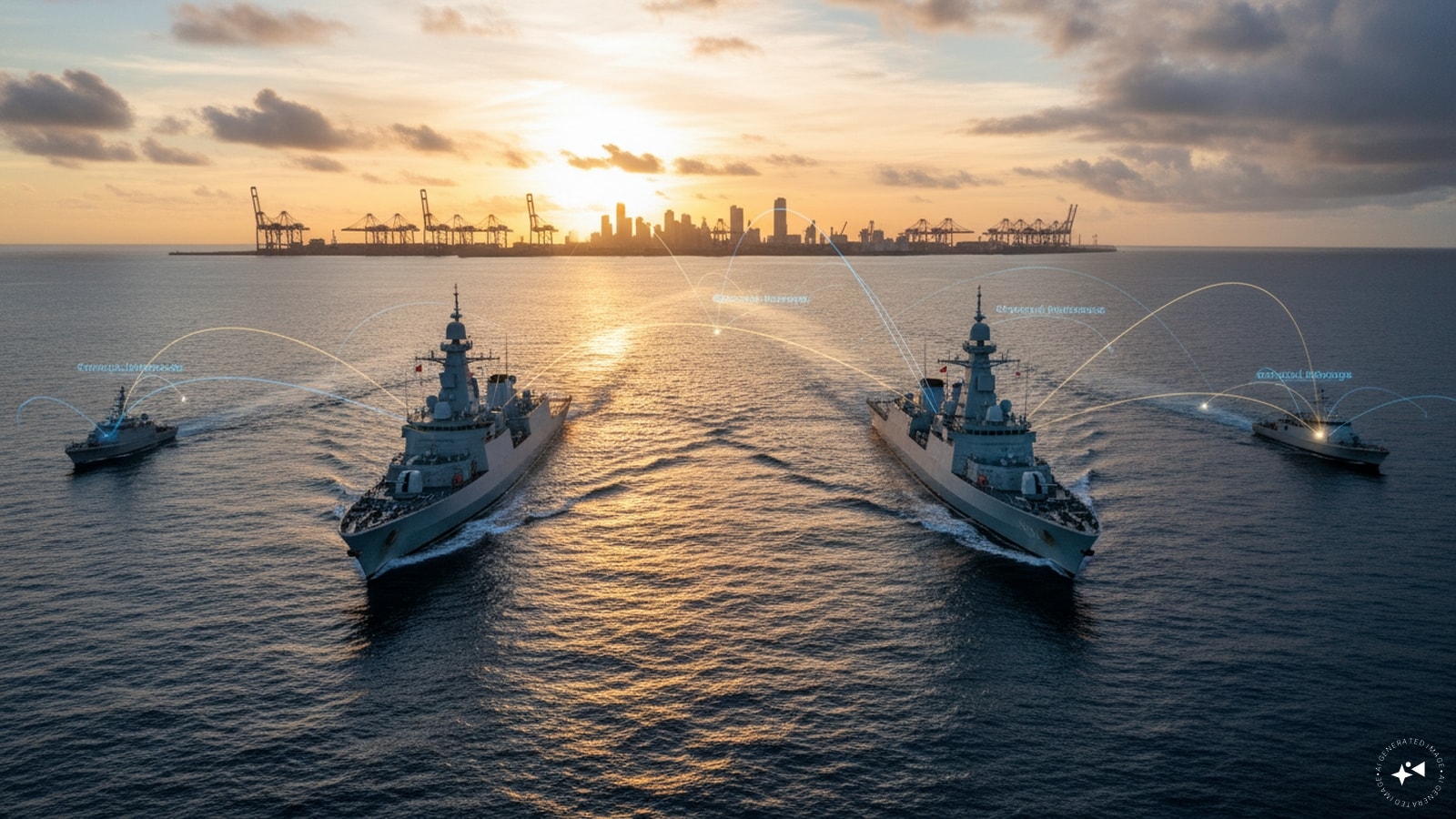
Every major defense publication on the planet just printed the exact same press release disguised as journalism. Australia and Vietnam shook hands in Canberra, upgraded their ties to a comprehensive strategic partnership, and promised to deepen security cooperation. Analysts lined up to call it a geopolitical masterstroke. They talked about regional stability, maritime domain awareness, and a unified front in the South China Sea.
They are wrong.
I have spent the last decade watching Canberra sign memorandum after memorandum with emerging Southeast Asian economies, only to watch those agreements dissolve the moment Beijing applies economic gravity. This latest deal with Hanoi is not a strategic alignment. It is diplomatic theater. It papers over an irreconcilable contradiction: Australia wants a military proxy to check Chinese maritime expansion, while Vietnam wants Australian capital and technological cover without ever becoming anyone's frontline state.
Let us look past the ceremonial guard of honor and examine the mechanics of what is actually happening.
The Lazy Consensus on Middle Power Diplomacy
The standard narrative goes like this: Middle powers like Australia must band together with ASEAN states to constrain an assertive Beijing. By sharing intelligence, conducting joint naval exercises, and boosting defense trade, Canberra and Hanoi create a denial network that makes aggression too costly.
This argument relies on a fundamental misunderstanding of Hanoi's grand strategy. Vietnam does not practice alliance politics. It practices bamboo diplomacy. Roots are solid, trunk is sturdy, branches bend with the wind.
When you sign a security cooperation agreement with a state whose core doctrine is non-alignment, you are not building an alliance. You are buying a temporary conversation. Vietnam's defense white papers explicitly forbid foreign military bases on its soil, entering military alliances, or using one country against another. Hanoi will gladly take Canberra's patrol boats, accept cybersecurity assistance, and share intelligence on regional maritime movements. But the second a crisis flares up in the Spratly Islands, Vietnam will look out for Vietnam. Canberra will be left holding a bilateral agreement worth less than the paper it was printed on.
I have seen defense bureaucrats blow millions on capacity-building programs in nations that take the hardware, pocket the funding, and quietly reassure Beijing that their core strategic orientation remains entirely independent of Western spheres of influence.
The Economic Reality Check
You cannot decouple security cooperation from economic gravity. China is Vietnam's largest trading partner and the primary source of the raw materials that feed Vietnam's manufacturing sector. Australia's total trade with Vietnam is respectable, but it sits in a completely different financial universe compared to Hanoi's cross-border supply chains with its giant northern neighbor.
When strategic analysts claim that defense agreements can override economic realities, they are ignoring the ledger. Vietnam's economic survival depends on frictionless trade through the South China Sea and with mainland China. A security pact with a middle power thousands of miles away does not alter the geography of the East Sea. It does not move Vietnam one inch further from Beijing.
Imagine a scenario where a maritime clash escalates between Chinese coast guard vessels and Vietnamese fishermen near the Paracel Islands. Does anyone seriously believe that Canberra will deploy naval assets to back up Hanoi? Of course not. Australia's defense posture is inherently risk-averse, constrained by its own personnel shortages, acquisition delays, and a primary strategic focus on the northeast approaches and the ANZUS framework.
To pretend that Australia can offer credible hard-security guarantees to a nation sitting directly on China's doorstep is geopolitical gaslighting.
What Strategic Cooperation Actually Means on the Ground
Strip away the diplomatic communique, and here is what this agreement actually boils down to:
- Procurement Margins: Australian defense contractors and consultants looking for new export markets in Southeast Asia.
- Information Sharing Theater: Low-level intelligence exchanges on transnational crime and maritime domain awareness that do little to alter the military balance of power.
- Diplomatic Signaling: Both capitals signaling to Washington that they are doing their part to maintain regional engagement without having to make hard choices.
Hanoi gets institutional legitimacy and technical assistance. Canberra gets a nice headline for the domestic press about projecting influence in Southeast Asia. It is a win-win for bureaucrats, but a zero-sum illusion for anyone looking for actual deterrence.
The Fallacy of Maritime Domain Awareness
The favorite buzzword in Canberra right now is maritime domain awareness. The theory is that if we give partner nations better radar, satellite data, and patrol vessels, they can track everything happening in their exclusive economic zones.
This assumes the missing link in stopping gray-zone coercion is a lack of binoculars.
Vietnam already knows when Chinese survey vessels violate its waters. The Philippine Bureau of Fisheries and Aquatic Resources knows every time a maritime militia fleet surrounds a reef. The constraint is never intelligence. The constraint is political will and the prohibitive cost of kinetic escalation against a superpower opponent.
Handing over advanced surveillance tech without a credible enforcement mechanism is like giving someone a home security camera while leaving the front door wide open. It records the robbery in high definition. It does not stop the intruder.
The Cost of Strategic Dilution
By pretending that bilateral deals with non-aligned states constitute a coherent containment strategy, Western policymakers are suffering from strategic dilution. They are spreading finite diplomatic and military bandwidth across dozens of superficial partnerships instead of focusing on what actually matters: hard power projection, indigenous defense manufacturing, and asymmetric denial capabilities closer home.
Australia's defense budget is stretched to the breaking point. Major surface combatant reviews, submarine acquisition timelines plagued by decade-long delays, and severe recruitment crises mean Canberra cannot afford vanity projects disguised as grand strategy. Every dollar and man-hour spent managing complex defense bureaucracies in Southeast Asia that yield zero operational return in a crisis is a misallocation of resources.
Stop Trying to Export the ANZUS Mindset
The core error is trying to apply a Western alliance mindset to a region that operates on an entirely different operating system.
Southeast Asian states do not want to choose between Washington and Beijing. They want to extract concessions, investments, and security training from both while retaining absolute operational autonomy. When Australian diplomats arrive in Hanoi talking about rules-based orders and security partnerships, they are speaking a language of binary choices that Vietnamese leadership actively rejects.
If Canberra wants a serious security policy in Asia, it needs to stop signing feel-good communiques that dissolve under pressure. It needs to look at supply chain resilience, domestic defense readiness, and targeted economic integration that actually alters the calculus of regional actors.
The Canberra agreement is not a milestone. It is a distraction. The next time you read about a comprehensive strategic partnership signed in a mahogany-paneled room, ask yourself a simple question: who is paying for the dinner, and who is holding the bag when the wind shifts?