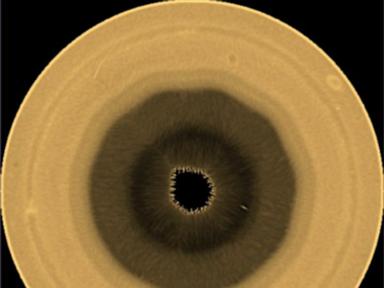
Planetary atmospheres maintain fluid regimes that resist intuitive scaling, yet Saturn repeatedly forces a re-evaluation of fluid mechanics through the generation of rigid geometric boundaries. The identification of a ten-sided wave structure—a decagon—circling Saturn's south pole establishes that the northern polar hexagon is not an isolated anomaly. Deconstructing this southern meteorological system requires examining the operational mechanics of jet stream meandering, vertical stratification, and wave instability under gas giant constraints.
The Fluid Mechanics of Bounded Jet Streams
The mechanics governing Saturn's polar polygons rely on high-velocity zonal jets interacting with planetary rotation gradients. At Saturn's northern and southern polar regions, eastward jet streams achieve velocities exceeding 400 kilometers per hour. In classical fluid dynamics, a purely zonal jet experiencing minor perturbations typically sheds eddies or dissipates into turbulent mixing. However, planetary-scale Rossby waves trapped within a narrow latitude band experience restoring forces driven by the variation of the Coriolis parameter with latitude.
When these waves become trapped in a confined shear zone, the kinetic energy cascading through the system organizes into discrete polygonal modes. The transition from a six-sided waveform in the north to a ten-sided waveform in the south indicates that the longitudinal wavenumber selection depends heavily on local boundary conditions, shear profile steepness, and background temperature gradients. The southern decagon spans a massive perimeter, with individual sides measuring approximately 16,700 kilometers, placing the total structure scale beyond the dimensions of terrestrial continents.
Structural Asymmetries Between Northern and Southern Polygons
Comparative analysis of Saturn's polar features reveals critical divergences in stability and morphology. The northern hexagon has persisted for over four decades, maintaining uniform vertex sharpness and structural integrity across multiple Saturnian years. Conversely, the southern decagon exhibits pronounced variability in vertex definition; certain corners are sharply demarcated while others remain rounded, indicating an evolving dynamical state.
The structural divergence stems from three primary operational differences:
- Latitude Placement: The northern hexagon sits closer to the pole, whereas the southern decagon anchors near 60 degrees south latitude, subjecting it to different solar insolation cycles and thermal gradients.
- Phase Velocity: While the northern hexagon remains nearly stationary relative to the deep planetary interior, the southern decagon migrates eastward at roughly 9 to 10 kilometers per hour.
- Vertical Stratification: Infrared observations using ground-based instrumentation demonstrate that the southern decagon's wind velocity decays with altitude, suggesting a vertically coupled wave pattern rather than a surface-level thermal artifact.
The Transient Evolution Hypothesis
Observational gaps historically obscure planetary transitions. Because Saturn's southern hemisphere remained tilted away from Earth between 2012 and 2023, the window of formation for the decagon was masked from direct telescopic capture. Shallow-water hydrodynamic simulations indicate that the decagon likely coalesced from transient disturbances along the southern subpolar jet, potentially forced by adjacent high-pressure vortex systems operating in lower latitudes.
This transient nature challenges long-held assumptions regarding the longevity of gas giant wave patterns. If the decagon represents a meta-stable state rather than a permanent equilibrium, its structural configuration will shift as southern illumination peaks toward the 2032 seasonal equinox. The influx of thermal energy alters the baroclinic instability profile of the upper weather layer, providing an empirical testing ground for atmospheric models that simulate multi-layered fluid dynamics under variable radiative forcing.
Predictive Modeling and Observational Constraints
Resolving the mechanics of Saturnian polygons requires continuous integration of space-based imaging and ground-based thermal infrared spectroscopy. Future observation runs must track the longitudinal drift rates of the decagon's vertices against underlying wind vectors to isolate the exact restoring forces maintaining the ten-sided symmetry. Atmospheric researchers are utilizing numerical models to test whether neighboring vortex interactions can force a high-wavenumber breakdown, which would confirm whether the decagon is actively decaying or stabilizing into a permanent fixture matching its northern counterpart.