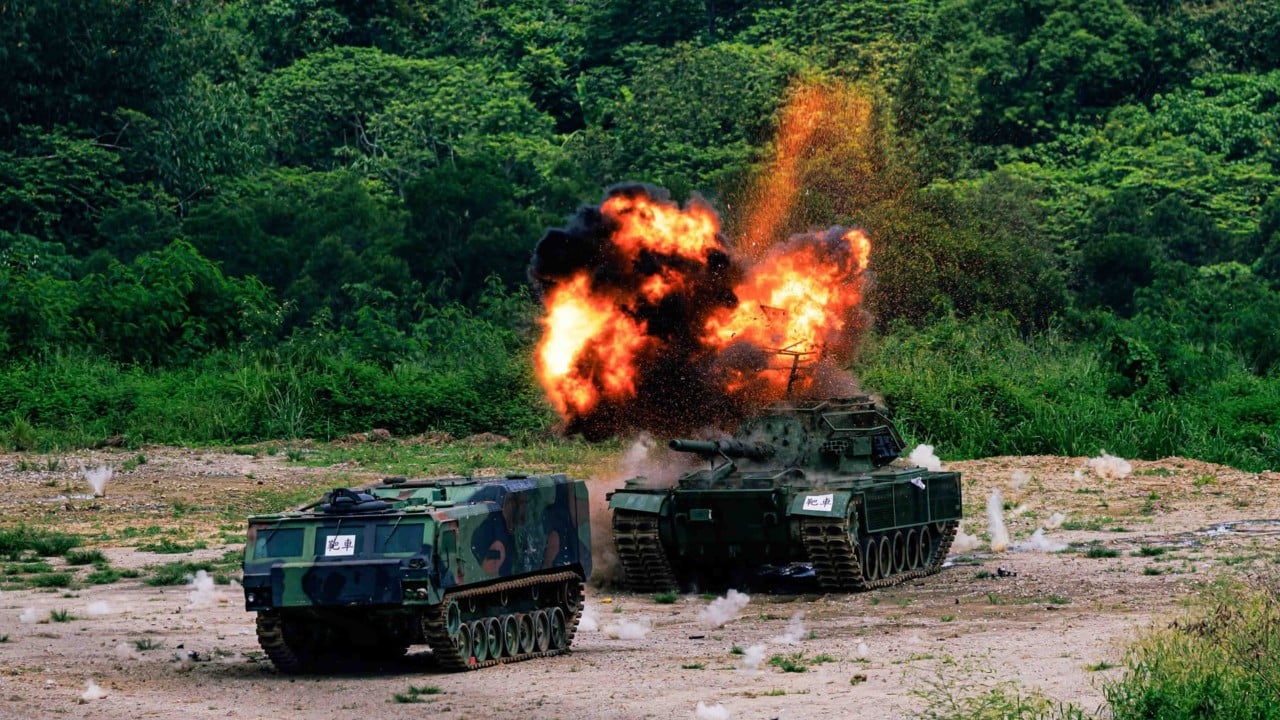
Modern military strategy increasingly dictates that force multiplication must decouple from exponential cost scaling. When conventional defense procurement relies on high-unit-cost assets like main battle tanks and precision artillery shells, defenders face a severe economic attrition trap against numerically superior adversaries. The integration of first-person-view unmanned aerial systems into routine artillery and infantry live-fire drills represents a structural shift toward closing this cost-capability gap. By analyzing recent military integration efforts, such as the deployment of armed small-scale platforms by Taiwan's artillery commands and marine corps units, strategists can evaluate the mechanics of low-cost asymmetric deterrence.
The Cost Function and Procurement Efficiency
The core economic driver behind the proliferation of first-person-view attack systems lies in absolute unit cost reduction relative to target value destruction. Traditional armored targets, such as retired or active combat vehicles like the CM12 tank or CM24 armored carriers, represent multi-million-dollar investments in metallurgy, optics, and propulsion. Destroying or neutralizing these assets traditionally required heavy artillery barrages or sophisticated wire-guided anti-tank missiles carrying high financial per-engagement overheads.
First-person-view strike platforms alter this financial equation drastically. Equipped with standardized high-explosive anti-armor warheads, such as 3.5-inch shaped charges or modified 6-inch munitions, these systems deliver terminal kinetic energy at a fraction of conventional munition costs.
- Capital Expenditure Efficiency: Commercial-off-the-shelf components and modular frames minimize baseline manufacturing overhead.
- Logistical Footprint: Lightweight airframes reduce transport burdens, allowing front-line infantry and specialized military police companies to carry multiple strike assets per squad.
- Production Scalability: Unlike complex guided missiles constrained by specialized supply chains, small tactical aerial platforms allow rapid industrial scaling during sudden mobilization requirements.
The Kill Chain Mechanics and Operator Proficiency
Introducing tactical aerial strike systems requires a complete restructuring of the traditional engagement cycle, commonly known as the kill chain: find, fix, track, target, engage, and assess. In conventional artillery operations, this loop involves forward observers relaying coordinates back to battery command posts, calculating ballistic trajectories, and executing indirect fires with inherent dispersion errors.
First-person-view operations collapse this timeline into a continuous, closed-loop visual process. Operators wearing virtual reality goggles receive real-time, high-definition video feeds, enabling terminal guidance adjustments down to the centimeter.
[Target Acquisition] ---> [Real-Time Video Feed] ---> [Manual Terminal Dive] ---> [Kinetic Impact / BDA]
This operational workflow transforms every pilot into both a reconnaissance scout and a precision bombardier. However, this direct human-in-the-loop control creates a severe training bottleneck. Just as a marksman cannot utilize an advanced rifle without foundational trigger discipline, a drone pilot requires rigorous, repetitive hours of flight control mastery to overcome atmospheric disturbances, electronic interference, and high-stress operational parameters. Mastery of frontal and flank attack angles against moving or stationary armored vehicles demands muscle memory and spatial cognition that cannot be simulated through theory alone.
Tactical Integration and Multi-Vector Coordinated Strikes
Deploying these systems as isolated tactical novelties yields minimal strategic value. Modern force structures require embedding unmanned capabilities directly into joint-service command hierarchies, ranging from specialized artillery commands to localized garrison defense units.
Recent field evaluations demonstrate two primary tactical employment models:
- Single-Drone Precision Engagement: Focused on high-value static or slow-moving assets, utilizing optimal dive angles to target vulnerable upper armor surfaces, bypassing modern countermeasures like cage armor through precise overhead drops or direct frontal-flank trajectories.
- Dual-Drone Coordinated Strikes: Designed to overwhelm active protection systems or saturated defensive zones by staggering approach vectors, ensuring that even if electronic countermeasures neutralize the primary unit, the secondary asset completes the terminal phase.
Furthermore, integrating these platforms into urban defensive operations and reserve mobilization addresses historical training gaps. Reservists and territorial defense units previously lacked access to decentralized precision strike tools. Equipping them with modular, explosive-rigged airframes shifts the urban defense paradigm from static barricades to active, mobile attrition zones where any building or street corner can project localized anti-armor deterrence.
The Operational Bottlenecks and Strategic Limitations
Despite tactical advantages, first-person-view platforms introduce distinct systemic vulnerabilities that preclude them from serving as complete replacements for traditional heavy ordnance.
- Electronic Warfare Susceptibility: Analog and digital control links operate within crowded radio frequency spectrums. Advanced jamming and spoofing technologies can sever the video feed or control signal, inducing mission failure unless autonomous terminal homing or frequency-hopping redundancies are engineered into the firmware.
- Payload Weight and Range Constraints: Battery chemistry limits operational flight times and combat radius. Balancing explosive mass with flight endurance restricts these systems primarily to tactical front-line and near-shore engagement zones rather than deep strategic interdiction.
- Environmental Dependency: High winds, heavy precipitation, and low-visibility atmospheric conditions degrade aerodynamic stability and optical targeting precision, reducing effectiveness during critical weather windows.
Strategic Realignment for Scaled Asymmetric Deterrence
To maximize the defensive yield of tactical unmanned systems, military planners must institutionalize continuous operator training pipelines and standardize explosive payload integration. Procurement priorities should shift away from over-reliance on exquisite, single-point failure hardware toward redundant, mass-producible aerial networks. Defense logistics must treat drone batteries, airframes, and warhead kits as consumable ammunition items akin to rifle magazines, ensuring deep reserves across all active and reserve echelons.
Watch: Taiwan Military Drills Simulate Chinese Attack With Missiles, Drones and Special Forces
This video provides visual context on how modern live-fire exercises integrate multi-domain drone defenses alongside conventional missile and special operations drills.