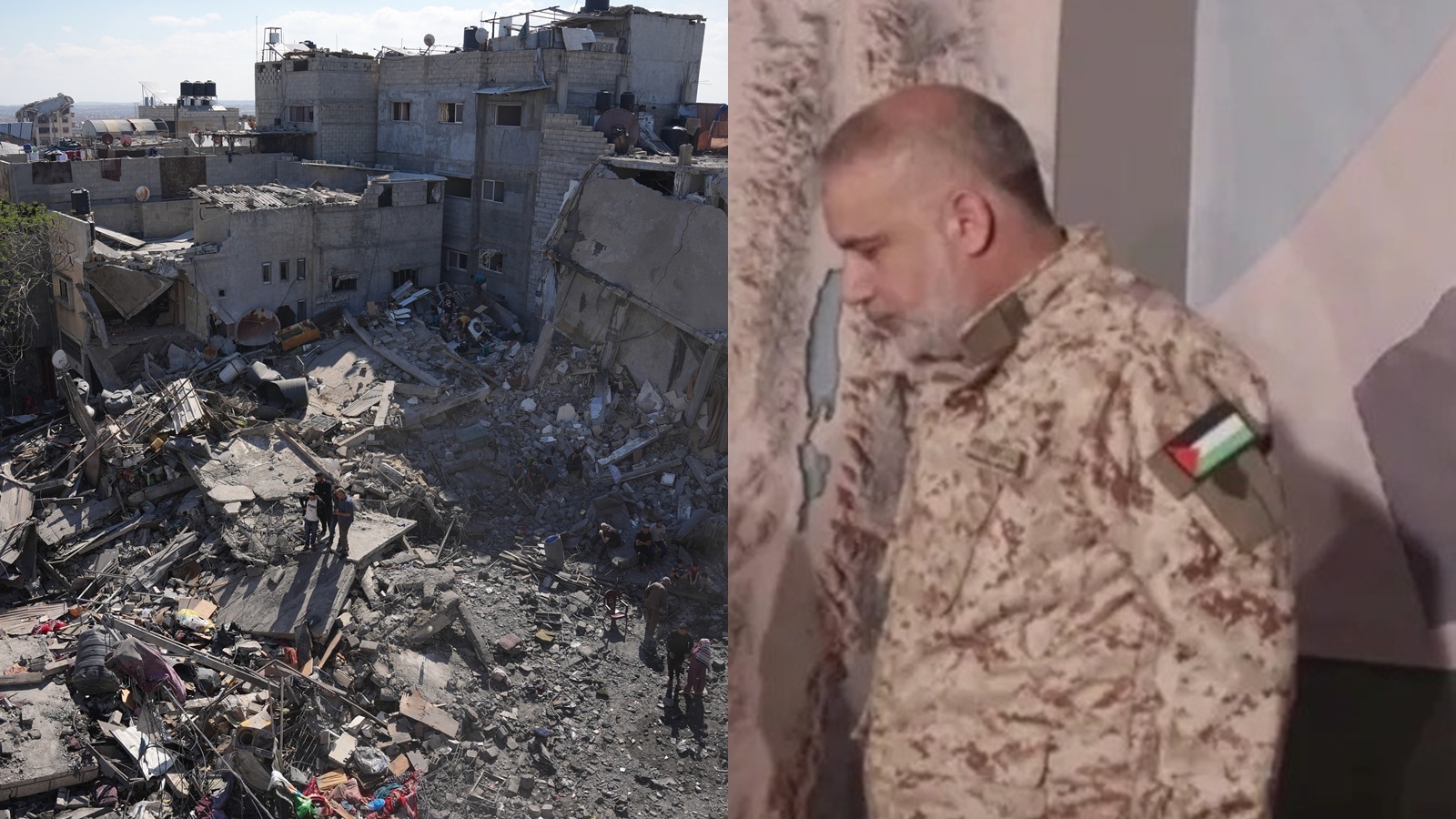
The mainstream media has its script, and it loves to stick to it. Every time an airstrike hits a high-ranking militant leader in the Gaza Strip, the breaking news banners roll out with predictable uniformity. The talking heads line up to declare a "shattering blow" to the insurgency. They paint a picture of a decentralized network suddenly thrown into chaos, its command structure decapitated, its operational capacity crippled.
We saw it again when Hamas confirmed the death of military chief Mohammed Odeh in an Israeli strike. The collective consensus immediately shifted to a narrative of strategic triumph and imminent institutional collapse for the group.
It is a comforting narrative. It is also completely wrong.
The belief that eliminating a single commander—even one as influential as Odeh—fundamentally alters the trajectory of a highly bureaucratized ideological movement is a persistent, lazy myth. Decapitation strategies look great on PowerPoint presentations in intelligence briefings. They look clean on evening news broadcasts. In the brutal reality of asymmetric warfare, they are a drop in the ocean.
If we look at decades of empirical data regarding targeted killings, a harsh truth emerges: killing Mohammed Odeh does not weaken Hamas. It merely accelerates its next evolution.
The Decapitation Myth and Institutional Inertia
Western observers love to view militant organizations through the lens of corporate hierarchies. They assume that if you remove the CEO, the entire enterprise grinds to a halt. This structural misunderstanding misjudges how modern insurgencies actually operate.
Hamas is not a fragile, top-down corporation. It functions more like a decentralized franchise with deep institutional inertia.
Traditional Hierarchy:   [CEO] ➔ [Executives] ➔ [Managers] ➔ [Execution] (Vulnerable)
Insurgent Network:       [Council] ➔ [Redundant Cells] ➔ [Autonomous Units] (Resilient)
For every Mohammed Odeh, there is an entire tier of mid-level commanders who have spent the last decade waiting for their turn to lead. These individuals are younger, often more radicalized, and deeply familiar with the operational mistakes that led to their predecessor's demise.
Consider the academic work of Jenna Jordan, an associate professor at the Georgia Institute of Technology, who conducted extensive research on the efficacy of leadership decapitation. Her data demonstrates that bureaucratic, older, and religiously motivated terrorist organizations are remarkably resilient against targeted killings. They possess high levels of institutionalization and local support, allowing them to replace fallen leaders almost instantly.
When you kill a bureaucrat of war, you do not destroy the bureaucracy. You simply create a job opening.
The Reality of the Martyrdom Economy
To understand why this strike fails to move the needle, you have to look at the psychological and ideological framework of the region. Mainstream analysis treats Odeh’s death as a net loss for Hamas’s ledger. It ignores the creation of what can only be described as the martyrdom economy.
In the ecosystem of Palestinian militancy, a commander who dies of old age in a villa abroad is a political liability. A commander who dies in an airstrike in Gaza becomes an asset.
- Recruitment Value: Death validates the rhetoric. It provides a fresh wave of propaganda that streams across Telegram channels, fueling the next generation of recruits.
- Ideological Hardening: It removes the possibility of compromise. Successors must prove their militancy, meaning the immediate aftermath of a decapitation strike usually results in a spike of more aggressive, less predictable operations.
- Operational Security Overhauls: The moment a leader is compromised, the entire organization changes its communication protocols. The flaw that allowed the strike to happen is violently corrected.
Imagine a scenario where a military assumes that killing a leader ends the war, only to find that the act itself hardens the enemy's resolve and flushes out old, compromised operational habits. That is the reality of the ground in Gaza. The strike on Odeh is a tactical success, but a strategic stalemate.
Dismantling the Premise of the "Shattering Blow"
Let's look at the standard questions that fill up search engines and news columns after an event like this, and answer them without the usual diplomatic sanitization.
Does losing a military chief destroy Hamas's command and control?
No. Hamas's military wing, the Izz ad-Din al-Qassam Brigades, operates on a highly decentralized cell structure. Local commanders possess the autonomy to execute operations without direct, real-time authorization from a central command post. Odeh was a strategist, but the machinery of ambush, tunnel warfare, and rocket fabrication is distributed across localized sectors. The cells on the ground do not stop fighting because a name is crossed off a list in Tel Aviv.
Will this force Hamas to the negotiating table on weaker terms?
The historical precedent says the exact opposite. When a radical organization loses a top leader, the immediate successors cannot afford to look weak. Making concessions right after a high-profile assassination is viewed as capitulation. The price of negotiations typically goes up, not down, as the new leadership seeks to project defiance.
Aren't targeted killings effective at reducing rocket fire?
Temporarily, perhaps, due to immediate tactical disruption. Logistically, no. Rocket stockpiles are decentralized, buried deep underground, and managed by technical teams whose jobs are entirely separate from the high-level military council. The manufacturing blueprints and operational knowledge are already widely distributed.
The Blind Spot of Tactical Success
I have tracked regional security dynamics for years, observing a cyclical pattern of behavior that yields identical results. Governments fall into the trap of prioritizing measurable tactical metrics—neutralized targets, destroyed tunnels, captured caches—over unmeasurable strategic outcomes.
It is easy to measure a missile strike. It is impossible to measure the resentment generated in the surrounding blocks, or the radicalization of the teenager who watches the funeral procession.
This is the fundamental blind spot of modern counter-terrorism. It mistakes the destruction of a component for the destruction of the system.
The competitor articles covering this event want to give you a clean narrative arc: Action, Reaction, Resolution. They want you to believe that the war is a series of chess moves, and Israel just took Hamas's knight. But this isn't chess. It is a Hydra. Cut off one head, and the body mechanism remains entirely intact, already growing the next one.
The strike on Mohammed Odeh will be analyzed in military academies as a masterclass in intelligence gathering and precision execution. It will be celebrated in political circles as a validation of defensive policy. But on the ground, in the concrete reality of Gaza, the tunnels remain, the rockets remain, the ideology remains, and the replacement is already sitting at the desk.
Stop looking at the name on the casualty list. Look at the system that built the list in the first place.