The air in Paris does not circulate when the heat arrives. It settles. It becomes a physical weight, pressing down on the zinc roofs, radiating off the limestone facades, and trapping eighteen million tourists and locals alike in a brilliant, suffocating pressure cooker.
By noon, the thermometer hits 41°C.
The government calls it a "red alert." The highest tier of meteorological warning. To the bureaucrats in offices with central cooling, it is a matter of statistics, infrastructure management, and public health advisories. But on the ground, on the cracked pavement of the Boulevard de Magenta, it is a matter of survival.
Consider Amandine, a composite of the thousands of students trapped in top-floor chambres de bonne across the city. Her room is barely nine square meters. Under the metallic roof, the temperature inside climbs to nearly 45°C. There is no air conditioning. In Paris, residential AC is a luxury reserved for the ultra-wealthy or the newly built complexes on the periphery. For everyone else, there is only a spinning plastic fan that merely shuffles the boiling air from one corner of the room to the other.
She has to leave. Everyone has to leave.
The Great Migration to the Canal de l'Ourcq
When the apartment becomes an oven, the city’s geography shifts. The traditional tourist hubs—the exposed stone of the Louvre courtyard, the baking asphalt of the Champs-Élysées—empty out. The crowds move northeast, drawn by an elemental instinct toward the water.
The Canal de l'Ourcq, once an industrial highway designed by Napoleon to bring fresh water into a disease-ridden city, is now a liquid sanctuary.
On a normal summer day, dangling your legs over the stone edge of the canal is a pleasant pastime. During a red alert heatwave, it is a collective act of defiance. The banks are packed tight, shoulder to shoulder. The smell of coconut sunblock mixes with the heavy, metallic scent of stagnant urban water and the faint aroma of lukewarm beer.
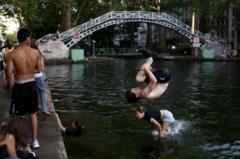
People jump.
Technically, swimming in most of the canal network is forbidden. The police patrol occasionally, their sirens cutting through the heavy air, but today, the sheer volume of humanity makes enforcement impossible. The authorities have quietly conceded defeat. When the human body reaches its thermal limit, rules become secondary to the biological necessity of cooling down.
A splash. Then another. Teenagers launch themselves from the iron footbridges, hanging in the air for a fraction of a second against the backdrop of a bleached-blue sky before breaking the murky surface.
The Illusion of Oasis
But water in a metropolis is a complicated savior.
While the dive into the canal provides an instant, shocking relief to a overheating body, it introduces a different set of invisible risks. Urban waterways during extreme weather events are prone to spikes in bacterial concentrations. The heat stimulates the growth of enterococci and E. coli, legacy pollutants from a city whose sewer systems are constantly fighting a war against modernization.
To jump into the Ourcq is to make a unspoken bargain: temporary physical relief weighed against the risk of infection. For most of the young people crowded along the Quai de de la Loire, the choice is not even a choice. The immediate agony of the heat outweighs the abstract threat of a stomach bug or a skin rash three days later.
The city has attempted to regularize this desperation. In recent years, dedicated swimming zones with filtered water, like the Bassin de la Villette, have been established. But these structured oases have structural limits. They have maximum capacities. They require queuing in the sun just to get into the water. When the red alert hits, a queue is a health hazard in itself.
So, the crowds bypass the gates. They find any patch of unprotected stone, any low-hanging bridge, and they leap.
The Structural Inequality of Heat
Extreme weather is often described as a great equalizer, but that is a myth. Heatwave vulnerability is deeply tied to social geography.
If you possess the means, you flee. The trains out of Gare de Lyon and Gare du Nord are packed with those heading to the coast of Brittany or the mountains of the Alps, where the air still moves and the night brings a drop in temperature.
For those who remain, the architecture of your life dictates your suffering. Paris is a dense city, built centuries before the concept of anthropogenic climate change. The iconic Haussmann buildings, beautiful as they are with their balconies and uniform cornices, were designed to retain heat during cold European winters. Their thick stone walls absorb the sun all day long and release that stored energy back into the apartments throughout the night.
The city never cools down. The phenomenon is known as the Urban Heat Island effect. Concrete, asphalt, and stone absorb solar radiation far more effectively than soil or vegetation. In a dense urban center like Paris, daytime temperatures can be up to 10°C higher than in the surrounding rural areas. At night, when rural fields drop to a comfortable 18°C, the center of Paris remains trapped at 28°C.
Without nocturnal relief, the human body cannot recover. The heart pumps faster to move blood to the skin for cooling. Sleep becomes impossible. Fatigue accumulates.
This is why the banks of the canal stay crowded long after the sun goes down. At midnight, the stone is still hot to the touch, but the proximity to the water offers a faint, psychological breeze. Thousands of people sit in the dark, speaking in quiet murmurs, reluctant to return to the brick ovens they call home.
The Changing Soul of the City
There is a specific sound to Paris under a red alert. It is not the usual bustle of traffic or the chatter of sidewalk cafes. It is a muted, heavy sound. The traffic slows down because engines overheat. The waiters at the bistros move with a deliberate, sluggish economy of motion.
The fountains of the city, from the grand monuments at Place de la Concorde to the small Wallace fountains scattered across the arrondissements, become communal plumbing. People douse their hats, soak their t-shirts, and submerge their forearms.
We are watching a historical shift in real-time. The romanticized version of Paris—the city of long walks along the Seine, of hot coffee on a crisp morning, of leisurely exploration—is incompatible with the reality of a changing climate. The city is being forced to adapt, not through grand architectural overhauls that take decades, but through immediate, chaotic human behavior.
The canal is no longer just a feature of the landscape. It is the lungs of the neighborhood.
As the sun finally dips below the horizon, painting the smoggy sky in shades of bruised purple and industrial orange, another group of swimmers lines up on the edge of the Quai de de la Marne. They don't look like thrill-seekers. They look tired. They are construction workers finished with their shifts, delivery drivers who spent the day on scooters, and families with young children who live in apartments without cross-ventilation.
They step off the edge, sinking into the dark water, leaving only their heads visible as they float quietly under the darkening sky, waiting for a breeze that will not come.


