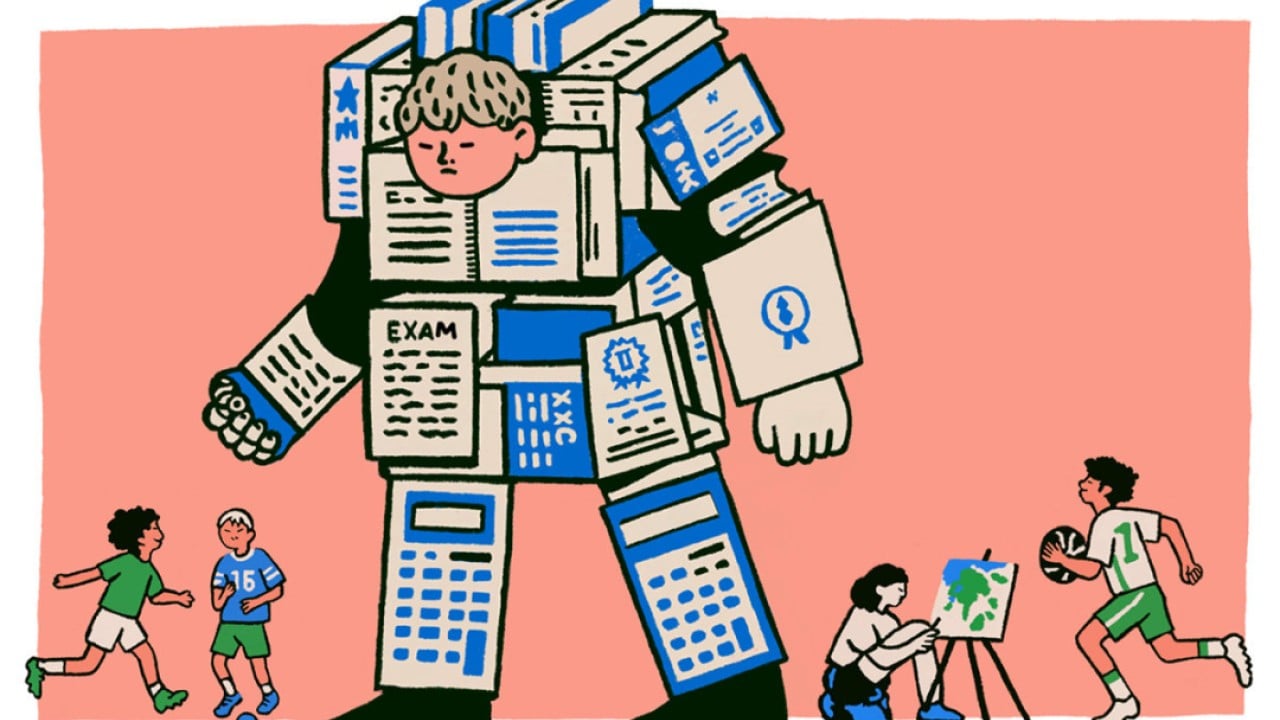
For decades, the blueprint was remarkably predictable. You drilled math equations into your toddler before kindergarten, demanded straight marks across every subject regardless of inclination, and funneled your child toward medicine, law, or engineering. This high-pressure conditioning, often labeled as strict high-yield rearing, produced millions of corporate cogs, Ivy League admits, and compliant professionals. Families traded leisure, emotional bandwidth, and spontaneous exploration for institutional security.
Now, generative algorithms and neural networks have broken the math. If you found value in this post, you should look at: this related article.
When software can clear the bar exams, write functional code from plain English prompts, and outperform human radiologists in pattern recognition, memorization loses its premium. The rigid formula of relentless test prep and rote mastery is hitting a wall. Families clinging to the old educational dogma are discovering that their children are being trained for a workforce that is rapidly vanishing.
The Obsolescence of Memorization
Human brains cannot out-compute silicon. For generations, academic dominance rested on the ability to store vast quantities of historical dates, mathematical formulas, and grammatical rules, retrieving them flawlessly under exam conditions. This capacity was the ultimate currency. For another angle on this event, see the recent coverage from Wired.
Large language models have rendered that currency nearly worthless.
When a pocket-sized device can synthesize a comparative analysis of Ming Dynasty trade policies in two seconds, spending formative years drilling those facts into a child is an egregious misallocation of time. The traditional model assumed that accumulation equaled competence. Today, accumulation is automated.
Consider the typical after-school schedule in urban centers from Shanghai to San Francisco. Children shuffle between cram schools, violin lessons, and Kumon centers, operating on schedules that would exhaust a trial lawyer. Parents pay exorbitant fees to ensure zero friction in academic output. Yet, this entire apparatus is calibrated to produce standardized answers. Artificial intelligence thrives on standardized answers. It digests them by the terabyte. By forcing children to think like deterministic machines—inputting formulas to yield correct test scores—parents have inadvertently prepared their offspring to be replaced by actual machines.
The Cognitive Trap of Compliance
Compliance was the bedrock of the old system. Children were expected to respect hierarchy, suppress creative deviations, and execute assignments precisely as instructed. Deviation was penalized; conformity was rewarded with gold stars and university admissions.
This obedience vector creates a fragile adult. In a professional environment reshaped by intelligent automation, compliance is a commodity, not an asset. Tasks that require strict adherence to a manual are precisely what software engineers automate first. The individuals who thrive are those comfortable with ambiguity, capable of lateral problem-solving, and willing to challenge faulty premises.
If a child is raised solely to follow instructions without friction, they flounder when handed an open-ended problem with no established precedent. The strict academic conditioning model rarely teaches how to fail productively or how to construct a hypothesis from scratch. It teaches how to solve equations where the answers already exist in the back of the textbook. Real-world technological innovation does not come with an answer key.
Shifting Economics of Skill
The financial calculus that justified relentless academic pressure is collapsing. The promise was simple: suffer through two decades of intense academic servitude, secure a prestigious credential, and coast on high-earning stability for the rest of your life.
That pipeline is clogged. Entry-level white-collar work is being hollowed out. Automated legal discovery tools review contracts faster than junior associates. Code-generation frameworks draft boilerplate software faster than fresh computer science graduates. The middle tiers of traditional professions are compressing.
Parents who double down on the old playbook are experiencing diminishing returns. They pour more money into private tutoring, specialized test prep, and elite extracurriculars, only to watch the target move further away. The credentials that once guaranteed entry into the professional upper-middle class are losing their exclusivity as software democratizes technical proficiency.
Instead of asking whether their child can master calculus by age twelve, forward-thinking households must ask a more uncomfortable question. Can their child invent a new framework when the old calculus becomes obsolete?
Cultivating Friction and Agency
Dismantling a generational parenting paradigm requires a deliberate pivot toward cognitive traits that algorithms struggle to replicate.
Resilience sits at the top of this list. Traditional high-pressure households often shield children from physical and emotional friction by managing every external variable, leaving them academically pristine but emotionally brittle. When failure arrives—and in a volatile economy, it always arrives—those who have never practiced independent recovery shatter. True capability is forged when a child is allowed to struggle with unstructured problems, face the consequences of poor decisions, and rebuild without an adult hovering with a checklist.
Curiosity must replace compliance. Instead of punishing children for questioning the premise of an assignment, parents need to encourage investigative autonomy. This means stepping back from hyper-scheduled days and allowing room for boredom. Boredom is the engine of original thought. When children are forced to entertain themselves and navigate unstructured time, they build internal motivation rather than relying on external rewards like grades or parental approval.
Social intelligence and physical dexterity also demand prioritization. While screens mediate a growing share of human interaction, nuanced negotiation, empathetic leadership, and physical craftsmanship remain deeply resistant to automation. A child who understands how to read a room, build consensus among conflicting personalities, and execute precise physical labor possesses a defensive moat that no language model can cross.
The old playbook promised safety through conformity and hard work. That promise expired the moment machines learned to work harder and faster than any human ever could. Clinging to the remnants of that philosophy is no longer discipline; it is denial. The families navigating the future successfully are those trading the illusion of control for the reality of adaptability, preparing their children not to memorize the world, but to remake it.