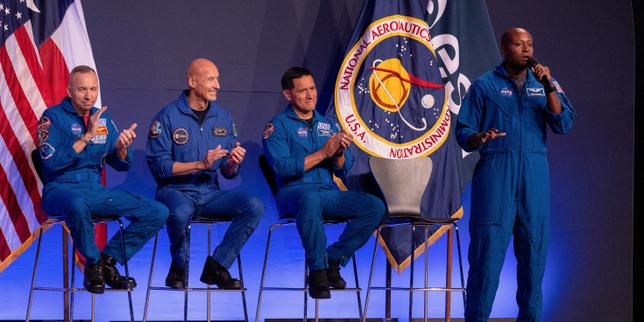
NASA just introduced the four astronauts for the highly anticipated Artemis 3 mission, and the internet immediately lost its mind.
The moment Randy Bresnik, Luca Parmitano, Frank Rubio, and Andre Douglas walked onto the stage at the Johnson Space Center, a loud faction of space enthusiasts on social media shifted from celebration to outrage. The core of their anger? The roster is entirely male.
For an agency that has spent years heavily promoting diversity and promising that the Artemis program would land the first woman on the Moon, this selection feels like a step backward to a lot of people. Especially coming off the massive success of Artemis 2 in April, where Christina Koch made history by looping around the Moon.
But if you look past the initial knee-jerk reaction, you realize this outrage misses the point.
NASA Administrator Jared Isaacman had to step up to defend the agency's choices. He pointed out that crew selection isn't a game of checking demographic boxes. It's about putting the absolute best team together to survive an incredibly dangerous, complex flight test. When you break down the logistics, the timeline, and the intense technical demands of this specific mission, you see that this all-male lineup isn't a snub against women. It's the logical result of hard operational realities.
The Harsh Logistics Behind the Flight Rotation
Spaceflight operates on a brutal, inflexible rotation schedule. You can't just pick your favorite astronauts out of a hat and put them on a rocket.
Training for a specific mission takes years. Right now, a huge chunk of NASA’s elite female astronauts are completely tied up. They’re either currently living aboard the International Space Station (ISS), recently returned and going through intense physical rehabilitation, or deep in the pipeline for upcoming long-duration ISS expeditions. They simply aren't logistically available for a 2027 launch window.
Then there is the issue of the talent pipeline itself. The current active US astronaut corps sits at roughly a 60-40 split between men and women. That sounds balanced enough until you look at the specialized roles required for a brand-new flight test.
Artemis 3 requires a Commander and a Pilot who possess elite, high-performance military test pilot backgrounds. This is where the math stops favoring representation.
If you look at the pool of astronauts qualified to sit in those two specific flight seats, the numbers skew roughly 80% male. Why? Because the military test pilot community, which feeds into NASA's pilot track, remains overwhelmingly male. Decades of historic barriers mean the pool of senior, hyper-experienced female test pilots with thousands of hours in supersonic jets is incredibly small.
You don't fix systemic military pipeline issues by lowering your flight requirements for a high-risk space mission. You take the people who have the hours.
This Isn't the Moon Landing You Were Expecting
A lot of the public anger stems from a massive misconception about what Artemis 3 actually is.
Originally, Artemis 3 was supposed to be the historic return to the lunar surface. But following a major program restructuring earlier this year, NASA changed the flight plan. The crew isn't going to the Moon. They aren't landing anywhere.
Instead, Artemis 3 is a two-week shakedown cruise in low-Earth orbit. The mission is designed to test hyper-complex docking procedures with two wildly different commercial lunar landers: SpaceX's Starship and Blue Origin's Blue Moon Mark II.
[Image diagram of the Orion spacecraft docking with a lunar lander in low-Earth orbit]
This change in scope dramatically altered the criteria for who should fly. NASA needs a crew that can handle extreme, unexpected orbital anomalies while testing unproven hardware from private vendors. They went with raw, battle-tested space flight experience.
Look at who is sitting in those seats:
- Randy Bresnik (Commander): A 58-year-old retired Marine Colonel, TOPGUN graduate, and veteran of both the Space Shuttle and the ISS with over 7,000 flight hours.
- Frank Rubio (Mission Specialist): An Army Black Hawk pilot and physician who holds the absolute American record for the longest single spaceflight—371 consecutive days in orbit.
- Luca Parmitano (Pilot): A legendary European Space Agency astronaut and Italian Air Force Colonel who has commanded the ISS and led some of the most complex spacewalks in history.
- Andre Douglas (Mission Specialist): The "rookie" of the group at 40 years old, but a brilliant systems engineer and Coast Guard reserve officer who literally just served as the prime backup crew member for Artemis 2.
This team isn't a political statement. It is a squad of elite mechanics and test operators chosen to break in a highly volatile piece of new machinery.
High Stakes and Volatile Hardware
If you want to know why NASA prioritized raw experience over a perfect public relations image, look no further than what happened on the launchpad on May 28.
An uncrewed Blue Origin New Glenn rocket exploded during a static fire test in Florida. The blast tore through the pad, illuminated the night sky with a massive orange fireball, and sent shockwaves through the entire space industry. That exact rocket architecture is what is supposed to carry the Blue Moon lander into space for the Artemis 3 mission.
While NASA and Blue Origin officials have publically maintained confidence that the timeline will hold for a 2027 launch, the anomaly highlights a sobering truth: this tech is experimental, and it is dangerous.
The Artemis 3 crew will be flying an Orion capsule into orbit, waiting for a SpaceX Starship and a Blue Origin lander to meet them, and conducting highly choreographed docking maneuvers. They have to figure out how these vastly different hardware interfaces, life support elements, and software systems play together in a vacuum. If a valve freezes, a docking latch jams, or a private vendor's software glitches out, you don't want a crew selected for their demographic value. You want the guy who lived in space for a year straight and the pilot who has survived thousands of hours in failing military aircraft.
Spaceflight is an unforgiving environment where physics doesn't care about social progress. Inclusion is a vital goal for the agency's long-term health, but mission success and crew survival come first.
The Playbook for Future Lunar Missions
An all-male crew on Artemis 3 doesn't mean women are being locked out of the deep space program. It actually sets them up for a much bigger stage.
By using this highly experienced crew to iron out the dangerous technical kinks of the SpaceX and Blue Origin landers in low-Earth orbit, NASA minimizes the variables for the next phase. Artemis 4, currently slated for 2028, will be the actual historic mission that returns humans to the lunar surface for a touchdown.
The strategy here is pretty clear:
- Isolate the tech risks: Use the senior test pilots on Artemis 3 to prove the hardware works safely near Earth.
- Clear the path: Once the docking and landing systems are certified by the test crew, the operational risk drops significantly.
- Build the future: This opens the door wide for younger, highly capable female astronauts currently gaining valuable experience on the ISS to claim their seats on Artemis 4, 5, and the permanent moon bases to follow.
If you're upset about the lack of immediate representation on this specific flight, look at the broader landscape. Jared Isaacman noted that nearly half of NASA's mission directorate leaders are women, and the most recent astronaut candidate classes have leaned heavily female based entirely on merit. The pipeline is changing rapidly.
If you want to track the real progress of the Artemis program, stop treating every individual crew announcement like a corporate branding exercise. Focus on the engineering. Support the men who are putting their lives on the line to test this volatile hardware next year. Their success is the only thing that guarantees a woman will actually step onto the lunar surface in 2028.