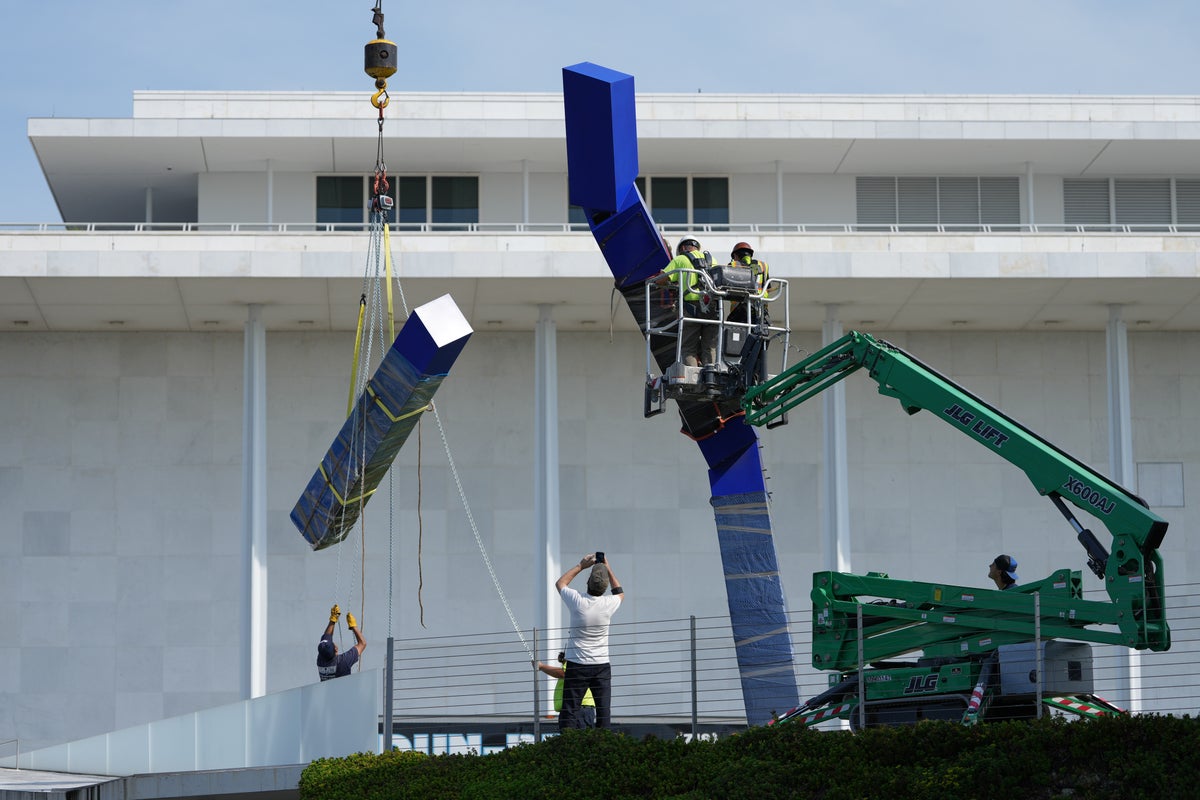
Power in Washington is rarely exercised through policy alone. Often, it finds expression in the symbolic scrubbing of a predecessor's footprint, followed immediately by the petty acquisition of the debris. When the Trump-aligned board at the John F. Kennedy Center for the Performing Arts ordered the physical dismantling of Joel Shapiro's iconic installation, Blue, they intended to signal a complete ideological purge. Instead, they inadvertently triggered a high-stakes game of cultural chess. David Rubenstein, the billionaire philanthropist and former Kennedy Center chairman who was unceremoniously ousted by the administration, stepped in and purchased the displaced piece.
This transaction is much more than a routine art acquisition. It represents a bitter turf war over the aesthetic identity of the nation's capital, pitting discarded institutional leadership against a White House determined to bend public spaces to its exact specifications.
The Anatomy of a Removal
The physical dismantling of Blue on September 2, 2026, did not happen in a vacuum. For months, the transformed leadership board under the second Trump administration has sought to stamp its ownership onto the cultural landmark, pushing controversial architectural overhauls, battling in federal courts over naming rights, and threatening structural shutdowns if legal roadblocks persist.
Shapiro’s minimalist, vibrant blue stick figure—poised in mid-stride outside The REACH expansion since 2019—was an inviting landmark for millions of visitors. To the incoming administration loyalists, however, it represented the old guard. It stood for an institutional ethos they were explicitly mandated to dismantle. The crane operators wrapping the sculpture's arms and legs in protective material were performing an act of bureaucratic cleansing.
Public reaction was swift and furious. Advocacy groups like Hands Off the Arts converged on the site, documenting what they characterized as the cultural vandalism of public art. Yet, while protestors shouted slogans from the perimeter, the structural chess board was moving behind closed doors. Rubenstein, whose tenure as chairman was cut short by presidential fiat during the governance reshuffle, possessed both the capital and the motivation to respond.
Philanthropy as Counter-Governance
David Rubenstein is no ordinary art collector. As a co-founder of the Carlyle Group and a prolific mega-donor who has spent decades using his vast personal fortune to rescue historical documents and anchor cultural institutions, he understands the soft power of preservation. Ousting him from the Kennedy Center was meant to silence a institutional power center. Buying Blue was Rubenstein's masterclass in quiet defiance.
By stepping in to acquire the sculpture through coordination with the Joel Shapiro and Ellen Phelan Foundation, Rubenstein effectively short-circuited the administration's narrative. The regime wanted Blue gone because it belonged to an era they rejected. Now, that exact piece of public animus lives on, rescued by the very man the administration threw out.
This maneuver exposes a fundamental vulnerability in political takeovers of cultural spaces. Authoritarian impulses can easily dictate who controls a specific piece of federal real estate, but they cannot legislate private ownership or control the secondary market of high-end contemporary art. When a government attempts to rewrite cultural history by hauling away bronze and aluminum stick figures, it creates an immediate vacuum that well-resourced adversaries are more than happy to fill.
The Broader Battlefield
The fate of a single blue sculpture cannot be separated from the broader architectural and cultural campaign currently reshaping Washington, D.C. The administration's plans extend far beyond the Kennedy Center stage. Proposals to demolish portions of the White House complex for grand ballrooms, construct triumphal arches near military cemeteries, and scrub institutional names clean are all cut from the same cloth.
In this environment, art ceases to be merely decorative. It becomes a proxy war. Every statue removed, every gallery renovated, and every plaque altered serves as a billboard for political dominance. The Kennedy Center board's ongoing legal threats—including arguments that donations will dry up unless the president's name is permanently emblazoned across the facade—illustrate an institution weaponized for personal branding.
When public institutions abandon their traditional role as neutral stewards of culture, they invite institutional rot. Donors pull back. Boards fracture along partisan lines. The public loses trust. Rubenstein’s purchase of Blue highlights the privatization of resistance. When the government abdicates its responsibility to protect shared cultural touchstones, wealthy patrons step into the breach, turning private living rooms and foundations into safehouses for politically inconvenient art.
The Cost of Cultural Polarization
We are watching the erosion of a post-partisan consensus that once shielded American cultural institutions from the worst impulses of shifting political tides. For decades, the Kennedy Center functioned under a fragile détente, where high art was treated as a public good transcending the occupant of the Oval Office. That détente is dead.
The removal of Shapiro's work and its subsequent rescue by an ousted chairman signal a darker phase for public spaces in the capital. It tells us that nothing is permanent, that history is subject to executive order, and that every monument or modern sculpture is vulnerable to the shifting winds of political retaliation.
Blue will find a new home, far away from the Potomac shoreline where it welcomed dancers and theatergoers for seven years. But the empty plinth left behind at the Kennedy Center remains a monument to a much larger loss. It stands as concrete proof that the institutions designed to elevate our national discourse have themselves become prisoners of our deepest divisions.