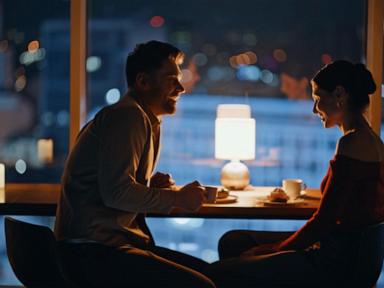
The screen glows in the dark room, casting a faint blue tint across the ceiling. Thumb hovers over glass. For weeks, the relationship has existed in the quiet spaces between heart emojis and late-night voice notes, a fragile secret shared only with the algorithms. Then comes the moment of exposure. A hand resting on a knee. A pair of coffee cups on a wooden table. A shadow stretching across a sidewalk.
It is the modern ritual of the soft launch. For a deeper dive into similar topics, we recommend: this related article.
We live in an era where announcing a new romance no longer requires a formal introduction or a status change. Instead, it demands a breadcrumb trail. A blurred silhouette, an ambiguous reflection in a subway window, a sliver of a shoulder. It is an invitation for the digital crowd to lean in, squint, and whisper. Who is that?
And now, the machinery behind our feeds has learned how to play the game. To get more context on this issue, detailed analysis can be read at Ars Technica.
Instagram’s latest feature additions to how we share and hint at our lives do not just document relationships; they orchestrate them. They add a calculating twist to an already delicate dance. To understand why this shift matters, we have to look past the pixels and examine the heavy psychological architecture of modern affection.
Consider Maya and Leo. They have been dating for four months. They are past the stomach-drop phase of the first text, but not quite ready for the permanence of a grid post tagged with full names and anniversary dates. Maya wants to share her happiness, but she fears the microscope of public scrutiny. Too early, and it looks desperate. Too late, and it feels like hiding.
So she posts a story. Just a corner of a jacket. Just a laugh captured off-camera.
In the past, this was purely organic anxiety at play. Now, artificial intelligence steps into the editing bay. Features designed to automatically optimize, crop, or even suggest contextual framing turn accidental intimacy into a curated production. The software detects faces, adjusts lighting, and recommends filters that amplify the mysterious ambiance. The algorithm does not just distribute the image; it refines the vagueness. It helps you say just enough to start a rumor while retaining plausible deniability.
This is where the human element fractures.
When technology assists in staging our vulnerability, vulnerability ceases to be vulnerable. It becomes a performance. We begin to look at our partners not simply as companions in a quiet room, but as aesthetic variables in a public broadcast. Does this angle show enough of his jawline to prove I am dating someone interesting? Does this background look upscale enough?
Behavioral patterns show that human beings crave validation through communal witness. We want our joys to be seen. Anthropologists remind us that relationships have always had a public component—from village square announcements to wedding receptions. The digital space is merely our modern village square. But the village square did not have an artificial intelligence whispering optimization tips into the ear of the bride before she walked out.
The invisible stakes are staggering.
When an algorithm optimizes your soft launch, it feeds on engagement. Clicks, replies, speculative DMs. The system rewards ambiguity because ambiguity drives comments. Every time a friend asks, "Wait, whose arm is that?", the platform registers a spike in attention. We trade the sacred awkwardness of real intimacy for a measurable metric of intrigue.
Think back to the last time you shared something real. It probably was not lit by a ring light. It probably did not feature a smart-cropped shadow. It was messy. It was out of focus.
The danger of letting artificial intelligence touch our relational milestones is that we start prioritizing the reaction over the reality. We spend more energy crafting the illusion of a spontaneous life than actually living it. The soft launch becomes less about protecting a budding romance from external pressure and more about building suspense for an audience that cares more about the plot twist than our actual happiness.
Yet, we cannot entirely blame the software. The software only mirrors our deepest insecurities. We are terrified of rejection, terrified of looking foolish, and equally terrified of going unnoticed. We want to be found, but we want to map out the escape route before we open the door.
Imagine what happens when the breadcrumbs become so sophisticated that no one ever has to be brave again. When every hesitation is smoothed over by a predictive tool. When every hint is polished to a cinematic sheen. We lose the grit. We lose the nervous sweat of pressing post on a photo that might get ignored. We lose the raw, unpolished truth of two people stumbling blindly toward each other through the static.
The quiet rise of algorithmic romance forces a reckoning.
We have to ask ourselves what we are actually building on these screens. Are we chronicling our lives, or are we auditioning for an audience of strangers?
Next time the blue light illuminates the dark room, and the temptation arises to post that clever, perfectly cropped fragment of a life half-shared, pause. Look at the person sitting across from you. Notice the way the light actually hits their face, without a filter, without an automated crop, without a single line of code deciding how much of them the world deserves to see.
Some things are worth keeping off the feed entirely. Not because they are secrets, but because they are too heavy for an algorithm to carry.