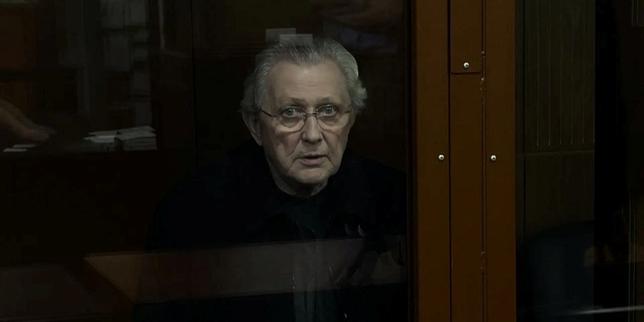
The rules of survival in Russia just changed completely. For decades, it seemed like some guys were simply untouchable because they knew where the bodies were buried from the wild 1990s in Saint Petersburg. Ilya Traber was exactly that kind of guy. Known in the criminal underworld as "The Antiquary," he isn't just another wealthy port tycoon. He is widely considered the only living crime boss whose acquaintance Vladimir Putin openly acknowledged.
Yet, on June 17, 2026, the Federal Security Service (FSB) smashed through that aura of invincibility. Elite officers swept through Traber's sprawling mansion in the Leningrad region, raided his offices on Starorusskaya Street, and dragged the 75-year-old billionaire off to a detention facility. Within hours, Moscow's Basmanny District Court slapped him with a two-month pre-trial detention order.
The official reason given by authorities sounds like a classic mob thriller: organizers tie him to the brutal October 2020 sniper assassination of Alexander Petrov, a local municipal deputy who was once Traber's right-hand man and the "shadow owner" of the border town of Vyborg. But anyone who understands how the Kremlin operates knows that a cold case from 2020 doesn't suddenly spring to life with central FSB backing unless the political winds have shifted.
The Port, the Mafia, and the Four Percent Kickback
To understand why Traber's fall is sending shockwaves through the Russian elite, you have to go back to the collapse of the Soviet Union. Traber was a former Soviet Navy submarine lieutenant who reinvented himself in Leningrad. He started out working at a beer bar before securing a lucrative monopoly on the city's antiques trade in 1991, courtesy of then-Mayor Anatoly Sobchak.
That antiques business gave him his nickname, but his real wealth came when he moved into the logistics sector and heavy infrastructure. During the cutthroat privatization wars of the 1990s, Traber aligned himself with the feared Tambov criminal syndicate. Together, they seized control of the Port of Saint Petersburg, an indispensable maritime gateway for both legal trade and massive contraband operations.
"Traber served as the crucial, quiet intermediary between the criminal underworld and the St. Petersburg mayor's office."
The man handling foreign economic relations for the mayor's office at the time was Vladimir Putin. The two men formed a highly functional, symbiotic relationship. When the Tambov gang wanted control of the oil supply terminal at Pulkovo Airport in 1996, it was Deputy Mayor Putin who signed the necessary paperwork to lease the complex to a company called Sovex, which was controlled by Traber and his partners.
Insiders from that era haven't minced words about how business was conducted. Maxim Freidzon, a former business partner who later fled Russia, revealed in a series of high-profile investigative reports that Putin allegedly negotiated directly over the financial terms of these arrangements. According to Freidzon, the future president originally demanded a 15% kickback on the airport oil revenues but ultimately settled for a 4% cut of the profits.
Traber reciprocated by taking care of the Kremlin's rising star. When Putin needed a reliable corporate bureaucrat to run the newly consolidated port operations, Traber obliged by appointing a young protégé named Alexei Miller. Today, Miller runs Gazprom, Russia's state-owned natural gas monopoly. The connections run even deeper: Traber's business network historically included individuals like Nikolai Shamalov, whose son Kirill would eventually marry Putin's daughter, Katerina Tikhonova.
Surviving the Spanish Dragnets
What made Traber unique among the old-school St. Petersburg bosses was his ability to navigate both the Russian state and Western financial systems without losing his head. When his criminal peers started dropping dead or getting locked up in the late 1990s, Traber packed his bags for Western Europe.
He established deep roots in Spain, Switzerland, and Monaco. European investigators alleged that Traber built an intricate web of hundreds of shell companies designed to buy up luxury real estate, artificially inflate the prices through circular sales, and launder hundreds of millions of dollars for the Tambov-Malyshev syndicate and high-ranking officials back in Moscow.
When Spanish anti-corruption prosecutors launched Operation Troika in the late 2000s, targeting the upper echelons of the Russian mafia, Traber's name was at the top of the international wanted lists. He eventually fled back to the safety of Russia in 2016 to avoid an Interpol warrant. Astonishingly, by 2018, a Spanish court acquitted the remaining defendants in the sprawling case, citing a lack of definitive evidence connecting the corporate structures to specific money laundering activities.
Back home, Traber wasn't treated like a fugitive. He was treated like royalty. He claimed to be among the 40 richest entrepreneurs in the country, controlling critical stakes in the deep-water Baltic port of Primorsk—a massive project designed to handle up to 70 million metric tons of cargo annually. Kremlin spokesman Dmitry Peskov was even forced to publicly address their relationship, dryly characterizing it to journalists as purely "professional" meetings about an oil terminal project from the 1990s. Traber was so secure in his standing that he routinely sat in places of honor at Putin's private birthday celebrations.
The Real Motive Behind the 2026 Crackdown
If Traber was a protected piece of history, why pull him down now? The official indictment focuses heavily on the murder of Alexander Petrov, who was taken out by a single sniper bullet while standing in the yard of his cottage. Investigators claim they recently received new evidence pointing to a bitter financial feud between Traber and Petrov over the division of their business empires in the Leningrad region. Along with Traber, the FSB arrested his longtime business partner Vladimir Danilenko and a two-time Russian boxing champion, Alisultan Nadirbegov, who faces weapons trafficking and organized murder charges.
But the timing suggests a far more calculated purge within the Russian elite. Since the full-scale escalation of the war in Ukraine, Traber tried hard to demonstrate his loyalty to the modern war state. He even co-founded "The Leningrad Frontier," a prominent charitable foundation explicitly designed to raise funds and supply equipment for the military. The foundation pulled in millions of rubles, though independent journalists quickly discovered that a massive chunk of those donations suspiciously diverted into companies controlled by families close to Traber.
The reality of Russia in 2026 is that wartime economic pressures have created an acute shortage of resources, forcing the state to cannibalize its own oligarchs. We saw the warning signs in April 2025, when a Russian court abruptly seized 55% of the shares in the lucrative St. Petersburg Oil Terminal (PNT)—an asset Traber had historically influenced—and handed them over to the state following a bitter shareholder lawsuit.
When resources shrink, the Kremlin stops honoring old handshakes. Traber simply knows too much about the financial origins of the current regime, and his massive Baltic logistics assets are far too valuable to leave in the hands of an aging 1990s crime boss. By bringing him to Moscow under tight FSB guard, the state sends an unmistakable message to the remaining oligarchs: nobody's historical relationship with the president offers a permanent shield anymore.
If you are tracking Russian political stability or corporate risk, you need to watch what happens to Traber's remaining shares in the Primorsk port complex over the next few weeks. If those assets are swiftly nationalized or reassigned to state-backed entities like Rosneft or Gazprom, it confirms that the Kremlin is systematically stripping the old guard of their economic fiefdoms to fund the state apparatus. The era of the untouchable St. Petersburg middleman is officially dead.


