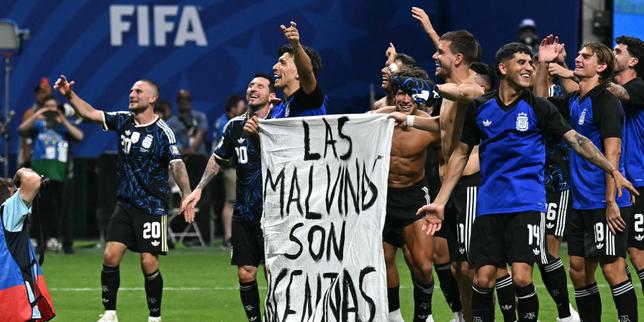
When Giovani Lo Celso and Nicolás Otamendi unfurled a banner reading "Las Malvinas son Argentinas" on the turf in Atlanta after beating England 2-1 in the World Cup semi-final, nobody was surprised. It's a phrase every Argentine learns in primary school. It's etched into the national psyche.
What happened next was just as predictable. Downstreet erupted. U.K. Business Secretary Peter Kyle went straight on the BBC to call it an "egregious violation" of sporting neutrality, while Prime Minister Keir Starmer backed demands for an immediate investigation. Within hours, FIFA launched formal disciplinary proceedings against the Argentine Football Association (AFA).
The U.K. wants blood, Argentina points to decades of political history, and FIFA gets to pretend it runs a pitch completely detached from global politics.
Let's cut through the official statements. The idea that you can stage a massive international match between England and Argentina, hand one team a victory on a global stage, and expect players to forget a 1982 war that killed over 900 people is pure fantasy. But the real story isn't just about a banner unfurled on the pitch. It's about how FIFA handles political speech when it suits them versus when it doesn't.
What FIFA Rules Actually Say About Political Banners
FIFA's Disciplinary Code doesn't leave much room for nuance. Article 11 strictly prohibits using sports events for "demonstrations of a non-sporting nature," explicitly banning political, ideological, or religious slogans.
If you bring a banner, a shirt, or even a wristband onto the field that carries a political message, you're breaking the rules. It doesn't matter if it's printed on a fan's flag or handed down from the stands. The moment a player displays it inside the stadium boundary, the national federation assumes financial and disciplinary liability.
Here is what the AFA is facing right now:
- Financial fines: Historical precedents for political slogans range from $20,000 to $40,000.
- Federation reprimands: Formal warnings that trigger stiffer penalties for repeated offenses.
- Individual player suspensions: Extremely rare for post-match banner displays, though technically within FIFA's sanction framework.
The expected outcome isn't a surprise. FIFA will almost certainly issue a fine to the AFA rather than suspending key players for the final. That's the standard playbook.
This Happened Before and FIFA Handed Out a Slap on the Wrist
If this entire spectacle feels familiar, that's because we've seen this exact movie before.
Back in June 2014, just before the World Cup in Brazil, the Argentine national team lined up behind a nearly identical banner during a friendly against Slovenia in Buenos Aires. It read: "Las Malvinas Son Argentinas."
The U.K. protested then, too. FIFA opened an investigation, found the AFA guilty of breaching Article 60 of the Safety Regulations and Article 52 of the Disciplinary Code, and handed down a fine of 30,000 Swiss francs.
The AFA paid the check and moved on.
When the fine for a massive political statement costs less than a single corporate hospitality ticket, it isn't a deterrent. It's just a fee for doing business. Argentina's players knew what would happen when they took the banner from fans in Atlanta. They calculated that paying another small fine was a price worth paying to make their point in front of tens of millions of viewers.
The Double Standard of Neutrality on the Field
The U.K. government insists that politics and football must remain entirely separate. But FIFA’s enforced neutrality has never been applied consistently.
Look at the precedents over the past decade:
- Switzerland vs. Serbia (2018): Xherdan Shaqiri and Granit Xhaka celebrated goals by making the double-headed eagle gesture symbolising Albania. FIFA fined them 10,000 Swiss francs each, avoiding any match suspensions.
- South Korea vs. Japan (2012): Park Jong-woo held up a sign reading "Dokdo is our territory" after a bronze medal match. He received a two-match ban and a fine.
- Serbia Locker Room Banner (2022): Serbia hung a flag in their locker room showing Kosovo as part of Serbia. FIFA issued a fine of 20,000 Swiss francs.
- OneLove Armbands (2022): European nations planned to wear anti-discrimination armbands in Qatar. FIFA threatened immediate yellow cards at kickoff, forcing team captains to back down before a ball was even kicked.
When European teams wanted to wear armbands advocating human rights, FIFA threatened sporting sanctions. When South American or Balkan teams bring territorial disputes onto the pitch, FIFA settles it with a minor invoice.
This isn't strict enforcement; it's situational damage control.
Why the Falklands Issue Never Left the Pitch
For British observers, bringing up a 1982 territorial conflict after a semi-final victory seems bizarre and unsportsmanlike. For Argentines, it's virtually impossible to separate the two.
The 1982 Falklands War lasted 10 weeks and cost the lives of 649 Argentine personnel, 255 British service members, and three Falkland islanders. Four years later, Diego Maradona scored his "Hand of God" goal against England in Mexico City—a match he famously described in his autobiography as symbolic revenge for the young men killed in the South Atlantic.
That emotional connection hasn't faded for the current squad. Lisandro Martínez and Leandro Paredes both spoke openly after the semi-final win, framing their performance around national duty and honoring veterans.
"We knew we were playing for them, too," Paredes remarked when asked about the post-match banner.
When players view a fixture through that lens, no FIFA fine will stop them from using the moment to send a message back home.
What FIFA Must Do to Fix This Mess
If FIFA wants its rules on political neutrality to mean anything, it has to stop relying on financial slap-on-the-wrist penalties that federations treat as pocket change.
First, replace flat monetary fines with scale-based penalties linked to a federation's tournament earnings. A $30,000 fine means nothing to a country taking home tens of millions in prize money from a semi-final run.
Second, create a clear framework that distinguishes between fan-driven political displays and coordinated player actions. When players actively take a sign from the crowd and display it on the field of play, sporting consequences—like touchline bans or touchline restrictions for team staff—need to be on the table.
Until FIFA enforces its rules with actual consequences, expects players to keep bringing geopolitical grudges right onto the grass. The U.K. can demand all the investigations it wants, but as long as the penalty is just a small fine, Argentina won't stop holding up that banner.