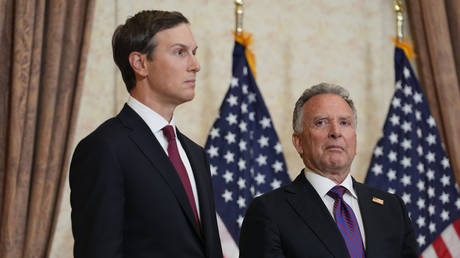
Moving diplomatic negotiations between the United States, Ukraine, and Russia to Abu Dhabi shifts the conflict from an attrition-based kinetic stalemate to a structured bargaining game governed by third-party mediation mechanics. Standard diplomatic reporting treats the venue selection and the confirmed attendance of a US official as mere logistical updates. That framing misses the underlying strategic calculus. The selection of the United Arab Emirates as a neutral ground, combined with the transition from bilateral backchannels to an explicit trilateral format, alters the incentive structures, information asymmetries, and domestic political costs for all three actors.
To understand what actually occurs when Washington, Kyiv, and Moscow sit at the same table in the Persian Gulf, analysts must strip away public posturing and examine the mechanics of multi-party conflict resolution. The success or failure of the Abu Dhabi summit depends entirely on how the participants manage three structural variables: venue-induced neutrality, the elimination of intermediary distortion, and the alignment of domestic survival thresholds with battlefield realities.
The Geopolitics of Venue Selection
Venue selection in high-stakes international negotiations is never incidental; it is a primary signaling mechanism that establishes the baseline power dynamics before a single word is spoken. Traditional European diplomatic hubs—such as Geneva, Vienna, or Brussels—carry institutional and legal baggage that instantly disqualifies them as neutral territory in the eyes of Moscow. European Union sanctions regimes, airspace closures, and International Criminal Court jurisdictions create physical and political friction that prevents Russian delegations from engaging without conceding symbolic ground.
Abu Dhabi solves this friction through a specific set of geopolitical attributes:
- Sanctions Non-Alignment: The United Arab Emirates maintains active financial, aviation, and trade links with Moscow while simultaneously operating as a major defense and intelligence partner for Washington. This dual-track alignment ensures that Russian officials can travel, secure communications, and operate without the threat of asset freezes or diplomatic isolation.
- Transactional Mediation Credibility: Unlike European states that frame foreign policy around normative values and alliance solidarity, Emirati statecraft operates on strict transactional pragmatism. Abu Dhabi has already demonstrated operational competence in this specific conflict by brokering multiple high-volume prisoner-of-war exchanges between Russia and Ukraine. Those exchanges built a baseline of procedural trust—proving the host can keep secrets, enforce protocol, and deliver narrow, verifiable outcomes.
- Information Containment: The UAE’s domestic media environment and tight state security apparatus allow the host to enforce strict information blackouts. In Western capitals, leaks to the press are frequently used by domestic factions to sabotage nascent compromises before they harden into policy. Abu Dhabi offers a sealed environment where negotiators can test concessions without immediate domestic political blowback.
The limitation of the Emirati venue lies in its lack of coercive enforcement power. While Abu Dhabi can host the table and guarantee the physical security of the delegations, it possesses neither the military weight nor the economic control over the belligerents required to underwrite a lasting security guarantee. The UAE provides the container for the negotiation, not the structural steel that holds an agreement together.
The Structural Shift from Bilateral to Trilateral Mechanics
For the majority of the conflict, diplomatic signaling operated through fragmented bilateral channels. Washington communicated with Kyiv to coordinate aid and strategic boundaries; Washington occasionally engaged Moscow through intelligence or deconfliction channels to manage escalation risks; and Kyiv and Moscow communicated strictly through tactical intermediaries on narrow humanitarian issues. A formal trilateral meeting collapses these separate tracks into a single room, fundamentally changing the game theory of the interaction.
In a bilateral setup, the intermediary—in this case, the United States—retains complete control over information flow. Washington could theoretically soften Ukrainian demands when speaking to Moscow, or downplay Russian red lines when briefing Kyiv, in order to keep a dialogue alive. Moving to a trilateral format eliminates this intermediary filtering. Every party hears the exact phrasing, tone, and conditionalities of the other two simultaneously.
This structural shift produces two immediate operational consequences:
- Reduction of Principal-Agent Distortion: When Kyiv and Moscow hear Washington’s position directly in front of each other, the room for misinterpretation shrinks. Moscow can no longer rely on the assumption that Washington will unilaterally force Kyiv into a settlement behind closed doors. Conversely, Kyiv observes the exact limits of American diplomatic leverage over Moscow in real time, forcing Ukrainian planners to calibrate their expectations against actual US commitments rather than rhetorical support.
- Creation of the Three-Body Bargaining Dilemma: In a two-party negotiation, a concession by Party A is a direct gain for Party B. In a trilateral negotiation, every concession alters the bilateral balance between the remaining two pairs. If Washington signals willingness to discuss sanctions relief with Moscow, it immediately triggers defensive reactions from Kyiv regarding security guarantees. If Kyiv demands specific military aid thresholds from Washington as a precondition for territorial compromises, Moscow adjusts its baseline demands upward to offset the perceived strengthening of the US-Ukraine axis.
Because of this three-body dynamic, trilateral talks rarely produce sweeping, comprehensive peace treaties in their initial stages. The complexity of aligning three distinct utility functions simultaneously creates too many veto points. Instead, trilateral formats are structurally optimized for sequenced, conditional de-escalation—where Party A takes a verifiable step, Party B reciprocates, and Party C verifies and underwrites the transaction.
Known Facts Versus Strategic Hypotheses
Rigorous analysis requires a hard boundary between verified operational facts and analytical projections. Conflating the two leads to severe miscalculations regarding the timeline and scope of potential outcomes in Abu Dhabi.
Verified Baseline Facts
- Confirmed Participation: A US official has explicitly confirmed that the United States will hold trilateral talks involving both Ukraine and Russia in Abu Dhabi next week. This confirms the elevation of the diplomatic track from covert intelligence contacts to acknowledged state-level engagement.
- Venue Precedent: The UAE has successfully mediated multiple bilateral prisoner swaps between Russia and Ukraine over the preceding months, establishing an active, functioning diplomatic infrastructure in Abu Dhabi capable of handling sensitive Russian and Ukrainian delegations.
- Asymmetric Dependencies: Ukraine remains structurally dependent on US financial, intelligence, and military assistance to sustain high-intensity combat operations. Russia remains dependent on sanctions circumvention networks, domestic industrial mobilization, and the preservation of its occupied land bridge to Crimea to justify the domestic cost of the war.
Analytical Hypotheses
- The Agenda Hypothesis: Given the compressed timeline and the public confirmation of the meeting, the initial session in Abu Dhabi is unlikely to resolve core sovereignty disputes. The primary agenda almost certainly centers on establishing a framework for freeze conditions—specifically targeting critical infrastructure strikes (energy grids and maritime export corridors) where both sides face severe, asymmetric economic pain.
- The US Leverage Hypothesis: Washington’s decision to formalize trilateral talks indicates a strategic pivot toward locking in a manageable equilibrium. The hypothesis is that US policymakers have calculated that the marginal utility of continued high-intensity attrition is declining for both Kyiv and Washington, and that an active diplomatic track is required to prevent an uncontrolled escalation or a sudden collapse of Ukrainian defensive lines.
- The Russian Delay Hypothesis: Moscow’s agreement to attend does not automatically signal a readiness to concede territory. A competing hypothesis is that Russia is utilizing the Abu Dhabi venue to buy operational time, test the cohesion between Washington and Kyiv, and extract incremental sanctions relief or diplomatic normalization without altering its maximalist political objectives.
The Incentive Matrices of the Three Delegations
Every delegation arriving in Abu Dhabi operates under a strict internal cost function. An agreement is mathematically impossible unless the proposed terms score higher than the Best Alternative to a Negotiated Agreement (BATNA) for all three capitals simultaneously.
The United States Utility Function
Washington’s primary objective is strategic stabilization and resource reallocation. Sustaining a high-intensity proxy conflict in Eastern Europe consumes finite air defense interceptors, artillery stockpiles, and executive bandwidth required for competition in the Indo-Pacific and crisis management in the Middle East.
- The Gain: A durable ceasefire or a structured freeze reduces the immediate financial and material drain on US stockpiles while preventing a catastrophic Ukrainian defeat that would damage American alliance credibility globally.
- The Constraint: Washington cannot be seen as capitulating to Russian aggression or abandoning a democratic partner. Any framework emerging from Abu Dhabi must allow the US administration to frame the outcome as a successful defense of Ukrainian statehood and a containment of Russian expansion, even if territorial realities remain unresolved on the ground.
Ukraine’s Survival Calculus
Kyiv faces an existential equation where territorial integrity, demographic survival, and long-term security guarantees are pitted against immediate battlefield attrition.
- The Gain: Entering trilateral talks with the US physically present at the table ensures that Ukraine is not partitioned in absentia. Kyiv’s primary goal is to trade any temporary cessation of kinetic hostilities for binding, multi-year Western security commitments, air defense integration, and reconstruction capital.
- The Constraint: Domestic political legitimacy in Ukraine is tightly bound to the defense of sovereign territory. A formal legal recognition of Russian annexation is a non-starter for any Ukrainian leadership, as it would trigger severe internal political instability. Therefore, Kyiv must pursue a distinction between de facto operational control along a ceasefire line and de jure legal sovereignty.
Russia’s Imperial and Economic Equation
Moscow evaluates the Abu Dhabi talks through the lens of regime security, economic endurance, and geopolitical status.
- The Gain: Sitting as an equal alongside the United States in a high-profile trilateral forum breaks the Western diplomatic isolation strategy. Beyond status, Moscow seeks the formalization of its territorial gains in southern and eastern Ukraine, the permanent exclusion of Ukraine from NATO, and the dismantling of key financial and technological sanctions regimes.
- The Constraint: The Russian economy has been heavily reoriented toward military production. A sudden cessation of hostilities without a clear narrative of victory creates domestic economic shockwaves as defense spending contracts and mobilized personnel return home. Furthermore, Moscow views any Western security guarantee for Ukraine as a future threat, meaning Russia will attempt to insert strict caps on the size and capability of the post-conflict Ukrainian military.
Operational Bottlenecks and Failure Modes
Even if all three delegations enter Abu Dhabi with genuine intent to reduce hostilities, the mechanics of modern warfare create severe verification and enforcement bottlenecks. History demonstrates that ceasefires fail most frequently not over grand political principles, but over tactical ambiguities on the front lines.
The first bottleneck is Verification Asymmetry. A 1,000-kilometer front line saturated with low-cost first-person-view (FPV) drones, electronic warfare systems, and decentralized artillery units cannot be monitored by traditional, small-footprint international observer missions. If a drone strike occurs in a contested sector during a fragile truce, attributing responsibility becomes technically difficult. Without an automated, satellite-and-sensor-backed verification mechanism agreed upon by Washington, Kyiv, and Moscow, local skirmishes will rapidly escalate back into full-scale engagements.
The second bottleneck is The Sequencing Trap. Moscow demands sanctions relief and limits on Western arms deliveries to Ukraine before or simultaneously with a troop freeze. Kyiv and Washington demand verifiable Russian compliance with a ceasefire and troop pullbacks before lifting economic restrictions. In international relations, simultaneous concessions are notoriously unstable because the party that moves second retains the option to defect after pocketing the first party's concession. Overcoming this requires an escrow mechanism—such as holding frozen Russian sovereign assets or phased sanctions waivers in neutral jurisdictions—that automatically triggers or reverses based on satellite-verified compliance metrics.
The third failure mode is Spoiler Dynamics. Hardline factions within Moscow, nationalist elements within Kyiv, and allied governments in Europe that feel excluded from the Abu Dhabi format all possess the capacity to disrupt the process. If European states refuse to align their sanctions policies with a US-brokered framework, Moscow will view American promises of economic relief as hollow, collapsing the entire incentive structure.
Strategic Execution for the Abu Dhabi Summit
To prevent the Abu Dhabi meeting from degenerating into a sterile exchange of maximalist talking points, the delegations must abandon the pursuit of a comprehensive peace treaty and execute a compartmentalized, functional de-escalation strategy.
The immediate play for Washington and Kyiv is to anchor the first round of talks strictly to a Reciprocal Infrastructure and Maritime Moratorium. Both Russia and Ukraine suffer severe, measurable economic degradation from long-range strikes on energy generation facilities and commercial shipping infrastructure in the Black Sea. A narrowly defined moratorium on deep-strike drone and missile attacks against energy grids and port facilities offers immediate, tangible relief to both populations, requires minimal territorial concessions, and is easily verifiable via existing US and Russian space-based infrared and radar assets.
By isolating infrastructure protection from the intractable question of legal borders, the trilateral format can establish a functional proof of concept. Once the verification protocols and communication hotlines between Washington, Kyiv, and Moscow are tested and proven reliable under a limited moratorium, those exact same institutional mechanisms can be expanded to govern a localized, sector-by-sector freeze along the ground line of contact. Attempting to solve sovereignty before proving verification will guarantee diplomatic failure in Abu Dhabi; sequencing verification first creates the only viable path toward sustained conflict containment.