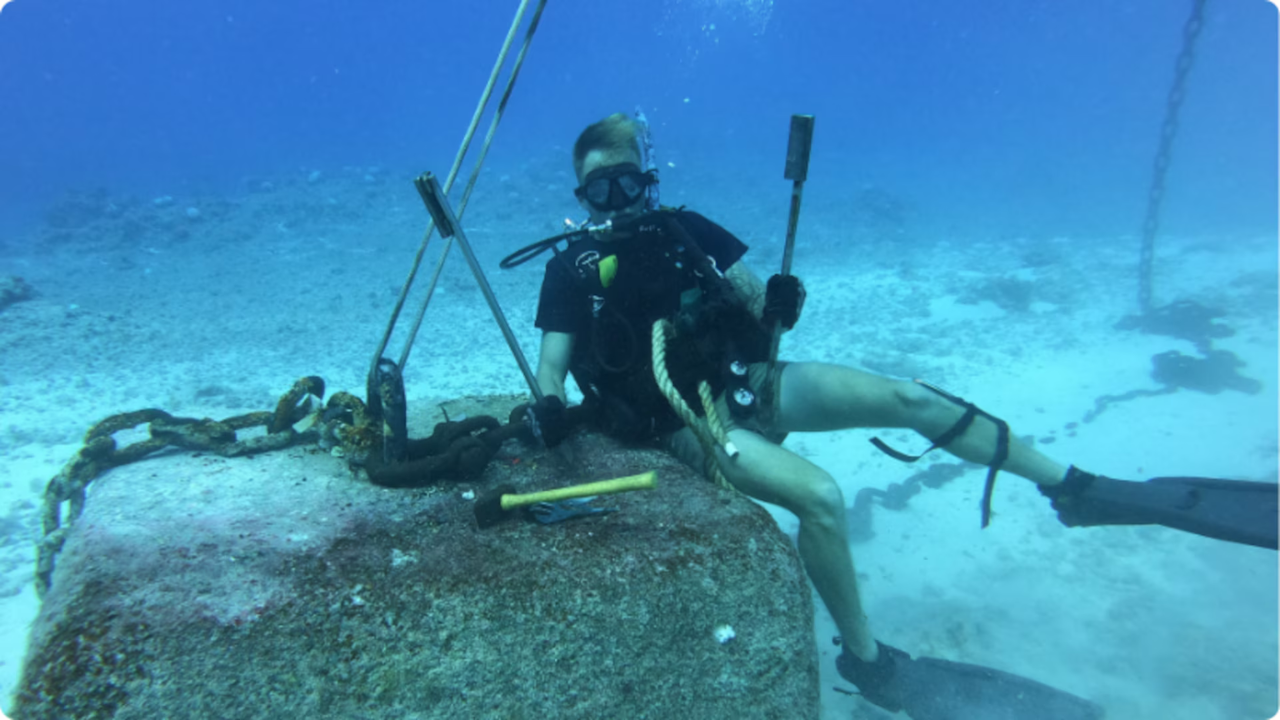
The operational matrix of military diving prioritizes safety, risk mitigation, and systemic redundancy over raw physical performance. When Senior Chief Petty Officer Thomas Hansen graduated from the United States Navy Master Diver course at the Naval Diving and Salvage Training Center (NDSTC) in Panama City, Florida, the achievement was widely framed as a milestone for the United States Coast Guard (USCG) Diver (DV) rating. However, viewing this solely through the lens of institutional history obscures the rigorous mechanics of the training itself. The Master Diver qualification represents the absolute peak of subsurface operational management, transitioning an operator from executing technical tasks to managing hyperbaric risks, complex salvage mathematics, and high-stress command environments.
Understanding this milestone requires analyzing the structural barriers, the human capital architecture, and the cognitive stress models built into the military's most demanding underwater curriculum.
The Structural Evolution of the Coast Guard Diver Rating
To understand how a USCG asset reached this tier of qualification, one must analyze the institutional framework of the Coast Guard's subsurface program. Established formally in 2015, the DV rating is one of the smallest and most highly specialized communities within the service, numbering fewer than 100 active-duty personnel.
Historically, the USCG relied on a collateral-duty model where machinery technicians or marine science technicians performed subsurface tasks—such as repairing Aids-to-Navigation (AtoN) buoys or inspecting hulls—alongside their primary ratings. This structure limited specialized technical depth. The establishment of a dedicated DV rate shifted the paradigm toward specialized human capital.
[Collateral Duty Model (Pre-2015)] -> Broad focus, limited depth, high variable risk
[Dedicated DV Rating (Post-2015)]  -> Deep specialization, formalized pipeline, managed risk
The progression profile of a military diver follows a rigid, tier-based structure across three distinct operational phases:
- Second-Class Diver (Initial Qualification): Focuses entirely on task execution, physical adaptation to hyperbaric environments, and basic underwater tools.
- First-Class Diver (Advanced Operations): Introduces basic dive-site management, complex underwater repair mechanics, and hyperbaric chamber operations.
- Master Diver (Command and Supervision): The peak tier. A Master Diver does not typically enter the water to execute tactical tasks. Instead, they function as the ultimate technical authority, supervising complex deep-sea salvage, mixed-gas operations, and emergency recompression protocols.
While USCG personnel routinely completed Second-Class and First-Class schools alongside Navy personnel, a structural bottleneck existed at the Master Diver level. Earning this qualification required Hansen to systematically clear prerequisite operational milestones, eventually securing the role of Dive School Chief to interface directly with the Navy's primary instructional cadre.
The Master Diver Evaluative Framework
The Navy Master Diver course is not an endurance test; it is an evaluation of an operator's ability to maintain cognitive clarity under extreme psychological and physiological loads. The training architecture isolates and tests specific capabilities through a dual-phase assessment model.
Phase I: Cognitive and Theoretical Foundations
Before a candidate can even begin the practical curriculum, they must pass a grueling six-hour written examination. This phase filters out individuals who lack the deep technical acumen required to manage hyperbaric physics and engineering principles. The academic matrix evaluates candidates on several core variables:
- Hyperbaric Physics and Physiology: Calculating partial pressures of gases, gas consumption rates at depth, and the physiological impacts of nitrogen narcosis, oxygen toxicity, and decompression sickness.
- Decompression Methodology: Mastery of the U.S. Navy Diving Manual decompression tables, exceptional exposure profiles, and the mathematical modeling required to compute real-time deviations during omitted decompression emergencies.
- Salvage Engineering: Calculating underwater physics problems, including negative buoyancy, rigging mechanics, patch calculations for damaged hulls, and explosive calculations for subsurface demolition.
Phase II: The Stress-Inversion Model (Graded Week)
The true differentiator of the Master Diver curriculum is "Graded Week." This phase utilizes a stress-inversion framework where evaluators deliberately manipulate environmental predictability and feedback loops to test a candidate's psychological resilience.
During this phase, seven Navy Master Divers observe and grade the candidate as they run complex, multi-variable diving scenarios, such as a simulated catastrophic equipment failure paired with an unconscious diver at depth. The evaluators maintain total silence, offering zero real-time feedback, cues, or validation.
[Standard Training Protocol]   -> Action -> Direct Feedback -> Behavioral Adjustment
[Stress-Inversion Framework] -> Action -> Zero Feedback   -> Cognitive Ambiguity -> Internal Stabilization
This structural silence removes the external validation loop that human beings rely on to measure success. If a candidate internalizes this ambiguity, their decision-making degrades, leading to compounding errors. To pass, the candidate must possess absolute confidence in their operational calculus, managing the dive site purely against objective physics and established protocols rather than supervisor approval.
The Strategic Value of Cross-Service Interoperability
Hansen's integration into the Navy's highest tier of subsurface qualification solves a critical operational challenge for the Coast Guard: scaling internal training capability and expanding joint-force interoperability.
The USCG operates across a vast geographic envelope, from polar icebreaking missions in Antarctica to international aids-to-navigation maintenance in the deep Pacific. These missions are frequently conducted in austere environments with zero civilian support infrastructure. By embedding Navy-qualified Master Diver expertise directly within the USCG, the service gains several immediate strategic capabilities:
- Autonomous Hyperbaric Risk Management: The ability to independently field, maintain, and supervise advanced recompression chambers during deep-sea or remote diving operations.
- Standardized Salvage Capability: Aligning USCG subsurface recovery and port-security operations directly with Navy Fleet Salvage standards, ensuring seamless integration during joint maritime defense operations.
- Institutional Knowledge Transfer: Bridging the tactical gap within the USCG Diver School House. Hansen’s stated strategic goal is to formalize and streamline a direct qualification pathway for future Coast Guard personnel, accelerating the maturity of the DV rate.
Operational Limitations and Systemic Hurdles
Despite the success of this milestone, scaling this capability across the wider Coast Guard presents clear structural challenges. The primary bottleneck is the size of the DV community itself. With roughly 70 to 80 active-duty divers, dedicating personnel to a highly exclusive, five-week advanced pipeline—on top of the years of prerequisite operational experience required—creates a significant temporary strain on fleet readiness.
Furthermore, the physical and cognitive attrition rates at NDSTC remain incredibly high. The pipeline cannot simply be scaled by increasing candidate volume; it requires a highly selective vetting process at the lower echelons of the First-Class diver population.
The logical next step for USCG leadership is not merely celebrating a historical first, but structurally integrating this milestone into the service's force-generation model. This requires formalizing a permanent liaison pathway at NDSTC, updating the USCG Diving Manual to reflect advanced Master Diver supervisory frameworks, and allocating the necessary budget to procure the specialized mixed-gas and recompression infrastructure that a Master Diver is uniquely qualified to command.


