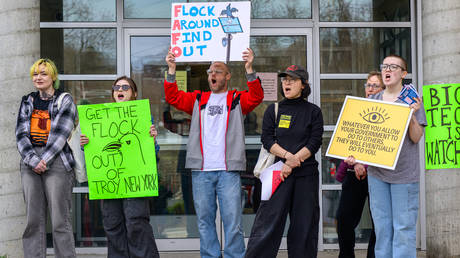
Municipal surveillance infrastructure expands not through sudden mandates, but via incremental procurement loops that couple automated license plate recognition hardware with local law enforcement data systems. When a citizen appeared at a San Diego City Council committee meeting dressed as Darth Vader to offer a satirical endorsement of the local camera network, the performance highlighted a core tension in modern civic administration: the friction between public safety optimization and systemic privacy erosion. Behind the theatrical framing lies a complex deployment of automated tracking technology that demands rigorous structural analysis rather than superficial commentary.
The Three Operational Layers of Automated License Plate Recognition
To understand how urban surveillance networks function, one must deconstruct their architecture into three distinct operational tiers. Each tier transforms raw physical movement into actionable, queryable intelligence for municipal authorities.
- Data Capture and Optical Character Recognition: Fixed optical sensors mounted on utility poles or police cruisers capture high-resolution imagery of passing vehicles. Edge-computing hardware processes these frames instantly, extracting alphanumeric license plate data alongside timestamps, GPS coordinates, and directional vectors.
- Centralized Aggregation and Cloud Storage: The captured telemetry does not remain local. It routes to cloud-hosted repositories managed by private vendors like Flock Safety. These databases ingest millions of records daily, cross-referencing incoming plates against dynamic "hot lists" of stolen vehicles, warrants, or custom police-generated alerts.
- Inter-Agency Data Sharing Protocols: The final layer involves network interoperability. Municipal databases link with state, regional, and federal repositories, permitting cross-jurisdictional querying. This allows law enforcement agencies outside San Diego to query local movement histories without localized judicial oversight or physical warrants.
This tripartite pipeline shifts the economics of policing. Traditional surveillance required targeted human observation, creating a natural bottleneck based on manpower constraints. Automated tracking removes that constraint, substituting human labor with passive, continuous data harvesting that catalogs the routine movements of entire populations.
The Cost Function of Urban Monitoring
Deploying hundreds of optical sensors across a municipality creates a complex economic and social equation. The utility function of this hardware is typically justified through crime reduction metrics, such as stolen vehicle recoveries and Amber Alerts resolved. However, evaluating the return on investment requires examining the hidden liabilities embedded in the system.
The primary variable in this cost function is systemic error. False positives generated by misread plates or outdated database entries carry severe downstream consequences. Documented cases involving automated plate readers feature innocent citizens detained at gunpoint or incarcerated due to administrative mismatches between scanned data and criminal databases. The marginal benefit of recovering a stolen vehicle must be weighed against the systemic cost of wrongful detentions and the erosion of civic trust.
A secondary variable involves administrative creep. Systems procured explicitly for high-priority criminal investigations frequently experience expanded utility over time. Investigative reporting across multiple jurisdictions has revealed instances where law enforcement personnel misused proprietary database access to track romantic partners, acquaintances, or individuals outside authorized criminal investigations. This vulnerability stems from inadequate internal auditing mechanisms, turning public safety infrastructure into a potential tool for personal surveillance.
Regulatory Response Mechanisms and Corporate Risk Mitigation
As municipal pushback intensifies—evidenced by grassroots mapping projects, contract cancellations in numerous municipalities, and public legislative theater—private surveillance vendors face mounting pressure to adjust their product architecture. Industry responses generally focus on tightening data retention parameters and introducing mandatory audit logging.
For instance, lowering default data retention windows from thirty days to seven days restricts the historical depth available for retroactive investigations. Similarly, requiring officers to input explicit case numbers before executing historical queries introduces accountability checkpoints. Yet, these adjustments represent mitigation rather than resolution. They constrain the symptoms of over-collection without altering the foundational design of continuous public tracking.
Legal challenges currently working through federal appellate courts focus on whether the aggregation of persistent location data violates Fourth Amendment protections against warrantless searches. While courts have historically upheld the collection of public-facing license plate data under the doctrine of plain view, the creation of a searchable, longitudinal archive of a citizen's daily movements challenges traditional legal definitions.
Municipalities expanding their optical sensor networks operate within a shifting legal and operational landscape. Future system viability will depend less on satirical public commentary and more on whether judicial rulings redefine passive public data collection as an unconstitutional search, forcing cities to re-evaluate the true cost of automated oversight.