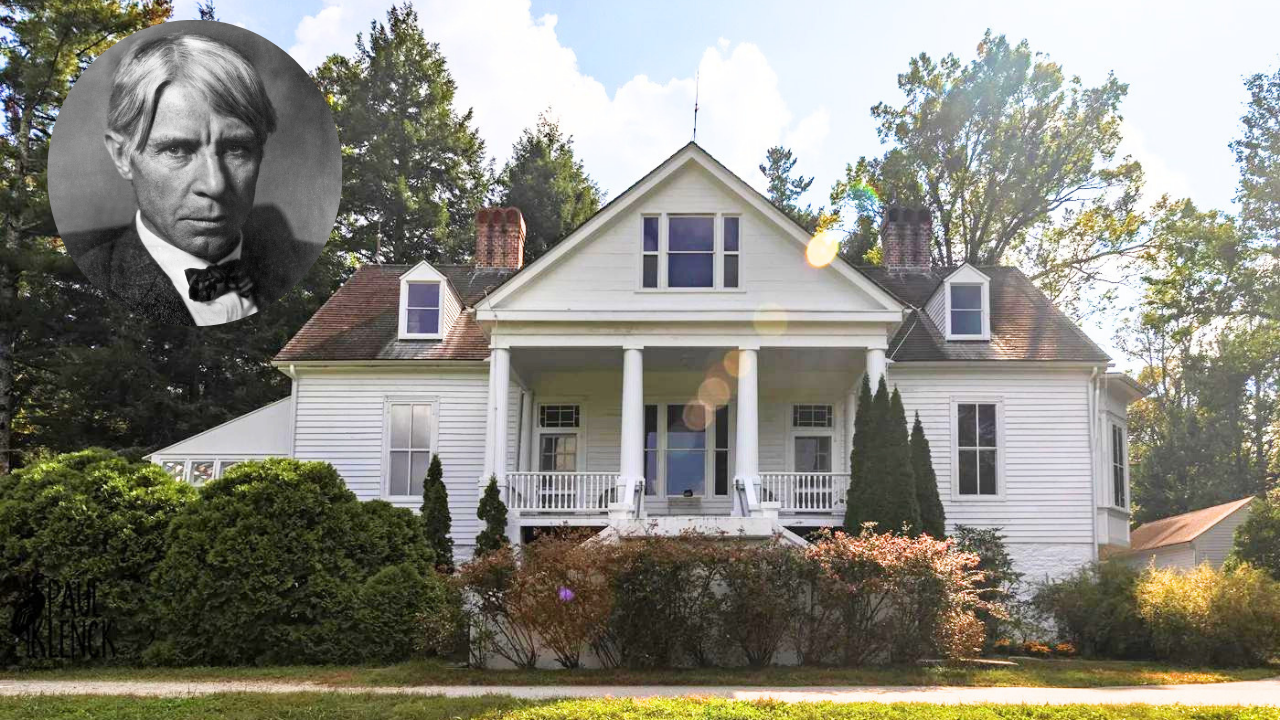
In October 1945, Pulitzer Prize-winning author Carl Sandburg and his wife, Lilian, completed a real estate transaction in Flat Rock, North Carolina. They acquired a 245-acre estate known as Connemara for $45,000. Standard historical narratives frame this relocation as a romantic retreat for a tired poet seeking mountain air. This interpretation obscures the underlying asset requirements. The primary operational driver for the move was not literary seclusion, but the spatial and agricultural scaling constraints of Lilian Sandburg’s premier dairy-goat enterprise, the Chikaming Herd.
Evaluating Connemara requires examining how an agricultural enterprise subsidizes an intellectual environment, and how that dual-purpose property ultimately transitioned into a federal asset managed by the National Park Service.
The Input Variables of Rural Relocation
The Sandburg household operated under two distinct output requirements in the mid-1940s. Carl Sandburg required acoustic isolation and expansive archival storage for his Abraham Lincoln research materials and personal library. Lilian Sandburg required specific biological parameters: a minimum of 30 contiguous pasture acres, barns capable of housing multiple breeding lines, and a climate that minimized winter feed overhead.
Their previous location in Harbert, Michigan, presented severe operational bottlenecks. Michigan winters imposed high heating and indoor fodder costs, while suburban encroachment limited pasture expansion. The operational requirements of a world-class dairy breeding program conflicted directly with the need for quiet writing conditions.
Connemara solved both equations through structural capacity:
- Land Area: The 245-acre footprint provided over 30 dedicated acres of pasture alongside timberland, water features, and outbuildings, matching the exact scaling threshold required for herd growth.
- Isolation Index: Situated roughly 25 miles south of Asheville, the property buffer isolated the main residence from urban density while remaining accessible via post-World War II freight and rail networks.
- Infrastructure Baseline: Built originally in 1838 and expanded by textile industrialist Ellison Adger Smythe, the estate possessed pre-existing agricultural outbuildings, stables, and staff quarters that eliminated the capital expenditure of building a farm from scratch.
The Economics of the Chikaming Goat Operation
Lilian Sandburg did not maintain a casual hobby farm. The Chikaming operation functioned as a scientifically managed breeding facility specializing in Saanen, Toggenburg, and Nubian dairy goats. The enterprise aimed to elevate the genetic baseline of American dairy goats and overcome cultural resistance to goat milk consumption by optimizing butterfat yield and flavor profiles.
Operating a high-yield dairy herd requires strict nutritional tracking and lineage documentation. The North Carolina geography altered the cost function of the enterprise in three distinct ways. First, the longer growing season reduced the window of stored-feed dependency compared to Michigan. Second, the sloping topography of the Blue Ridge foothills naturally conditioned the herd, enhancing hoof health and structural hardiness. Third, the localized market for high-grade goat milk and breeding stock provided a steady cash flow stream that insulated the household from the volatile income fluctuations typical of freelance writing.
The enterprise achieved international recognition not through passive management, but via rigorous pedigree tracking. Lilian Sandburg treated breeding lines as intellectual property, systematically recording milk production metrics, butterfat ratios, and conformational traits. The physical estate served as the laboratory where these biological variables were tested and scaled.
The Production Output of Intellectual Capital
While Lilian managed the biological asset, Carl Sandburg utilized the stability of the estate to maximize his literary output. During his 22 years at Connemara, Sandburg produced more than one-third of his total lifetime works.
The spatial separation between the main 22-room house and the agricultural operations established an efficient division of labor. The library housed thousands of volumes, while the surrounding trails provided routine physical maintenance for a writer prone to sedentary work patterns. The asset structure of Connemara created a closed-loop ecosystem: the agricultural revenue and rural routines supported the domestic foundation, which in turn yielded high-value literary output.
This dynamic challenges the solitary genius trope. Creative production at this scale relied on a functioning agricultural enterprise, domestic support systems, and a physical infrastructure capable of insulating the creator from administrative friction.
The Preservation Paradox and Federal Acquisition
The transition of Connemara from a private working estate to a federal historic site illustrates a rare institutional pivot. When Carl Sandburg died in 1967, the property held competing claims for future use. Real estate development pressures in Henderson County threatened to fragment the 245-acre parcel into residential lots.
Lilian Sandburg bypassed commercial liquidation. In 1968, she coordinated with the Department of the Interior to sell the property to the federal government, executing a deed of gift for the family's furnishings, books, and personal effects. This transaction preserved the integrity of the archive and the physical plant.
In October 1968, President Lyndon B. Johnson signed the legislation establishing the Carl Sandburg Home National Historic Site, officially designating it as the first unit in the National Park Service system dedicated to a poet.
This designation created an administrative paradox for the National Park Service. The agency typically preserves static wilderness or political monuments. Connemara required maintaining an active agricultural landscape, including a living historic goat herd descended from the original Chikaming bloodlines. The park service had to absorb agricultural operations into federal land management protocols, balancing public tourism access with the biological demands of livestock maintenance.
Strategic Resource Allocation
The historical trajectory of Connemara offers a clear blueprint for asset conversion. When evaluating legacy properties or cultural assets, long-term preservation depends on aligning operational revenue streams with archival protection.
To secure institutional continuity for a multi-use property, map the physical infrastructure requirements against the primary output targets before capital deployment. Ensure that subsidiary operations—whether agricultural, commercial, or residential—directly subsidize the core intellectual or cultural asset without introducing regulatory liabilities that complicate eventual public stewardship.