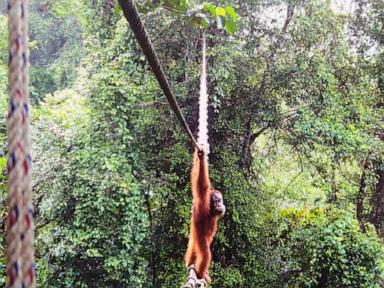
The recorded utilization of a rope bridge by a Sumatran orangutan (Pongo abelii) to bypass a roadway in Indonesia represents more than a biological curiosity; it is a successful validation of a specific infrastructure intervention designed to mitigate the fragmentation of critical primate habitats. Habitat fragmentation functions as a biological tax, increasing the energetic cost of movement and elevating the risk of mortality for arboreal species forced to ground level. When linear infrastructure, such as roads, intersects an ecosystem, it creates a physical and psychological barrier that restricts gene flow and isolates populations. The effectiveness of artificial canopy bridges must be evaluated through the lens of spatial ecology and the specific behavioral mechanics of the species they are intended to serve.
The Mechanics of Habitat Fragmentation
Linear infrastructure creates three distinct vectors of ecosystem degradation: direct mortality through collisions, the "edge effect" where microclimates are altered along the road periphery, and the psychological barrier of open space. For an arboreal specialist like the Sumatran orangutan, the ground is an environment of high risk and low efficiency. These primates have evolved for brachiation and quadrumanous climbing; their anatomy is optimized for a three-dimensional canopy matrix.
When a road bisects this matrix, it forces a binary choice: total isolation or terrestrial crossing. Terrestrial movement exposes the orangutan to domestic dogs, human conflict, and vehicle strikes. Furthermore, the loss of canopy continuity results in a "genetic bottleneck" where sub-populations are unable to interbreed, leading to a long-term decline in the fitness of the species. The canopy bridge acts as a restorer of the third dimension, bypassing the two-dimensional hazard of the asphalt.
Engineering Connectivity: The Three Pillars of Bridge Efficacy
The success of a canopy bridge is not guaranteed by its presence alone. Its utility depends on three structural and biological variables:
1. Structural Integrity and Material Selection
The bridge must support the weight of a flanged male orangutan, which can exceed 90 kilograms. It must also withstand the high humidity and UV exposure of a tropical rainforest. Using durable, weather-resistant materials like heavy-duty nylon webbing or recycled fire hoses provides the necessary tensile strength while mimicking the tactile properties of vines and branches.
2. Strategic Placement and Canopy Integration
A bridge placed in a location that does not align with existing arboreal "highways" will remain unused. Primate movement is not random; it follows established routes based on seasonal fruiting patterns and social structures. Effective bridge placement requires pre-installation monitoring to identify "hotspots" where primates naturally approach the road edge. The bridge must be anchored to healthy, stable trees that can bear the lateral load without compromising their own root systems.
3. Behavioral Adaptation and Habituation
Orangutans are highly intelligent but also cautious. The transition from natural canopy to an artificial structure involves a period of risk assessment. The documented use of the bridge in Sumatra suggests that the individual performed a cost-benefit analysis, determining that the artificial structure was safer than a terrestrial crossing. The presence of juveniles often accelerates this habituation, as younger primates are more prone to exploratory behavior and can "teach" the route to the group through observation.
The Cost Function of Infrastructure Mitigation
Implementing canopy bridges is a cost-effective alternative to more invasive engineering solutions like tunnels or land bridges. However, the ROI of a bridge is measured in biological persistence rather than financial gain. The cost function of these interventions includes:
- Primary Capital Expenditure (CAPEX): The initial design, materials, and labor for installation.
- Maintenance Overheads (OPEX): Regular inspections to ensure the bridge has not been damaged by storms or fallen timber.
- Monitoring Costs: The use of camera traps and field researchers to quantify the frequency of use and the diversity of species utilizing the structure.
Failure to maintain these structures creates a "sink" where a bridge becomes a hazard if it fails while an animal is mid-crossing. Therefore, the long-term strategy must include a commitment to infrastructure lifecycle management.
Genetic Flow and Population Viability
The long-term survival of the Sumatran orangutan depends on the maintenance of large, interconnected populations. When a road isolates a group of 20 orangutans, that group becomes susceptible to stochastic events—a single disease outbreak or a bad fruiting season can wipe them out. By reconnecting these fragments, the bridge effectively increases the "effective population size" ($N_e$).
The formula for the loss of heterozygosity over time is expressed as:
$$H_t = H_0 \left(1 - \frac{1}{2N_e}\right)^t$$
Where:
- $H_t$ is the heterozygosity at time $t$.
- $H_0$ is the initial heterozygosity.
- $N_e$ is the effective population size.
By increasing $N_e$ through connectivity, we drastically reduce the rate at which genetic diversity is lost. The canopy bridge is a tool to manipulate $N_e$ without requiring the physical relocation of individuals.
Limitations of Artificial Connectivity
While the bridge in Sumatra is a victory, it is not a panacea. Artificial structures cannot replicate the complex biodiversity of a natural canopy. They do not provide food sources or nesting sites. Furthermore, a single bridge creates a bottleneck of its own; if a predator learns that primates are channeled through a single 50-meter rope, the bridge becomes a hunting ground.
Strategic planning must move beyond single-point interventions toward a network of connectivity. A high-density bridge strategy reduces the "predation trap" risk and accommodates the higher volume of movement required during mast fruiting years when primate activity peaks.
Technological Integration in Conservation Monitoring
The data captured by the camera traps in Indonesia serves as a feedback loop for future engineering. Computer vision models can now be trained to identify individual orangutans and track their movement patterns across the bridge. This allows researchers to move from qualitative observations ("the bridge is being used") to quantitative datasets ("the bridge has a 78% utilization rate among the local population with a peak frequency at 08:00 and 16:00").
This data-driven approach allows for the optimization of bridge design. If data shows that certain species avoid the bridge, the material or the "swing" of the rope may need adjustment. Engineering for biodiversity requires this iterative process of observation, hypothesis, and structural refinement.
Strategic Implementation for Infrastructure Projects
Future road construction in Indonesia and other biodiversity hotspots must integrate canopy connectivity into the initial environmental impact assessment (EIA). The current reactive model—building a bridge after the damage is observed—is less efficient than a proactive model where bridges are designed into the road's footprint from day one.
The integration of arboreal crossings into the civil engineering phase reduces mobilization costs and ensures that the bridges are placed in the most ecologically significant areas before the forest edge is further degraded. This shift from "remediation" to "integrated design" is the necessary evolution for infrastructure in the 21st century.
Conservation agencies and government bodies should prioritize the following tactical steps:
- Map all existing and planned road networks against known Sumatran orangutan corridors.
- Establish a standardized bridge design that balances structural load-bearing capacity with ecological mimicry.
- Mandate 24-month camera trap monitoring for every new installation to validate efficacy and inform future placements.
- Integrate local community management for bridge maintenance to ensure long-term structural viability and reduce the likelihood of poaching at crossing points.
The Sumatra case study proves that when we provide the infrastructure, the species will adapt. The bottleneck is no longer the animal's behavior, but the speed and scale of our engineering response.