History books love to tell a simple story about the transition from stone to metal. They make it sound like humans threw away their flint tools the second someone figured out how to melt copper and tin. But history is rarely that neat. A massive archaeological discovery in southern Israel proves that right at the dawn of the Bronze Age, stone technology didn't fade away. Instead, it went into hyper-drive, scaling up into a highly organized, secretive mass manufacturing system that looks surprisingly like modern industrial production.
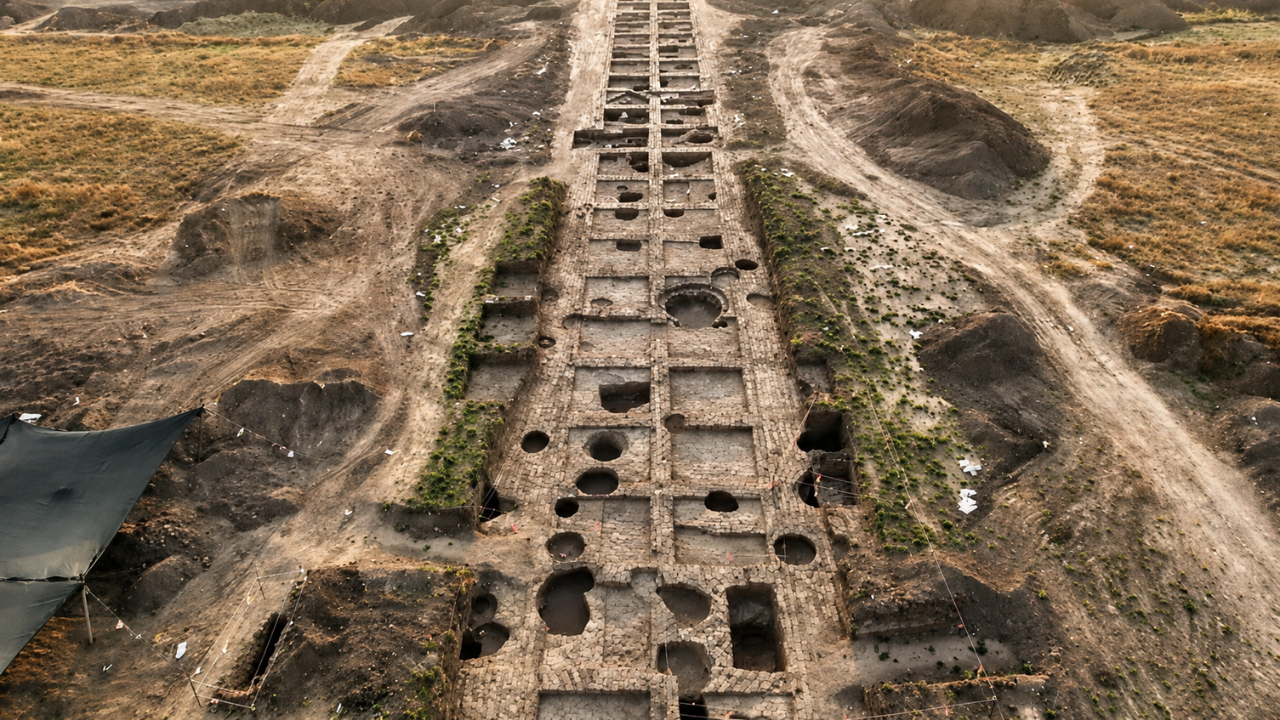
Archaeologists with the Israel Antiquities Authority recently uncovered a 5,500-year-old flint factory at the Nahal Qomem site near Kiryat Gat. This isn't a collection of random tools left behind by nomadic hunters. It's a massive, specialized manufacturing hub that spanned over half a square kilometer. The site operated continuously for centuries, spanning the late Chalcolithic period right into the Early Bronze Age. Finding high-quality flint tools in this region isn't new, but finding the actual factory floor, complete with the massive stone cores used to shape them, is incredibly rare.
This discovery fundamentally challenges the old assumptions about how ancient societies organized themselves. We used to think that true industrial specialization and regional trade networks only emerged much later, once cities were fully established. This factory proves that highly structured economic systems, trade secrets, and professional guilds were already driving human society before the first major cities of the Levant even took shape.
Secrets of the Flint Masters
You can't just pick up a piece of flint and whack it with a rock to get a uniform, razor-sharp Canaanite blade. The process requires an absurdly high level of physical control and engineering knowledge. The craftsmen at Nahal Qomem weren't just skilled; they were using advanced mechanical setups.
To create these distinctively long, straight blades, the toolmakers used large flint cores, which are essentially the raw blocks of stone from which blades are stripped. To get a clean, uniform slice along the length of the core, you need an exact, steady amount of pressure applied at a precise angle. Human muscle alone struggles to do this consistently. Because of this limitation, researchers believe these ancient craftspeople used a crane-like lever device to press down on the stone. By using a mechanical lever, they could multiply their force and direct it with pinpoint precision, popping off uniform blades that were perfectly standardized.
This level of standardization tells us that toolmaking had evolved past a casual household chore. In earlier eras, if you needed a knife, you made one yourself, or your neighbor did. At Nahal Qomem, the uniform size and quality of the blades show that this was a professional industry run by a small group of highly trained specialists. Israel Antiquities Authority prehistorians Dr. Jacob Vardi and Dudu Biton noted that only exceptional individuals possessed the skills required to manufacture these tools. You're looking at the birth of the professional specialist class.
The Missing Waste and Ancient Corporate Espionage
One of the most bizarre details of the excavation isn't what the team found, but what they didn't find. When you shape flint, you generate a massive amount of waste. Tiny shards, broken flakes, and stone dust, collectively called debitage, usually litter any ancient workshop site. Walk into almost any prehistoric tool-making area and you'll find yourself ankle-deep in sharp stone garbage.
At the Nahal Qomem factory, the production floor was meticulously clean. The waste fragments were completely missing from the immediate manufacturing area.
Dr. Jacob Vardi suggests this clean floor wasn't just about keeping a tidy workspace. It looks a lot like ancient intellectual property protection. By gathering every single piece of debitage and disposing of it somewhere else, or hiding it away, the master craftsmen ensured that outsiders couldn't study their waste products to reverse-engineer their techniques. The manufacturing group protected their professional knowledge from rival settlements. If you controlled the production of the sharpest, most durable cutting tools in the region, you controlled the regional economy. You didn't leave your blueprints lying around on the floor for anyone to steal.
Subterranean Networks and a Hidden Cache
The scale of the settlement at Kiryat Gat shocked the excavation directors, Dr. Martin David Pasternak, Shira Lifshitz, and Dr. Nathan Ben-Ari. The site was far larger than anyone anticipated, stretching across more than half a kilometer. The entire area is pockmarked with hundreds of underground pits, many of them reinforced with mud bricks.
These subterranean chambers served as an underground network that kept the entire community functioning. Some pits were used as cool storage rooms for agricultural goods, keeping food safe from the blistering heat. Others served as actual living spaces, workshops, or specialized areas for social and ritual activities.
Within this underground labyrinth, archaeologists stumbled upon something completely unexpected, a massive cache of hundreds of pristine, unused flint blades buried together in a single spot. Finding a stockpile of completed products that were never used or traded is highly unusual for a commercial hub. This wasn't a random lost inventory. The intentional burial of hundreds of valuable tools suggests a ritual or cultic offering. It hints at a deeply religious or symbolic culture where the tools of daily survival were valuable enough to be sacrificed to the gods, perhaps to guarantee the continued prosperity of the factory or the community.
Driving the Levantine Economy
The blades produced at this southern factory weren't luxury items for elites. They were the essential workhorses of the ancient world. Even though bronze was beginning to enter the picture, these high-quality flint blades remained the primary cutting tools for everyday life across the Levant.
People used these ultra-sharp implements as butcher knives for processing meat and as specialized sickle blades for harvesting grain. The agricultural revolution that allowed human populations to skyrocket depended entirely on the availability of reliable harvesting tools. By churning out standardized, high-performance sickle blades, the Kiryat Gat factory supplied the technological backbone for the region's food supply.
Geological analysis of the artifacts added another layer to the story. The raw flint used in the factory didn't come from the immediate vicinity of Kiryat Gat. It was sourced from the Beit Guvrin area, roughly 15 kilometers away. Moving massive stone cores across that distance requires organized transport and secure trade routes. Once the blades were finished, they were distributed across broad regions of the Levant, making this site a massive regional distribution node.
Rethinking the Dawn of Urbanization
For a long time, the prevailing archaeological theory claimed that massive cities had to develop first, and then their large populations created the demand for specialized industries. The Kiryat Gat discovery flips that timeline completely on its head.
This sophisticated industrial complex was up and running at the very onset of the Early Bronze Age, before true cities dominated the landscape. The economic complexity came first. The need to organize labor, secure raw materials from miles away, safeguard manufacturing secrets, and distribute finished products across long distances is exactly what forced these early communities to build more complex social structures. Craft specialization wasn't a byproduct of urbanization; it was the actual catalyst that made urbanization possible.
If you want to see these artifacts yourself, the Israel Antiquities Authority has put the flint cores and blades on public display at the Jay and Jeanie Schottenstein National Campus for the Archaeology of Israel in Jerusalem. Seeing the sheer size of the stone cores makes it obvious that managing this operation required serious physical effort and sophisticated logistics.
To get a true sense of how these ancient economic networks operated, your next step is to look into the trade routes of the early Levant, specifically focusing on how raw materials like Beit Guvrin flint traveled across the region before the rise of the major Canaanite city-states. Understanding the movement of raw stones tells you more about the birth of human economy than any bronze weapon ever could.


