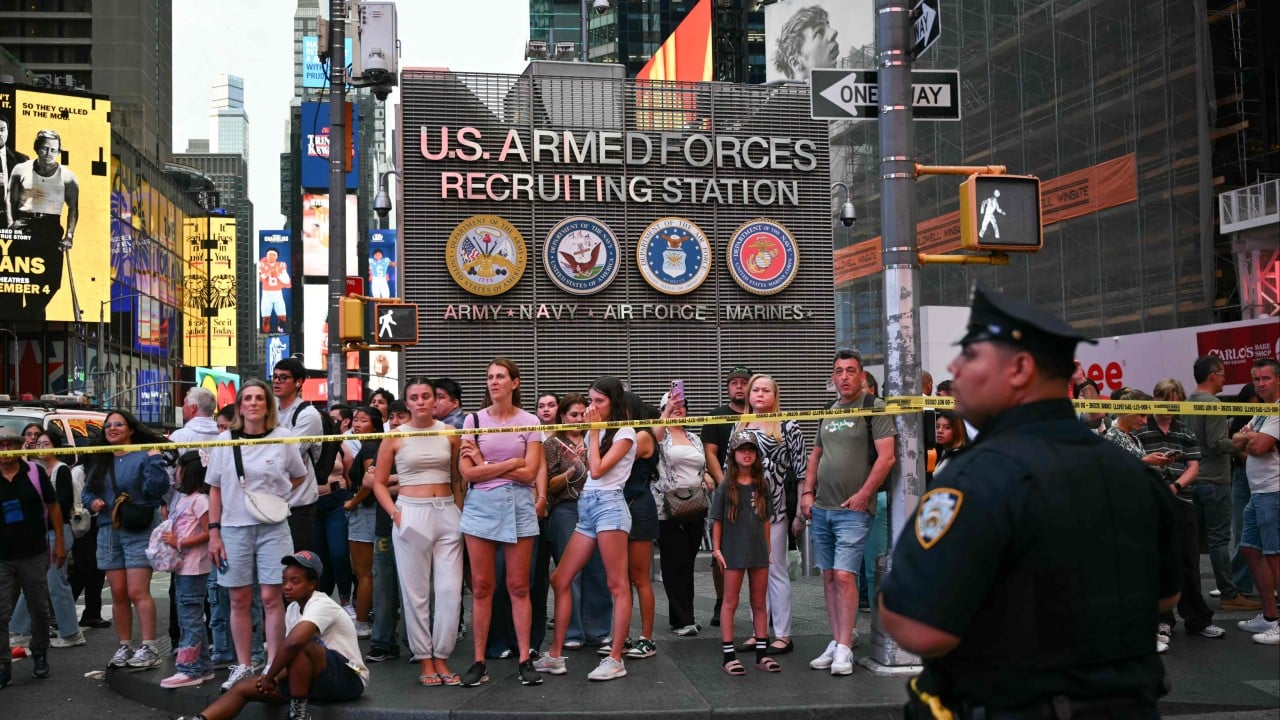
Urban public spaces present complex security environments where dynamic threats demand immediate tactical evaluation by law enforcement personnel. When an individual armed with two concealed-turned-brandished knives initiates an unprovoked violent sequence in a high-density pedestrian zone like Times Square, the timeline from threat identification to neutralization compresses into seconds. Deconstructing the incident involving 49-year-old Pamela Sisneros reveals the strict operational constraints, tactical mechanics, and decision-making calculus governing modern police response to active-assailant events.
The Chronological Compression of the Threat
The kinetic phase of the Times Square attack lasted approximately twenty seconds from inception to the final stabbing stroke. According to New York Police Department briefings, the suspect retrieved two knives from a red Target bag near West 41st Street and Seventh Avenue, immediately attacking a 68-year-old male victim in the abdomen. Within twenty seconds, she advanced northward and inflicted fatal wounds on a 32-year-old female victim near 42nd Street.
This rapid velocity highlights a fundamental limitation in urban policing: physical presence does not equal immediate interception. Even in a heavily policed commercial hub, response metrics are bound by the physics of human reaction time, situational assessment, and spatial transit. The perpetrator exploited the density of pedestrian traffic to obscure her transition from a dormant state to an active, lethal posture. Security architectures in public thoroughfares must account for this compression ratio, where the window for preventative intervention is virtually nonexistent once the initial weapon is deployed.
The Four Minute Negotiation and Tactical Escalation
Upon confronting the armed suspect between West 42nd and West 43rd Streets, responding officers engaged in a verbal negotiation phase lasting approximately four minutes. This operational choice directly contradicts the common public assumption that armed threats are met with instantaneous lethal force. Standard tactical doctrine prioritizes containment and de-escalation when an assailant is stationary or contained, even when armed.
However, the negotiation phase failed due to explicit declarations from the suspect. Body-worn camera footage verified that the individual refused compliance, stating an explicit intent to cause lethal harm to the officers: "I'm not dropping anything. I would rather kill both of you".
When an assailant verbally confirms intent to kill and maintains an aggressive advance, the tactical calculus shifts from containment to threat mitigation. The four-minute window illustrates the operational threshold where police restraint hits the boundary of imminent danger. Negotiation requires a baseline of rational feedback or hesitation from the subject; absolute intransigence combined with forward momentum forces a transition to intermediate and lethal options.
The Physics and Failure Modes of Intermediate Force
Before discharging service weapons, officers deployed electronic control weapons, commonly known as Tasers. These devices failed to incapacitate the suspect, allowing her to continue closing the distance while waving two knives.
Understanding why Tasers fail in high-stress, dynamic encounters involves distinct physiological and mechanical variables:
- Garment Interference: Thick, loose, or heavy clothing prevents the probe from making direct contact with the skin, preventing the completion of the electrical circuit necessary to disrupt the central nervous system.
- Spread Geometry: The distance between the two probes upon impact must be sufficient to affect muscle groups; close ranges or awkward body angles reduce probe spread, minimizing neuromuscular incapacitation.
- Adrenaline and Psychomotor State: Individuals experiencing extreme psychological crises, chemical intoxication, or high adrenaline surges can exhibit elevated pain tolerance and override neuromuscular disruptions, rendering electronic interventions ineffective.
When intermediate force options fail against an advancing subject armed with contact weapons, officers face a binary survival scenario. The reactionary gap—the distance required for an officer to draw a weapon and neutralize an advancing threat—was actively collapsing. Given that a motivated attacker can cover short distances faster than an officer can react to a knife thrust, the deployment of lethal force became the only remaining mechanism to prevent further loss of life.
Systemic Implications for Public Safety Architecture
The incident underscores the structural vulnerability of open urban environments. Times Square operates as an open-access transit and commercial hub, making target-hardening strategies difficult to implement without altering the fundamental nature of civic space.
The deployment of body-worn cameras and the rapid public release of footage by municipal leadership represent an institutional shift toward evidentiary transparency. In high-scrutiny operational environments, immediate release of primary source video mitigates narrative drift and subjects the tactical decision-making process to public and internal review.
Future security models in hyper-dense urban corridors will increasingly rely on predictive behavioral analytics and rapid-response containment grids rather than static post-incident interventions. The operational priority remains reducing the time interval between weapon display and containment, shifting the burden from reactive lethal force resolution to preemptive neutralization.