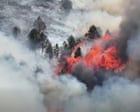
Upland peatlands and moorlands are distinct natural assets that function as critical infrastructure for carbon storage, regional water filtration, and transport corridors. When a wildfire penetrates these environments—as demonstrated by the blaze on Tintwistle Moor near Glossop, which rapidly expanded to engulf over 500 square meters of sensitive woodland and blanket bog—the immediate visible destruction represents only the surface layer of a compounding systemic failure. Traditional media reporting framing these events as localized, weather-driven disruptions misses the underlying physics of subterranean combustion and the far-reaching economic bottlenecks they trigger. Evaluating the true risk profile of these incidents requires modeling the crisis across three distinct vectors: the thermodynamic mechanism of peat combustion, the logistics of trans-Pennine supply chain disruptions, and the public health externalities forced onto downstream urban centers like Greater Manchester.
The Tri-Axe Matrix of Moorland Fires
Evaluating a wildfire in an upland peat environment requires moving past surface-area metrics. Instead, the incident must be broken down into three operational phases that dictate the compounding severity of the crisis.
       [PHASE 1: Subterranean Fuel Loading]
         - Smouldering combustion in dry peat layers
         - Smothers oxygen, bypasses surface water drops
                         │
                         ▼
       [PHASE 2: Infrastructure Bottlenecks]
         - Closure of key trans-Pennine arteries (A628)
         - Freight diversion costs and transit delays
                         │
                         ▼
       [PHASE 3: Downstream Air Quality Externalities]
         - Westward wind dispersion of PM2.5 particles
         - Urban public health and respiratory tax
The Thermodynamics of Subterranean Peat Combustion
The primary factor differentiating moorland fires from standard forest or grassland fires is the fuel substrate. Peatlands are composed of organic matter—partially decayed vegetation accumulated over millennia—which functions as a highly concentrated, dense carbon deposit.
Under normal ecological conditions, a high water table maintains a saturated, anaerobic environment that prevents rapid oxidation. However, prolonged periods of elevated atmospheric temperatures and suppressed precipitation draw down the water table through evapotranspiration. This creates an unmanaged fuel-loading zone in the upper horizons of the soil profile.
When an ignition event occurs, the combustion process splits into two distinct thermodynamic regimes:
- Flaming Surface Combustion: Driven by dry heather, bracken, and surface woodland canopy. This phase is characterized by high heat release rates, rapid forward rate of spread, and high visual signatures. It is highly sensitive to wind velocity and direction, which can quickly fan surface flames across roads or natural firebreaks.
- Smouldering Subsurface Combustion: Once the surface fire ignites the underlying dehydrated peat, the reaction transitions to a low-temperature, flameless, oxygen-deprived smouldering front. Because peat is porous and self-sustaining once ignited, the fire moves vertically downward into the soil profile rather than just horizontally across the landscape.
This creates a severe tactical challenge for emergency response teams. Standard aerial suppression—such as water-dropping helicopters deployed by utilities—is highly effective at knocking down flaming surface fronts to halt the horizontal rate of spread. It is fundamentally incapable, however, of penetrating deep into the subterranean peat layer.
The water frequently runs off the hardened, hydrophobic surface of dried peat, leaving the underlying embers completely undisturbed. Consequently, while a surface fire may appear suppressed within 24 hours, the subsurface front can smoulder undetected for weeks, migrating laterally beneath the surface until it hits an air pocket or a patch of surface vegetation, triggering a sudden re-ignition.
The Friction Logistical Function of Trans-Pennine Artery Closures
The spatial location of the Pennine moors means that upland wildfires directly intersect vital economic corridors. The closure of the A628 Woodhead Pass—the critical trans-Pennine artery linking Greater Manchester with South Yorkshire—serves as a case study in infrastructure vulnerability.
When smoke plumes drop visibility below operational thresholds or flames threaten the physical roadway between the A57 at Hollingworth and the A616 at Flouch, highways authorities are forced to implement full bilateral closures. The economic cost of this closure is modeled not by the localized damage to the asphalt, but by the systemic friction injected into regional logistics.
The displacement of commercial and private traffic can be quantified through a standard transport friction equation:
$$\Delta C = \sum (V_i \times \Delta T_i \times R_m) + \sum (V_i \times \Delta D_i \times R_o)$$
Where:
- $V_i$ represents the volume of displaced vehicles by category (light commercial, heavy goods, private).
- $\Delta T_i$ is the additional transit time forced by diversion routes.
- $R_m$ is the monetized value of driver and passenger time per hour.
- $\Delta D_i$ is the marginal distance added by the diversion.
- $R_o$ is the operational running cost per mile (fuel, vehicle depreciation).
When the A628 is compromised, traffic is diverted onto alternative trans-Pennine routes, primarily the M62 motorway to the north or the alternative passes to the south. This structural shift creates an immediate cascade failure.
The M62, which already operates near peak capacity during commuter and freight windows, experiences immediate artificial congestion. The resulting delays add significant variable costs to just-in-time supply chains operating across the North of England, turning a localized environmental incident into a regional productivity drag.
Downstream Air Quality and Public Health Externalities
The third structural impact of a major moorland fire is the generation and dispersion of fine particulate matter ($PM_{2.5}$). Because peat combustion is inherently incomplete due to restricted oxygen access deep in the soil, it produces significantly higher volumes of carbon monoxide, methane, and fine particulate matter per unit of biomass burned than standard flaming wood fires.
During periods of stable meteorological conditions or specific wind vectors—such as the westward airflow that carried the smoke from Tintwistle Moor across a broad arc of urban settlements—these airborne pollutants are transported directly into densely populated areas. Towns and cities miles from the fire front, including Oldham, Rochdale, Bury, Bolton, and parts of the Manchester city center, experience immediate drops in baseline air quality.
The public health impact of this particulate dispersion follows a predictable geographic and physiological progression:
- Plume Dispersion: The prevailing wind transports smoke particles downwind, creating a ground-level haze over urban centers. Particulate concentrations can spike rapidly, breaching safe daily exposure thresholds within hours of a major shifts in wind direction.
- Mechanical Penetration: Unlike larger dust particles, $PM_{2.5}$ bypasses the natural filtration systems of the human upper respiratory tract, penetrating deep into the alveoli of the lungs and directly entering the bloodstream.
- Acute Physiological Tax: The introduction of these foreign particulates triggers immediate inflammatory responses. This results in an acute surge in primary care admissions for respiratory distress, particularly among vulnerable cohorts with pre-existing conditions like asthma or chronic obstructive pulmonary disease (COPD).
This creates an unpriced health tax born entirely by the downstream urban economy. While emergency services issue generic public safety warnings advising residents to seal windows and doors, the aggregate loss in economic productivity due to illness, combined with the spike in emergency healthcare utilization, represents a significant hidden cost of upland ecosystem degradation.
Strategic Operational Recommendations
Managing the risk of upland peat fires requires moving away from reactive emergency suppression and moving toward proactive asset management. To mitigate the severity of future incidents, environmental agencies, regional authorities, and landowners must implement a dual-track strategy focused on restoring hydrological baselines and deploying targeted monitoring infrastructure.
Hydrological Restoration via Blanket Bog Rewetting
The most effective structural defense against subsurface peat combustion is the systemic rewetting of degraded blanket bogs. Decades of historical drainage ditch cutting (gripping) and intensive land management have artificially lowered the water table across many UK moors, leaving the peat vulnerable to drying. Land management authorities must scale up block-damaging programs on existing drainage channels using peat, heather bales, or stone dams.
By physically slowing the flow of water off the moors, the water table is restored to the surface layer. This permanently maintains the anaerobic conditions necessary to prevent subsurface ignition, transforming flammable, degraded peat back into a resilient, natural firebreak that self-suppresses surface embers.
Deployment of Subsurface Thermal Sensing Networks
Given the invisible nature of subterranean smouldering, reliance on visual smoke spotting or drone overflights represents a lagging indicator of fire activity. Fire services and land management coalitions should deploy localized networks of low-power, long-range (LoRaWAN) automated subsurface temperature probes along high-risk interfaces—specifically where managed moorlands border major transport corridors like the Woodhead Pass.
These sensor networks provide continuous, real-time telemetry on soil temperature profile variations. By detecting anomalous subterranean heat signatures before they breach the surface or manifest as visible smoke plumes, emergency teams can deploy targeted, high-pressure ground drenching to eliminate hotspots before they escalate into uncontained, multi-agency incidents.