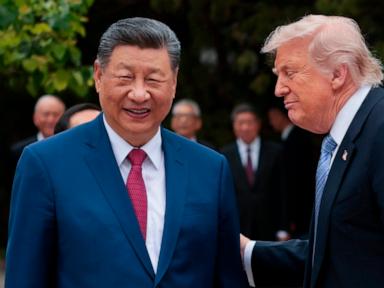
The announced $17 billion annualized Chinese purchasing target for United States agricultural goods across the 2026–2028 window signals a tactical reset rather than a structural alignment of bilateral commerce. Negotiated at the Beijing summit between Donald Trump and Xi Jinping, this structural framework attempts to artificially reverse a steep contraction: U.S. agricultural exports to China collapsed from a 2022 peak of $38 billion to $8 billion in 2025. Evaluating the viability of this deal requires analyzing the operational mechanics of commodity arbitrage, state-controlled market access, and structural shifts in global supply chains.
The political declaration of a $17 billion baseline introduces an immediate friction point between managed trade mandates and the microeconomics of the private Chinese processing sector. For these targets to materialize, state directives must override prevailing global price differentials, or the state must execute deep interventions via tariff relief and regulatory clearing.
The Non-Tariff Barrier Leverage Model
The volatility of American protein exports to China over the last twenty-four months demonstrates that regulatory enforcement operates as an economic throttle. Non-tariff barriers (NTBs) are deployed systematically to regulate import volumes independent of formal tariff structures.
The Administrative De-Registration Mechanism
In 2025, China let the export licenses for hundreds of U.S. beef facilities lapse. The direct consequence was an immediate restriction in supply, causing the value of U.S. beef exports to China to drop from a $2.14 billion peak in 2022 to under $500 million in 2025. This was not a failure of market demand; it was an administrative suspension of the supply chain.
The mechanism for the 2026 normalization relies on reversing this specific administrative barrier. Beijing’s post-summit concessions include:
- Granting five-year registration extensions to 425 U.S. beef plants whose access had lapsed.
- Issuing new five-year regulatory approvals for 77 additional domestic facilities.
- Committing to a process to resolve facility registration bottlenecks for major aggregators like Tyson and Cargill.
Sanitary and Phytosanitary Controls as Economic Variables
Poultry exports follow an identical pattern of administrative optimization. U.S. poultry exports to China dropped to $286 million in 2025, down from over $1 billion in 2022. This contraction was accelerated by broad, state-level bans linked to Highly Pathogenic Avian Influenza (HPAI).
The new framework replaces blanket import bans with a regionalized zoning model. The Chinese Ministry of Commerce agreed to resume imports from specific states certified as HPAI-free by the U.S. Department of Agriculture (USDA). By shifting from country-wide blocks to localized zoning, the deal establishes a variable capacity model where supply can be regulated by adjusting the geographic boundary of permitted export zones.
The Economics of Managed Trade Versus Market Arbitrage
The central vulnerability of the agreement is the decoupling of political purchasing commitments from the financial incentives of private commercial enterprises. Independent Chinese crushers and protein distributors operate strictly on crushing margins and landed cost dynamics.
Landed Cost = (Global FOB Price + Freight + Insurance) × (1 + Baseline Tariff - Tariff Rebate) + Port Clearing Costs
When retaliatory tariffs are active, the landed cost of U.S. commodities exceeds that of international alternatives, driving commercial buyers out of the market. To hit a $17 billion annualized target, the Chinese state must employ one of two implementation mechanisms:
1. Direct State-Owned Enterprise Allocations
The state can instruct central enterprises, such as Sinograin and COFCO, to execute non-commercial purchases. These entities absorb the premium of higher-priced U.S. origin goods as a state-directed compliance cost. This mechanism was used to fulfill the October truce commitments, which directed 10.9 million metric tons of U.S. soybeans to state reserves. However, state storage capacity is finite, and centralized buying cannot scale efficiently across diversified protein supply chains like beef and poultry, which require commercial cold-chain distribution networks.
2. Reciprocal Tariff Reduction Mechanisms
To incentivize commercial buyers, the preliminary agreement introduces a framework for "reciprocal tariff reductions on a specific range of products at an equivalent scale." Market analysts project that a targeted 10% reduction in soybean tariffs is required to restore competitiveness for private buyers. Without explicit tariff waivers, commercial crushers will continue to minimize U.S. origin exposure, leaving a structural deficit that state-owned entities cannot bridge alone.
The Structural Realities of South American Substitution
A fundamental limitation of the $17 billion target is that global agricultural trade is not a closed system. The trade disruptions of 2024 and 2025 accelerated a permanent realignment of logistics and capital infrastructure in competing export nations.
China's macroeconomic strategy treats food security as a component of national security. To mitigate the risk of import disruptions, Beijing has systematically diversified its agricultural supply chain away from the United States, transferring structural market share to the Mercosur bloc.
- Infrastructure Capitalization: Brazilian and Argentine producers have benefited from multi-year capital investments in logistics, including northern arc port expansions and dedicated rail corridors. These advancements have lowered the free-on-board (FOB) cost of South American origin goods.
- Acreage Expansion: Sustained demand from Chinese buyers has driven structural expansions in Latin American planting acreage, locked in by long-term supply agreements that cannot be easily unwound for short-term political shifts.
- Seasonal Arbitrage: The southern hemisphere harvest cycle provides a natural counter-seasonal supply cushion. Because South American production capacity now meets or exceeds Chinese baseline demand for key commodities, U.S. exporters no longer operate as default suppliers. They are residual suppliers, called upon only when South American export capacity is fully utilized or disrupted by weather events.
Structural Governance via Parallel Bilateral Councils
To manage these frictions without relying on existing, slow-moving diplomatic channels, the agreement establishes a dual-board governance architecture. This setup separates commercial flows into two distinct regulatory tracks:
The Board of Trade
This body is designed to isolate and manage the logistics of "non-sensitive goods." It serves as the primary forum for adjusting technical specifications, normalizing customs clearing protocols, and engineering the equivalent-scale tariff reductions required to keep U.S. products commercially viable. By moving technical negotiations to an isolated board, the framework attempts to shield agricultural flows from broader geopolitical disputes.
The Board of Investments
This council focuses on Chinese capital allocation within domestic U.S. industries and expanding market access for American corporations in China. This structural division reveals the underlying transactional framework of the deal: the U.S. grants investment discussions and technical concessions on imports in exchange for immediate Chinese capital allocation into American agricultural commodities.
Strategic Playbook for Market Participants
The $17 billion annualized target creates a temporary, policy-driven window of demand rather than a permanent return to open-market trade. Commercial operators must design their risk profiles around the specific mechanisms of this agreement.
- Agribusiness Asset Optimization: U.S. protein processors must immediately capitalize on the newly extended five-year registrations. This involves front-loading export volumes to China while the technical window is open, utilizing the 425 renewed plant licenses before alternative administrative hurdles are introduced.
- Supply Chain Regionalization: Poultry exporters must coordinate with the USDA to establish strict geographic containment protocols. Because market access is tied to state-by-state HPAI designations, logistical networks should be structured to route export products through certified disease-free zones, isolating processing lines from states vulnerable to sudden regulatory suspension.
- South American Hedging: Commercial originators should avoid expanding domestic production assets based on these political targets. The structural shift toward Brazil and Argentina remains an ongoing trend. Capital allocation should prioritize maintaining a dual-origin footprint to hedge against the expiration or political unwinding of the 2026–2028 purchasing window.


