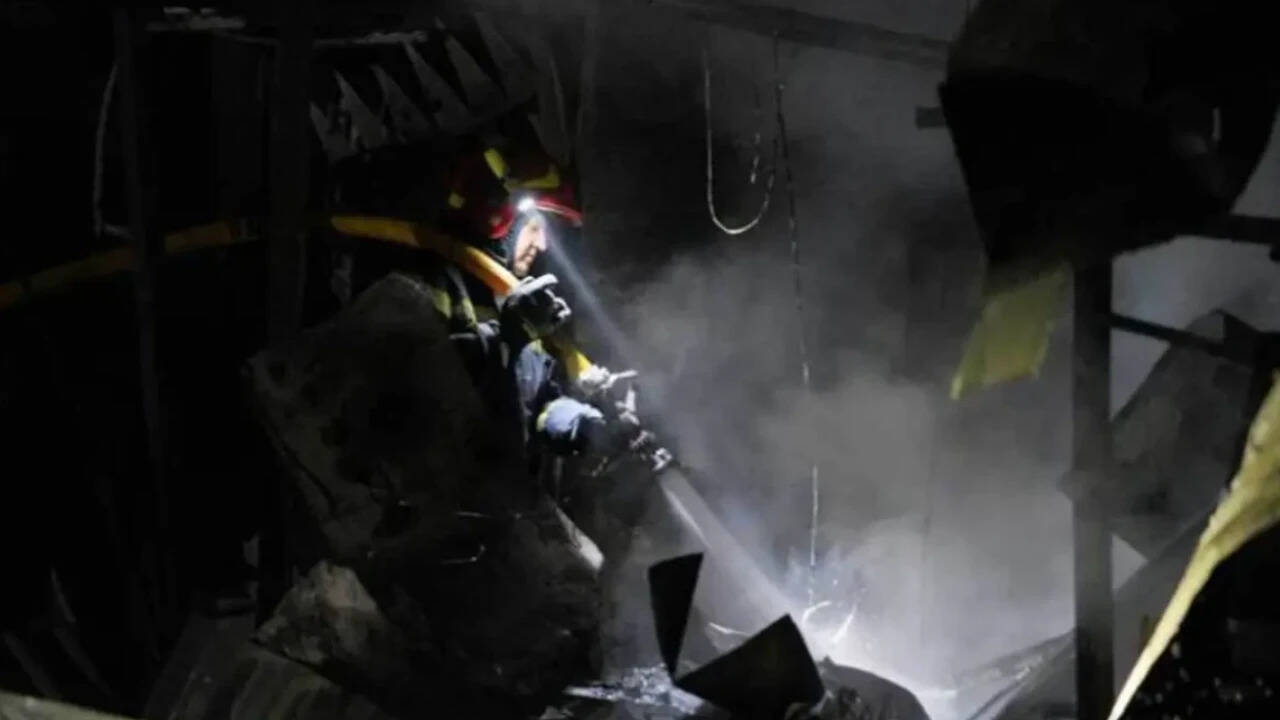
The floor of the warehouse did not smell like politics. It smelled like cardboard, packing tape, and the faint, sweet chemical tang of industrial sanitizer.
To walk those aisles in calmer days was to witness the logistics of survival mapped out in neat, towering pallets. Rows of sterile syringes. Cardboard boxes stamped with red crosses, heavy with insulin, gauze, and surgical kits meant for emergency rooms where windows had long since been blown out by concussion waves. Every square foot of that cavernous depot represented a fragile bargain: the agreement that even in the absolute worst of human conflicts, certain things remained sacred.
Then came the impact.
Sound arrived first, a tearing of the atmosphere that vibrated in the teeth before the concussion wave slammed outward. Glass did not just break; it pulverized into a shimmering fog. Concrete groaned. And when the smoke cleared, the roof lay peeled open to the gray indifference of the sky, exposing millions of dollars in medical supplies to the elements and the ash.
This was not a battlefield miscalculation. It was a calculated erasure.
When a World Health Organization warehouse in Ukraine takes a direct hit—marking the second such assault in a matter of weeks—the casualty report does not list names immediately. That is the initial deception of these headlines. We look for a body count and, finding none in the smoking rubble of the depot, we breathe a quiet, collective sigh of relief. We move on to the next feed.
That is the profound mistake.
The casualties of this strike are not lying in the dust of the loading bay. They are scattered hundreds of miles away, waiting in damp basements, triage tents, and freezing field hospitals. They are the trauma patient whose surgery must be delayed because the antiseptic went up in flames. They are the diabetic child whose insulin supply just turned to useless protein in the heat of a secondary fire. They are the nameless thousands whose survival depended entirely on the contents of those exact shelves.
Consider what happens next in the quiet calculus of supply chain failure.
Medical logistics in an active war zone operate on razor-thin margins. You cannot simply pull up to a local pharmacy when a missile destroys your central reserve. Every pallet is precious cargo, tracked across borders, smuggled past checkpoints, and guarded jealously by logicians who treat every box of bandages like gold dust. When a central warehouse goes up in smoke, the shockwave ripples through the entire capillary system of humanitarian aid.
I remember talking to a field coordinator in a comparable conflict years ago, a man whose eyes had the glassy, unblinking stare of someone who had lived too long on adrenaline and instant coffee. He pointed to a single box of intravenous fluids on a folding table and said something that stayed with me ever since.
"People think war is about bullets," he told me, stirring a cup of lukewarm tea with a plastic spoon. "Bullets are just the loud part. The real war is fought over what happens after the bullet lands. It is fought in the infection that sets in because the antibiotics didn't arrive. It is fought in the silence of an operating room that ran out of oxygen."
That coordinator was not speaking abstractly. He was naming the invisible stakes.
International humanitarian law is supposed to create a protective circle around these warehouses. The red cross or the blue emblem of the United Nations is not merely a logo; it is a legal and moral shield forged in the aftermath of history’s worst horrors, designed to whisper to combatants: Do not touch this. This belongs to the wounded.
Yet, when those emblems are ignored, burned, or blown to fragments, something far more dangerous than physical infrastructure is destroyed. The social contract of mercy dissolves.
We are watching the systematic normalization of the unthinkable. When medical depots become legitimate targets in the minds of aggressors, the rules that separate total war from barbarism are quietly rewritten. Every targeted warehouse lowers the threshold for the next atrocity. It tells relief workers that their neutrality is a fiction, that their life-saving mission is viewed not as a neutral act of human compassion, but as an obstacle to be cleared.
The smoke over the Ukrainian warehouse eventually drifted away, swallowed by the broader, unending gray of the conflict. The charred pallets were pushed aside. Accountants began the grim, bureaucratic task of tallying the losses in millions of dollars and metric tons of destroyed relief.
But the true cost cannot be entered into a spreadsheet.
It lives in the sudden scarcity of a field hospital. It lives in the quiet desperation of a doctor holding a scalpel, looking at a depleted shelf, and realizing that the next patient will have to endure the unbearable without enough anesthesia. That is the reality behind the dry news ticker. That is the fire burning long after the flames have been put out.