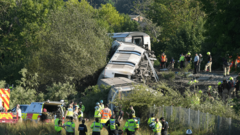
Infrastructure failure in high-density passenger transport networks exposes the rigid cost functions governing modern rail asset management. The derailment of the 14:24 Greater Thameslink Railway service from London Victoria to Eastbourne near Lewes, East Sussex, provides an empirical testbed for evaluating physical network vulnerabilities, thermal stress tolerances, and emergency triage protocols under pressure. Deconstructing the mechanics of this event requires moving past standard journalistic observations to examine the vector physics, asset parameters, and systemic load limits that dictated the outcome.
The Kinematics and Asset Configuration
The incident involved an eight-carriage Class 377 Electrostar electric multiple unit carrying approximately 150 passengers, operating on the East Coastway line just north of the Lewes Tunnel between Cooksbridge and Lewes. The core physical markers of the event establish a clear sequence of mechanical failure:
- The rear three carriages of the configuration left the rails and inverted onto their sides.
- Dynamic longitudinal forces concentrated heavily toward the rear of the train as emergency braking systems engaged immediately following structural destabilization.
- Passenger distribution within the consist played a definitive role in injury severity, with 110 of the total 150 occupants positioned in the rear four carriages where lateral overturning forces maximized.
Modern multi-unit electric trains utilize distributed traction rather than a heavy concentrated locomotive, which alters inertial distribution during a sudden track departure. When the rear bogies lost vertical alignment, the kinetic energy of the forward carriages maintained forward momentum while the trailing units experienced a severe rotational yaw vector. This created the lateral tipping movement that threw carriages onto their sides on the adjacent heathland.
Thermal Stress and Infrastructure Load Limits
While official investigators from the Rail Accident Investigation Branch continue their forensic evaluation, historical failure analysis points toward environmental boundary conditions as a primary variable in track geometry degradation. Rail steel possesses a specific thermal expansion coefficient. Under prolonged high-ambient temperature regimes, welded continuous rails experience immense compressive longitudinal stress.
When this internal stress exceeds the lateral resistance provided by the ballast and sleepers, the track geometry distorts. This phenomenon manifests as track buckling. Eyewitness accounts and initial field imagery from the Lewes site indicated localized geometric irregularities in the rail infrastructure preceding the point of derailment.
The mechanical interface between wheel and rail relies on precise tolerances measured in millimeters. A thermal lateral displacement alters the gauge width or introduces an abrupt angular deviation. When an Electrostar bogie encounters a compromised track modulus at speed, the wheel-set flange can climb the running edge, precipitating a sudden loss of containment.
Multi-Agency Response Logistics and Triage Efficiency
Emergency management parameters during a rail incident are governed by the declaration of a major incident, which triggers an automated escalation matrix across police, fire, and ambulance services. The geographic constraints of the site—situated on an embankment north of Lewes Tunnel—dictated distinct operational bottlenecks.
- Access limitations restricted heavy lifting and rapid extrication vehicle positioning, requiring personnel to traverse on foot with portable trauma gear.
- The South East Coast Ambulance Service deployed multiple ambulance crews alongside air ambulance assets to manage patient distribution.
- Triage distribution protocols successfully separated casualties into severity tiers, directing two individuals with severe polytrauma to regional major trauma centres while routing eighteen others to local medical facilities for observation and treatment of less critical orthopedic and soft-tissue injuries.
The evacuation phase tested the structural integrity of the Electrostar rolling stock. While the carriages rolled onto their sides, the extruded aluminum body shells maintained residual cabin space, preventing catastrophic crush injuries that historically characterized older timber or weak-steel carriage designs.
Systemic Remediation and Network Resilience
The immediate economic and logistical consequence of the Lewes derailment was the total severance of the East Coastway line, impacting routes connecting Brighton, Eastbourne, Haywards Heath, and Seaford. Network recovery models dictate a strict sequential workflow before commercial operations can resume:
- Forensic laser scanning of the damaged track bed and kinematic profiling of the derailed wheel-sets by the Rail Accident Investigation Branch.
- Non-destructive testing of adjacent rail lengths to measure residual internal thermal stresses and verify gauge integrity.
- Ballast tamping, sleeper replacement, and geometry realignment using high-output track renewal machinery.
- Low-speed dynamic testing runs utilizing empty engineering units to validate track stability prior to passenger service clearance.
Preventing recurrence demands a structural shift from reactive maintenance cycles to predictive, real-time continuous monitoring of rail stress parameters. Integrating fiber-optic strain gauges along vulnerable legacy alignments allows infrastructure operators to identify critical thermal expansion thresholds before track geometry deviates beyond safe operating limits. Rail asset management must transition from scheduled intervention to continuous state estimation to mitigate the systemic vulnerabilities exposed on the East Coastway line.