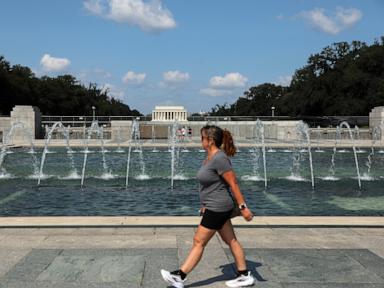
The defacement of the World War II Memorial in Washington, D.C., using bubbles and unauthorized graffiti exposes a critical friction point between open-access public architecture and the escalating cost function of modern asset protection. When a national commemorative site becomes the canvas for transient public expression or opportunistic vandalism, it signals a systemic failure across three distinct operational layers: physical security topology, jurisdictional response latency, and material vulnerability mitigation.
Understanding this incident requires stripping away the emotional rhetoric surrounding civic disrespect and examining the event through a rigorous security and operations lens. Memorials situated within the National Mall occupy a paradoxical design space. They are intended to invite unrestricted public engagement while simultaneously preserving material integrity in perpetuity. This tension creates predictable vulnerabilities that bad actors or disruptive groups routinely exploit.
The Three Vectors of Memorial Vulnerability
Public monuments of national significance face continuous exposure to degradation, but intentional vandalism differs fundamentally from routine wear and tear. The incident at the World War II Memorial highlights three distinct vulnerabilities that characterize modern urban monument security.
First is the geometry of open access. Unlike museums or enclosed federal installations equipped with controlled ingress points, open-air memorials feature high-permeability perimeters. The National Mall model prioritizes unfettered pedestrian flow, which inherently eliminates perimeter screening, bag checks, and temporal access controls. This design choice shifts the security burden from proactive prevention at the gate to reactive surveillance across expansive open zones.
Second is the material interface. Bronze, granite, and limestone surfaces react differently to cleaning agents, mechanical abrasion, and chemical compounds found in paint or soapy substances. Vandalism methods evolve faster than conservation protocols. While traditional graffiti involves pigment adhesion, alternative disruption techniques—such as introducing heavy-foaming surfactants or particulate mixtures—exploit the porous nature of architectural stone without triggering immediate chemical alarm systems.
Third is the response time differential. The spatial distribution of federal monuments creates a geographical coverage gap between security patrols. The United States Park Police and local municipal forces operate under resource constraints that dictate patrol frequencies. An individual or group can execute a defacement operation in minutes, whereas jurisdictional interdiction often relies on bystander reporting or automated closed-circuit television monitoring, introducing a critical latency window between event initiation and tactical intervention.
The Cost Function of Capital Asset Protection
Securing a public monument involves balancing the marginal cost of prevention against the historical and financial cost of restoration. Facility managers and federal authorities operate within a fixed budget constraint, forcing them to optimize resource allocation across a vast portfolio of public assets.
The cost function is defined by two primary variables: asset hardening expenses and restoration expenditure. Hardening a monument through chemical sealants, anti-graffiti coatings, and continuous physical surveillance reduces the probability of successful defacement. However, these measures introduce secondary costs. Advanced sealants can alter the visual texture and patina of historical stone, compromising aesthetic authenticity. Furthermore, round-the-clock physical guarding of every inscription and architectural element requires a personnel investment that exceeds standard municipal appropriations.
Conversely, adopting a reactive posture minimizes daily operational overhead but increases the expected value of restoration costs. When a monument is vandalized, restoration requires specialized conservation labor. Removing paint or chemical residues from historic stone without accelerating erosion demands proprietary cleaning solvents and skilled artisans. The total economic impact encompasses not only the direct remediation invoice but also the opportunity cost of public access restrictions during the restoration window.
Jurisdictional Friction and Enforcement Bottlenecks
The management of Washington, D.C., memorials involves a complex overlay of federal and local jurisdictions. The National Park Service holds primary administrative responsibility through the U.S. Park Police, while the Metropolitan Police Department maintains concurrent or adjacent authority depending on the exact property line.
This administrative overlap generates an operational friction coefficient that impedes rapid threat mitigation. Communication channels between federal dispatch centers and local patrol units require translation protocols that consume precious seconds during an active incident. Furthermore, prosecution rates for misdemeanor vandalism of public property rarely serve as an effective deterrent. The probability of severe legal consequence remains low relative to the anonymity provided by large crowds and dense urban thoroughfares.
When enforcement relies primarily on retrospective investigations using surveillance footage, the deterrent effect drops significantly. Potential offenders calculate the risk-reward ratio based on immediate physical presence rather than the distant prospect of a subpoena or minor fine. Without real-time kinetic deterrence or immediate perimeter containment, security measures remain purely forensic.
Strategic Asset Hardening and Material Science
Mitigating future incidents at open-access memorials requires moving beyond visible policing models and focusing on material science and predictive spatial monitoring.
Surface chemistry offers the first line of defense. Modern nanotechnology has enabled the development of sacrificial barrier coatings that bond molecularly with stone and metal substrates. These invisible layers prevent foreign substances, whether paint pigments or surfactant-based foams, from penetrating the microscopic pores of the material. When vandalism occurs, the sacrificial layer is washed away alongside the contaminant, leaving the underlying historic fabric untouched and eliminating the need for abrasive mechanical cleaning.
From a tactical perspective, spatial monitoring must transition from passive recording to active behavioral analytics. Traditional CCTV networks rely on human operators monitoring dozens of feeds simultaneously, a method prone to fatigue-induced error. Integrating computer vision algorithms capable of detecting anomalous physical interactions—such as prolonged contact with vertical monument walls, the deployment of pressurized dispensing equipment, or rapid gathering in restricted zones—allows security systems to cue automated loudspeaker warnings or dispatch nearest-unit vectors before the defacement reaches completion.
The long-term viability of open-access civic architecture depends on acknowledging that vulnerability is a design parameter, not an aberration. By treating monument security as an engineering problem rather than a purely cultural challenge, federal authorities can compress response latencies and raise the operational cost for disruptors without compromising the democratic accessibility of national spaces.