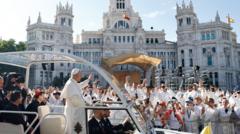
The heat in Madrid during August does not just sit on the skin. It presses. It is a thick, physical weight that radiates from the asphalt, turning the grand stone avenues into solar ovens. On a normal summer afternoon, locals flee to the coast or retreat behind heavy timber shutters, leaving the city to the dazed, sun-baked tourists.
But this was not a normal afternoon.
If you stood at the edge of the Cuatro Vientos air base, the sheer scale of humanity altered the horizon. The dry earth had been trampled into a fine, choking white dust by more than a million pairs of shoes. It hung in the air like a mist, catching the fierce Spanish sun. From a distance, the crowd did not look like a collection of individuals. It looked like a living, shifting ocean of color—yellow and red Spanish flags mixing with the banners of a hundred different nations, all rippling under a cloudless sky.
News reports would later summarize this with a sterile statistic: "Huge crowds throng Madrid streets for Pope's open-air Mass." They would give you the estimated attendance figures, the temperature readings, and the official itinerary of World Youth Day.
They would miss the entire point.
To understand what actually happened on that scorched airfield, you have to look past the macro-level logistics and focus on the micro-level friction. You have to understand what it feels like when a million people decide to share the same breath.
The Economics of Devotion
Consider a young woman named Maria. She is twenty-one, from a small town outside Porto, and she spent six months saving her tips from a local cafe just to afford the bus ride to Madrid. In a hypothetical ledger of modern value, her investment makes no sense. She paid to sleep on a concrete floor in a crowded school gymnasium. She paid to eat lukewarm bocadillos out of a brown paper bag. She paid to stand for hours in forty-degree heat with water rations running low.
Why?
In a hyper-connected world, we are told that community can be found through a screen. We are told that shared interests can be aggregated by algorithms, that belonging is a matter of clicking a button or joining a digital forum. But human beings are biological creatures. We possess an ancient, stubborn need for physical proximity.
When Maria stands in a crowd that stretches as far as the eye can see, something shifts in her perception of reality. The isolation of modern youth—the quiet anxiety of wondering if you are the only one who cares about something deeply—evaporates.
The air base became a pressure cooker of collective energy. It was loud. A chaotic symphony of acoustic guitars, chanting in Italian, singing in Polish, and the constant, rhythmic clapping of groups trying to keep their spirits up against the exhausting heat. Fire trucks lined the perimeter, turning their massive hoses onto the crowd. Instead of running from the water, thousands of people surged forward, cheering as the artificial rain cooled the baked earth. It was a carnival of shared endurance.
Then, the sky changed.
When the Sky Broke
Late in the evening, as Pope Benedict XVI took the massive, white-canopied stage, the oppressive heat broke in the most violent way possible. The air turned a bruised, metallic purple. A sudden, ferocious wind swept across the open plain, tearing at the banners and threatening to rip the vestments from the altar.
It was not just a breeze; it was a gale. The sound of the wind tore through the massive audio towers, drowning out the opening prayers with a low, menacing roar. Rain followed—sharp, heavy drops that stung the skin and turned the white dust into a slick, clinging mud.
Under the stage, security personnel whispered urgently. Advisers leaned into the Pope, suggesting he retreat to safety. The canopy above him was buckling under the force of the storm. For several long minutes, the entire event teetered on the edge of a logistical disaster. A million wet, freezing people stuck in the dark on a muddy airfield could easily turn into a panic.
But no one moved.
Instead, a strange phenomenon occurred. As the wind whipped harder, the crowd didn’t scatter for cover. They linked arms. Groups of complete strangers formed human walls against the storm, holding down plastic tarps to shield the elderly and the young. The singing grew louder, a defiant counter-melody to the thunder.
The Pope stayed. He sat quietly in his chair, refusing to leave the stage, shielded only by a cluster of umbrellas that threatened to turn inside out at any second. When the storm finally passed, leaving everyone drenched and shivering in the sudden drop in temperature, he looked out at the sea of muddy, smiling faces and smiled back.
"Thank you for your joy and your stamina," he told them. His voice was thin, but it carried across the quieted plain. "Your strength is greater than the rain."
The Silence After the Storm
The true climax of the event, however, did not happen during the drama of the tempest, nor during the grand musical crescendos of the liturgy. It happened during the adoration.
Imagine a million people. It is a number so large it becomes abstract. If you put a million people in a stadium, the ambient noise of throat-clearing, shifting feet, and whispered conversations creates a permanent, low-frequency hum. It is impossible to silence that many bodies.
Yet, when the consecrated host was placed on the altar, a signal seemed to pass through the crowd without a single word being spoken.
One by one, people dropped to their knees. First the front rows, then the middle sections, until the movement rippled all the way to the distant perimeter fences. And then, the noise stopped.
Not a gradual quiet, but a sudden, breathtaking drop into absolute silence.
The wind had died down. The rain had ceased. In the middle of one of Europe’s loudest, most vibrant capitals, a million young people knelt in the mud and did absolutely nothing. For ten full minutes, the only sound was the occasional distant siren from the city streets outside the base.
It was an uncomfortable, shocking silence. To an outsider, it might have looked like madness or submission. But to those inside the perimeter, it felt like an anchor. In a culture that demands constant commentary, instant reactions, and continuous noise, that silence was a radical act of rebellion. It was a collective refusal to be distracted.
The next morning, the sun returned, baking the mud back into hard clay. The buses lined up, the trains filled, and the million people began the long, messy process of going home. They left behind tons of plastic water bottles, lost shoes, and a city trying to figure out how to clean up after an invasion.
The headlines the next day spoke of traffic delays, municipal costs, and the political arguments surrounding the papal visit. They analyzed the event from thirty thousand feet, counting heads and calculating economic impact.
But on a train heading back toward the Portuguese border, a young woman with dried mud on her sneakers slept with her head against the glass. She didn't look like a statistic. She looked like someone who had stood in the eye of a storm, looked around, and realized she was no longer alone.