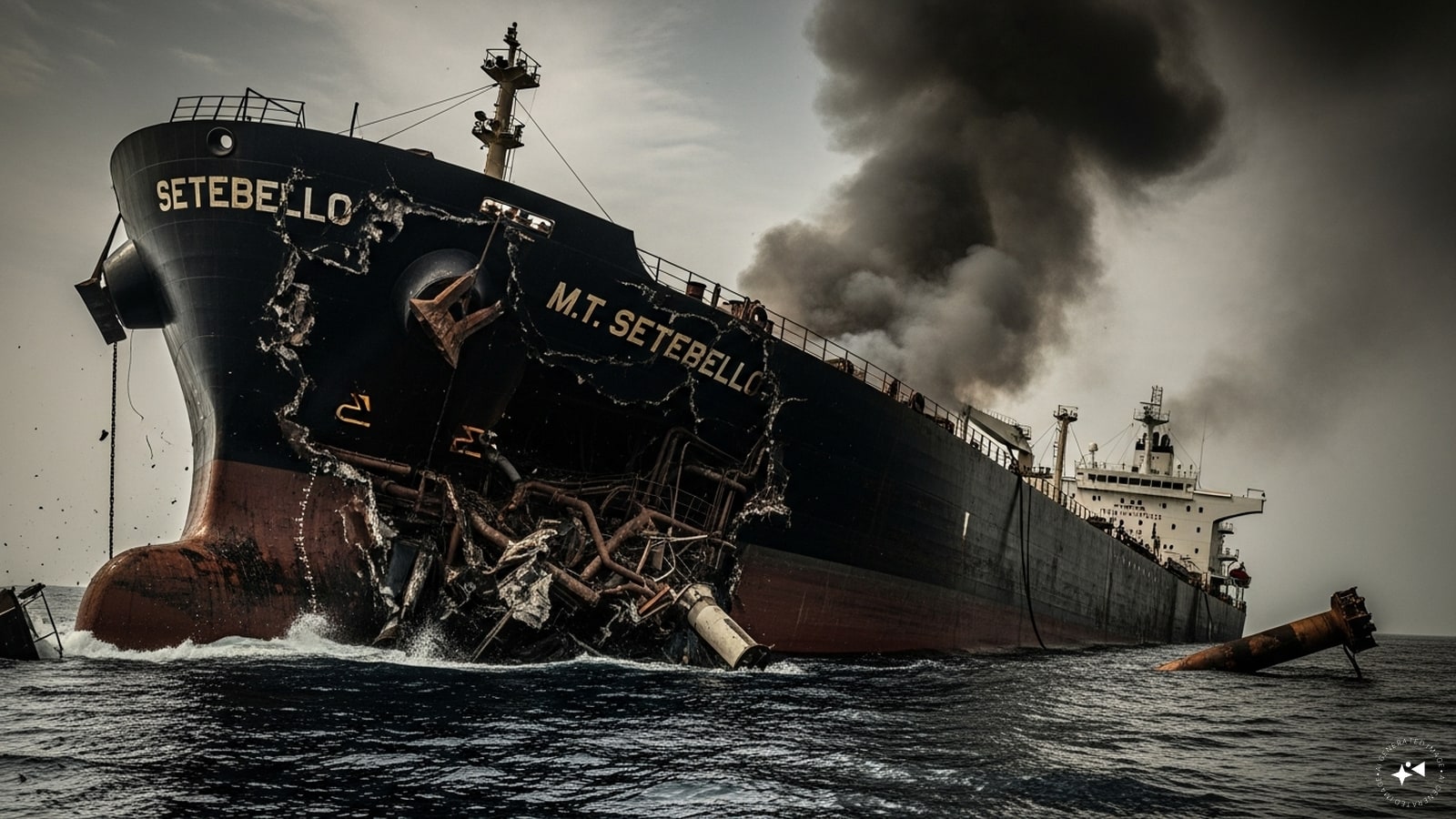
The kinetic strike on the Palau-flagged motor tanker MT Settebello in the Gulf of Oman exposes the high-friction realities of unilateral maritime blockade enforcement. When U.S. Central Command forces deployed precision munitions against the 29-year-old vessel's engine room, the action was framed as a direct enforcement mechanism against illicit Iranian energy logistics. Conversely, the vessel’s manager, Dubai-based IOS Marine FZE, defined the event as an unauthorized military assault on an innocent civilian merchant ship.
Beneath these competing public relations narratives lies a sophisticated operational matrix involving electronic warfare, sanctions evasion infrastructure, and the legal ambiguities of enforcement operations in international waterways. Resolving these conflicting claims requires breaking down the event into its structural components: tracking data, communication verification protocols, and the mechanics of the "Shadow Fleet."
The Asymmetric Architecture of Shadow Fleet Operations
To understand why the MT Settebello became a kinetic target, one must examine the operational structure of the shadow fleet—the network of aging, under-regulated vessels used to bypass Western sanctions. This infrastructure operates on three primary structural pillars:
- Flag of Convenience Arbitrage: Utilizing open registries, such as Palau or Panama, that lack the regulatory oversight or enforcement capabilities of traditional maritime states. This minimizes the risk of regulatory detention while masking ultimate beneficial ownership.
- Corporate Layering: Shielding the actual economic beneficiaries behind complex networks of shell companies, often shifting technical management to entities in jurisdictions with high corporate opacity.
- AIS Transponder Manipulation: Utilizing specialized spoofing techniques or complete Automatic Identification System blackouts to obscure port calls and ship-to-ship transfer operations.
While IOS Marine FZE asserts that the MT Settebello has no affiliation with Iranian oil and was engaged in legitimate commercial operations, maritime analytics frameworks provide a different diagnostic. Independent tracking data from specialized firms indicates the vessel had been integrated into Iranian crude logistics networks for approximately five years.
This long-term operational profile is what triggered the U.S. Navy’s interdiction framework. Within a strict blockade environment, a vessel's historical data profile acts as a primary risk indicator, neutralizing the legal protection typically granted to civilian commercial shipping.
The Signal Verification Bottleneck: Did Communications Fail?
The core tactical disagreement between the vessel manager and CENTCOM centers on the execution of pre-strike warnings. CENTCOM asserts that the crew repeatedly failed to comply with directions from American forces. IOS Marine FZE categorically rejects this claim, challenging the U.S. Navy to publish empirical evidence of successful communication.
This dispute highlights a critical technical vulnerability in maritime interdiction: the signal verification bottleneck. In a high-tension operational environment, the breakdown of communication typically follows a predictable failure chain.
[Interdiction Asset Transmits Warning via VHF Ch 16]
                         │
                         ▼
             [Vessel Fails to Acknowledge]
                         │
        ┌────────────────┴────────────────┐
        ▼                                 ▼
[Intentional Non-Compliance]    [Technical Interruption]
• Evasive maneuvers             • Jamming/Electronic warfare
• Bridge abandonment            • Antenna damage
• Command hierarchy refusal     • Language/Protocol friction
The ship manager notes that the MT Settebello remained stationary for approximately ten days prior to the strike, interpreting this lack of movement as proof of non-evasive, peaceful intent. However, within the logic of naval blockade enforcement, a stationary vessel idling inside a restricted corridor without clear commercial justification can be interpreted as a staging tactic or a deliberate refusal to comply with a redirection order.
If electronic warfare assets were active in the corridor, or if the vessel's bridge crew intentionally ignored standard VHF Channel 16 transmissions to preserve plausible deniability, a fatal miscalculation becomes mathematically probable. The U.S. military's subsequent release of thermal imagery showing a precise strike on the engineering compartment—rather than the hull or living quarters—demonstrates a calculated tactical objective: neutralize the vessel's propulsion and steering capabilities while attempting to minimize structural disintegration and total hull loss.
The Economic Cost Function of Kinetic Sanctions Enforcement
The physical consequences of the strike carry severe structural and financial liabilities for global maritime commerce. IOS Marine FZE estimates structural damages to the MT Settebello to exceed $35 million, noting that the vessel will require an extensive transcontinental tow to the Far East for drydocking and structural reconstruction.
This damage represents more than a localized loss; it alters the risk pricing model for regional shipping. The maritime insurance cost function in high-risk corridors is calculated using three primary variables:
$$C_i = f(P_k, V_s, H_m)$$
Where:
- $C_i$ is the total insurance premium adjustment.
- $P_k$ is the quantified probability of kinetic interdiction or asymmetric attack within the specific geographic coordinate bounds.
- $V_s$ is the structural vulnerability and age index of the vessel class.
- $H_m$ is the historical compliance tracking metric of the operating entity.
Because the MT Settebello is an older vessel built in 1997, its structural resilience is significantly lower than modern double-hulled designs, compounding the financial risk of kinetic damage. When a unilateral blockade results in the actual destruction of propulsion assets and seafarer fatalities, the value of $P_k$ spikes across the entire regional corridor. This causes an immediate escalation in war-risk premiums, effectively creating an economic barrier to entry for legitimate operators who share the waterway with high-risk shadow fleet vessels.
Legal Geopolitics and Freedom of Navigation Boundaries
The demand by the vessel manager for an international probe underscores the deep legal ambiguities defining this conflict. Under the United Nations Convention on the Law of the Sea (UNCLOS), civilian vessels in international waters enjoy freedom of navigation and are generally subject only to the exclusive jurisdiction of their flag state.
Unilateral blockades enforced outside an explicit United Nations Security Council mandate occupy a highly contested legal space. The international community assesses these enforcements through two conflicting doctrines:
- The Sovereign Right of Self-Defense and Economic Interdiction: Proponents argue that states may enforce maritime exclusions to neutralize systemic economic threats or halt the flow of strategic materials funding regional proxy conflicts.
- The Absolute Sanctity of Flag-State Jurisdiction: Opponents hold that stopping, boarding, or disabling a foreign-flagged merchant ship in international waters without flag-state consent or a UN mandate constitutes a violation of international maritime law.
This tension places neutral seafaring nations in a difficult diplomatic position. India’s Ministry of External Affairs condemned the strike due to the loss of Indian seafarers but notably refrained from naming the United States in its official statements. This carefully calibrated response reflects a delicate geopolitical balancing act. New Delhi must protect its citizens and domestic energy security while maintaining its strategic maritime alliance with Washington, which is vital for balancing broader regional security interests.
Tactical Reconfiguration for Maritime Operations
Operating commercial assets within heavily monitored maritime corridors requires a fundamental shift from passive compliance to proactive verification. Entities choosing to navigate these zones must implement strict operational protocols to prevent catastrophic misidentifications.
First, operators must establish redundant communication verification channels. Relying exclusively on standard bridge VHF radios is insufficient when operating near active military assets. Crews must be equipped with secondary, satellite-based communication systems that maintain an open, recorded log with global maritime security coordination centers. If a military asset attempts to establish contact, the interaction must be logged concurrently via encrypted off-ship servers to create an indisputable digital audit trail.
Second, the practice of utilizing flags of convenience with weak regulatory oversight must be factored against the increased risk of military profiling. Blockade enforcement forces use automated data matrices to flag vessels based on registry history, age, and management changes. Shifting assets to highly transparent registries and maintaining clear, verifiable chains of beneficial ownership acts as a direct risk-mitigation strategy.
Finally, technical management firms must enforce absolute transparency regarding historical tracking data. If a newly acquired asset possesses a history of sanctions-evasion operations under previous ownership, the vessel must undergo a comprehensive, verified compliance audit before entering contested corridors. Failing to purge the vessel’s digital tracking footprint ensures it will remain a high-priority target within automated military screening frameworks, regardless of its current cargo or immediate operational intent.