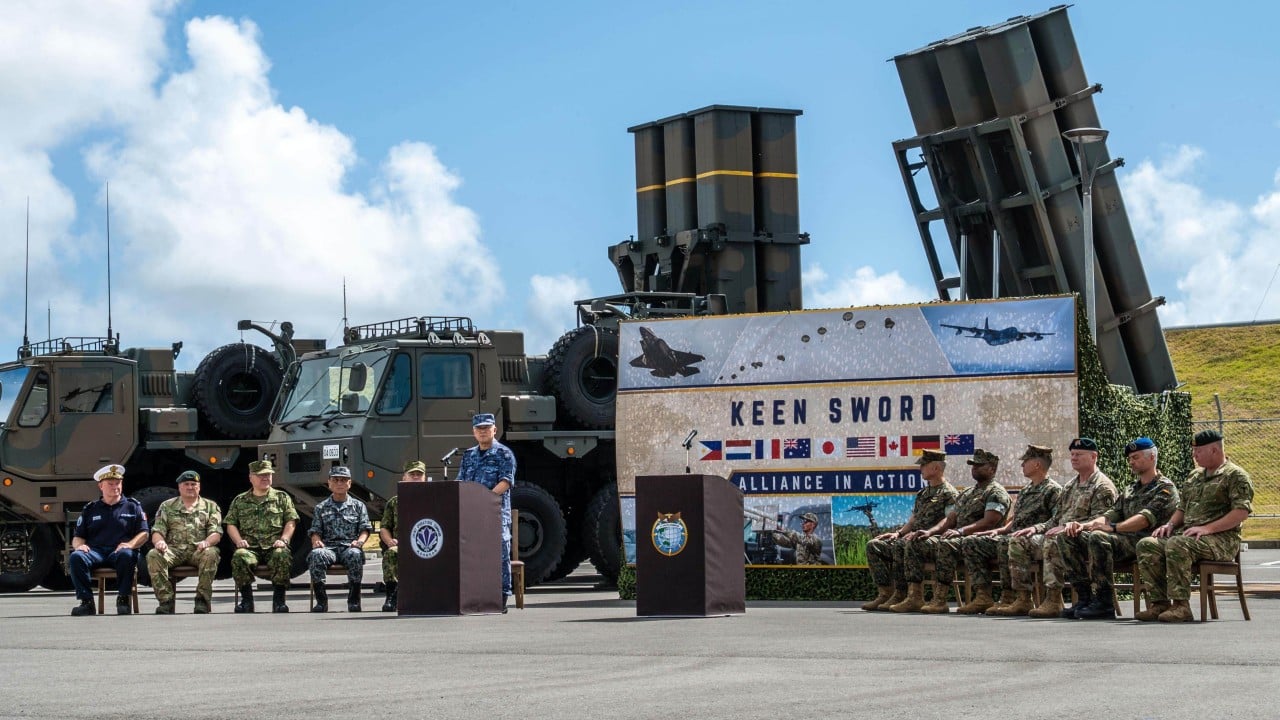
Tokyo’s security architecture has shifted from reactive constitutional pacifism to an integrated, forward-deployed maritime containment network designed to neutralize Beijing’s naval breakout across the First Island Chain. Driven by acute hedging against fluctuating American security guarantees and escalating People’s Liberation Army (PLA) air-sea transits, Japan is constructing an interlocking regional deterrence grid that imposes steep operational costs on Chinese power projection.
Standard geopolitical commentary frequently mischaracterizes this transformation as a simple return to mid-twentieth-century militarism or a passive extension of Washington’s hub-and-spoke alliance system. Both interpretations miss the structural mechanics driving Tokyo’s defense planners. Under Prime Minister Sanae Takaichi’s administration, Japan is executing a calculated strategy of autonomous collective deterrence. Rather than waiting for multilateral consensus or relying solely on Washington’s nuclear and conventional umbrella, Tokyo is using targeted defense spending, long-range strike integration, and bilateral security agreements to stitch together a contiguous perimeter stretching from the Korean Peninsula through the Ryukyu archipelago down to the South China Sea and the Indian Ocean.
The Structural Catalyst: Alliance Hedging and the Credibility Gap
For seven decades, Japan’s grand strategy rested on the Yoshida Doctrine: outsourcing external security to the United States while concentrating state capacity on industrial and economic expansion. That equilibrium collapsed under the dual pressures of rapid Chinese naval modernization and growing doubts in Tokyo regarding the durability of American extended deterrence.
When a junior alliance partner perceives a widening commitment credibility gap—the fear that its security guarantor might hesitate to intervene in a regional crisis due to domestic political shifts, great-power transactionalism, or fear of nuclear escalation—the junior partner faces two choices. It can accommodate the rising regional hegemon, or it can internalize its own security costs while building redundant regional partnerships. Tokyo chose the latter.
This dynamic explains why Japan accelerated the revision of its foundational Three Security Documents ahead of schedule and pushed defense expenditure toward the 2 percent of GDP threshold. By standing up a permanent Joint Operations Command to unify ground, maritime, and air self-defense forces, Tokyo eliminated a critical command-and-control bottleneck. Previously, Japan’s military branches operated in silos that required American coordination to synchronize. Today, Japan possesses the institutional architecture to conduct independent, multi-domain campaign planning, positioning itself as a regional security organizer rather than an auxiliary force.
The Three Pillars of the Containment Arc
To understand how Tokyo is operationalizing this strategy without triggering immediate kinetic conflict, the emerging containment arc must be broken down into three distinct functional layers.
1. Geographic Chokepoint Saturation (The Southwestern Wall)
The physical spine of Japan’s containment strategy runs along the Nansei (Ryukyu) Islands, an archipelago stretching roughly 1,200 kilometers from Kyushu to Yonaguni, just over 100 kilometers east of Taiwan. Every major surface and subsurface route connecting China’s East Sea Fleet to the open Pacific passes through narrow maritime straits within this chain, most notably the Miyako Strait and the Osumi Strait.
Tokyo is transforming this island chain into a dense anti-access/area-denial (A2/AD) barrier—effectively turning Beijing’s own operational doctrine back against the PLA Navy. Key operational components include:
- Distributed Missile Batteries: Deploying upgraded Type-12 surface-to-ship missiles and newer Type-25 systems across garrisons on Miyako, Ishigaki, and Yonaguni. Extending missile ranges to 1,000 kilometers allows Japanese forces to hold PLA surface combatants at risk well inside the East China Sea before they reach open ocean.
- Integrated Air and Missile Defense (IAMD): Layering Patriot PAC-3 batteries and Aegis-equipped destroyers to protect fixed island bases and radar installations from saturation strikes.
- Persistent ISR Grids: Expanding intelligence, surveillance, and reconnaissance networks using unmanned aerial and underwater vehicles to track PLA submarine movements through deep-water channels in real time.
2. Institutional Lock-In via Minilateral Webs
A bilateral defense buildup alone cannot contain a continental power with China’s industrial scale. Recognizing this asymmetry, Tokyo has constructed an overlapping network of minilateral security agreements—small, agile coalitions designed for rapid operational interoperability rather than broad diplomatic consensus.
Tokyo anchors this network through Reciprocal Access Agreements (RAAs), visiting forces pacts, and joint industrial programs:
- The Southern Anchor (Australia and the Philippines): Through its RAA with Canberra and enhanced defense pacts with Manila, Japan has established legal frameworks for regular troop deployments, joint exercises, and shared logistics across the South China Sea’s northern and southern approaches.
- The Western Flank (India): Cooperation between Tokyo and New Delhi targets maritime domain awareness in the Indian Ocean, securing the vital sea lines of communication through which over 80 percent of China’s seaborne energy imports must pass.
- Out-of-Area Technological Integration: Through the Global Combat Air Programme (GCAP) with the United Kingdom and Italy, alongside formal liaison channels with NATO and the European Union, Japan has tied European defense-industrial capacity directly to Indo-Pacific deterrence.
3. Defense Capacity-Building as Strategic Leverage
Where formal military alliances are politically unviable—particularly among Southeast Asian states determined to avoid choosing sides between Washington and Beijing—Tokyo deploys Official Security Assistance (OSA). Unlike traditional economic development aid, OSA provides direct grants for military hardware, coastal radar systems, patrol vessels, and satellite communications to partner nations such as the Philippines, Malaysia, Vietnam, and Bangladesh.
This mechanism functions as low-cost force multiplication. By upgrading the maritime surveillance capabilities of littoral states bordering the South China Sea, Japan degrades Beijing’s ability to conduct unmonitored "gray-zone" coercion—tactics using coast guard cutters and maritime militias that fall below the threshold of conventional warfare. Every coastal radar station funded by Tokyo in Southeast Asia feeds into a broader regional picture of PLA movements.
The Cost-Imposition Function on Beijing
From Beijing’s perspective, the emergence of a Japanese-led containment arc fundamentally alters the strategic calculus in East Asia. For decades, Chinese military planners operated under the assumption that deterring or defeating a Taiwan contingency required solving a single primary problem: delaying or denying American carrier strike groups access to the Western Pacific.
Japan’s transformation introduces a multi-axis operational dilemma for the PLA:
- Loss of Strategic Surprise: Continuous Japanese ISR coverage across the Ryukyu gap and the South China Sea compresses Beijing’s mobilization timelines, making covert naval deployments virtually impossible.
- Force Dilution: In any regional conflict, the PLA can no longer concentrate its missile and naval assets solely against American bases in Guam or Taiwan’s defenses. It must simultaneously allocate substantial firepower to neutralize hardened Japanese missile sites across a 1,200-kilometer archipelago, degrading the weight of its primary offensive thrust.
- Diplomatic Isolation: Unlike American intervention, which Beijing frames domestically and regionally as external interference by a Western superpower, Japanese security initiatives carry the legitimacy of a resident Asian power protecting established maritime trade routes. Beijing’s standard tools of economic coercion—such as restricting tourism, launching trade probes into Japanese materials, or freezing high-level diplomatic exchanges—have consistently failed to reverse Tokyo’s defense trajectory. Instead, punitive Chinese measures have hardened Japanese domestic consensus in favor of rapid rearmament.
Structural Vulnerabilities and Operational Constraints
Despite the coherence of Tokyo’s strategic blueprint, treating the Japanese containment arc as an airtight barrier ignores severe structural constraints. Any realistic assessment must account for four primary points of friction that limit Japan’s capacity to sustain this posture.
- Demographic and Recruitment Deficits: Japan faces the most acute demographic contraction in the developed world. The Japan Self-Defense Forces (JSDF) consistently miss annual recruitment targets, leaving frontline units understaffed. Advanced missile batteries and unmanned systems reduce manpower requirements per platform, but they cannot fully compensate for a shrinking pool of military-age personnel needed for sustained high-intensity operations.
- Defense-Industrial Fragility: Decades of strict arms export bans left Japan’s domestic defense sector fragmented, low-volume, and reliant on bespoke government contracts. While Tokyo has relaxed export controls and increased procurement budgets, scaling up munitions manufacturing—particularly for precision-guided stand-off missiles and air-defense interceptors—requires years of capital investment and supply chain restructuring. In a protracted conflict, Japan’s magazine depth remains dangerously shallow.
- The Escalation Trap: Deploying long-range counterstrike missiles on islands close to Taiwan blurs the line between defensive denial and offensive strike capability. In a crisis, Beijing may view Japanese island garrisons as immediate existential threats to its mainland coastal infrastructure, incentivizing pre-emptive strikes against Japanese territory before Tokyo even decides whether to enter a conflict.
- ASEAN Hedging Limits: Southeast Asian nations welcome Japanese infrastructure investment and maritime patrol boats, yet few are willing to host offensive Japanese weaponry or commit to mutual defense treaties. If Tokyo pushes its regional partners too aggressively toward explicit anti-China alignment, Southeast Asian capitals will recoil to preserve their economic ties with Beijing.
Strategic Trajectory and Operational Imperatives
The trajectory of East Asian security is no longer governed solely by the bilateral balance of power between Washington and Beijing. Japan has successfully institutionalized a third pole of deterrence. Because Tokyo’s defense buildup is anchored in multi-year procurement budgets, permanent command restructuring, and binding multilateral defense treaties, this containment architecture will persist regardless of short-term diplomatic thaws or leadership transitions in Washington.
For strategic planners and institutional stakeholders operating across the Indo-Pacific, three operational realities now dictate regional risk management:
- Treat the Ryukyu Archipelago as a Primary Contested Zone: Supply chain and maritime logistics operators must model the East China Sea and the waters surrounding the Nansei Islands as permanently militarized corridors. Commercial shipping routes transiting the Miyako and Bashi Straits face heightened disruption risks from frequent live-fire exercises, electronic warfare interference, and gray-zone blockades.
- Expect Asymmetric Chinese Counter-Measures: Unable to dismantle Japan’s island wall militarily without triggering a broader coalition war, Beijing will intensify non-kinetic pressure. Expect targeted supply chain chokeholds on critical minerals and dual-use industrial inputs, alongside sustained cyber operations against Japanese defense contractors and critical infrastructure.
- Prioritize Distributed Resilience Over Centralized Alliances: Security and economic frameworks in the Indo-Pacific will continue shifting away from broad, consensus-based institutions toward specialized, functional coalitions. Entities aligning with Tokyo’s industrial and technological ecosystem—particularly in dual-use aerospace, autonomous maritime systems, and semiconductor supply chains—will capture the primary capital flows of the region’s defense transformation.