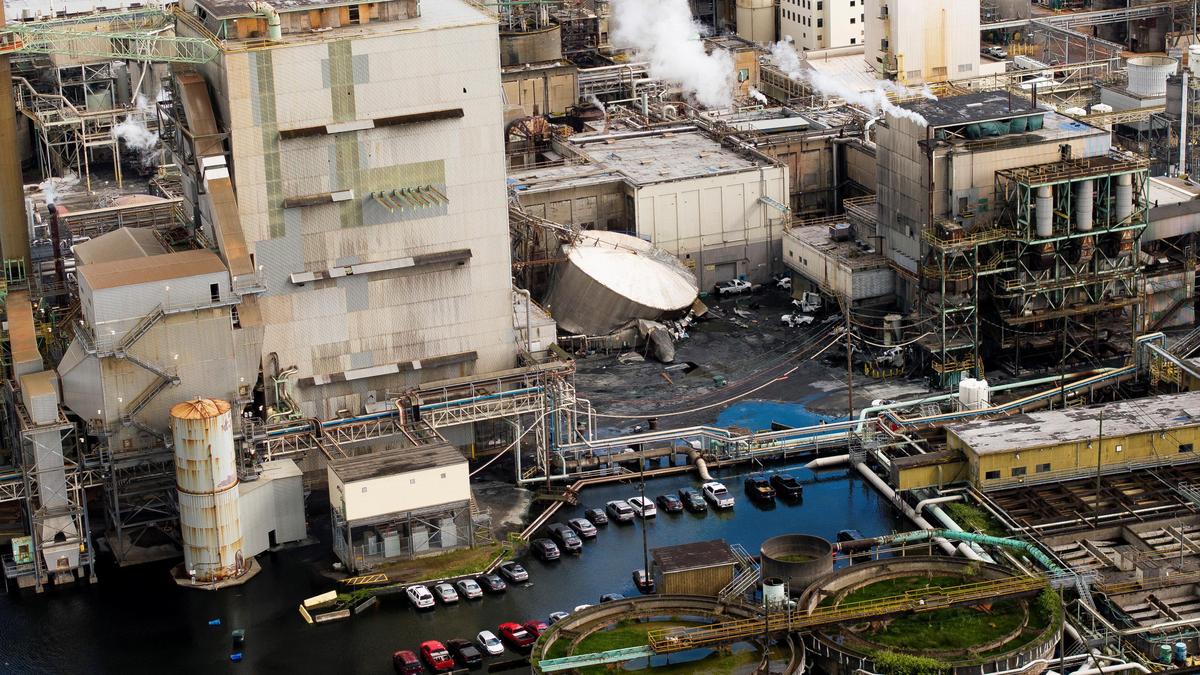
Industrial disasters involving atmospheric or low-pressure storage vessels are rarely the result of a single isolated anomaly; they are the consequence of structural and operational dynamics failing in sequence. The catastrophic failure of a 900,000-gallon chemical storage tank at the Nippon Dynawave Packaging facility in Longview, Washington, serves as a case study in how mechanical instability and chemical hazards intersect. Initial assessments confirming one fatality, nine missing workers, and nine injuries underscore the high physical costs of containment breaches involving highly corrosive industrial processes.
To understand why this event progressed from a localized structural failure into a mass-casualty containment breach, analysts must look beyond standard reporting and isolate the specific physical mechanisms of an industrial tank implosion. By mapping the mechanical variables of low-pressure vessels and evaluating the operational constraints of hazardous material management, we can establish a blueprint for structural risk mitigation.
The Mechanics of Vacuum-Induced Implosion
Low-pressure and atmospheric storage tanks are designed to withstand massive internal outward pressure from liquid payloads, but they possess exceptionally low tolerance for negative internal pressure differentials. When an atmospheric vessel undergoes an implosion, the primary cause is typically a rapid, uncompensated drop in internal pressure relative to the surrounding atmosphere.
This mechanical vulnerability can be expressed through a fundamental equilibrium equation. A stable tank requires that internal pressure plus structural resistance equals external atmospheric pressure:
$$P_{internal} + P_{structural} \geq P_{external}$$
When a vacuum forms, $P_{internal}$ drops below $P_{external}$. Because thin-walled industrial storage tanks have minimal structural resistance against inward forces ($P_{structural}$ in compression), even a minute pressure differential—often less than 1 to 2 pounds per square inch—can trigger an instantaneous geometric collapse.
The physical catalyst for this negative pressure differential generally traces back to three operational vectors:
- Unvented Liquid Drawdown: High-volume pumps rapidly evacuate liquid from the tank without an equivalent volumetric inflow of air or inert gas, causing the internal headspace to expand and pressure to drop.
- Rapid Thermal Contraction: A sudden cooling event, such as a cold water wash down or a torrential downpour on a hot tank exterior, causes the internal vapor or gas phase to rapidly condense, instantly reducing headspace volume.
- Ventilation Blockage: Mechanical failure, chemical crystallization, or particulate buildup clogs the conservation vents or flame arrestors, preventing the vessel from breathing during standard thermal cycles or pumping operations.
When the structural envelope buckles under compressive stress, the failure is not localized. The geometry of the cylinder integrity fails completely, leading to a rapid vertical or diagonal collapse that compromises the bottom shell rings and spills the stored payload into the immediate footprint.
Chemical Hazards and the Corrosive Kinetic Chain
The severity of the incident at the Longview mill was amplified by the specific chemical properties of the payload. The tank was filled to approximately 60% capacity with "white liquor," a critical reagent used in the Kraft pulping process to dissolve the lignin binding wood fibers together.
White liquor is not a single chemical substance, but a highly alkaline aqueous solution primarily composed of two active components:
- Sodium Hydroxide ($NaOH$): A strong base responsible for breaking down chemical bonds in organic matter, highly corrosive to human tissue and capable of causing severe chemical burns upon contact.
- Sodium Sulfide ($Na_2S$): An inorganic salt that accelerates the delignification process. When exposed to acids or high temperatures, it can generate highly toxic hydrogen sulfide gas ($H_2S$).
- Sodium Carbonate ($Na_2CO_3$): A process residual that contributes to the overall alkalinity of the liquor.
The kinetic chain of a white liquor spill creates immediate physical threats. The liquid has a high pH (typically exceeding 13), meaning that any contact with human skin results in liquefaction necrosis—a process where the chemical dissolves tissue proteins and lipids, allowing the burn to penetrate deeply into sub-dermal layers. Furthermore, the vapor or mist generated during a high-energy structural collapse causes severe respiratory tract burns if inhaled, explaining why first responders categorized the event as a mass-casualty scene requiring immediate hazardous material decontamination.
The Post-Collapse Operational Bottleneck
When an industrial tank implodes and retains a residual payload—as was the case in Longview, where an estimated 90,000 gallons remained trapped within the compromised structure—emergency responders face a complex optimization problem. The interaction between structural instability and hazardous material containment prevents immediate physical intervention, shifting the operation from a rapid rescue to a deliberate recovery phase.
This operational bottleneck is governed by three conflicting priorities:
[Structural Stabilization] ──► Reduces risk of secondary collapse
           │
           ▼
[Chemical Decontamination] ──► Neutralizes contact and inhalation hazards
           │
           ▼
[Victim Extraction]        ──► Allows safe access to the hot zone
The primary constraint is structural instability. A buckled, partially collapsed steel cylinder holding tens of thousands of gallons of liquid represents an unpredictable distribution of kinetic energy. Moving heavy debris or introducing rescue personnel can shift the center of gravity, causing a secondary collapse.
The second constraint is payload management. Responders must decide whether to pump out the remaining corrosive fluid before stabilizing the steel walls, or stabilize the walls first to prevent a secondary spill during pumping. Pumping reduces the liquid mass but can alter the internal pressure and vacuum dynamics, potentially causing further structural movement. Conversely, attempting to shore up a shifting, chemical-soaked structure poses severe risks to hazardous material teams.
The third constraint is environmental isolation. As liquid escapes the immediate containment zone into secondary areas like drainage ditches, environmental teams must establish physical booms or neutralization protocols without disrupting the structural containment area.
Risk Mitigation Frameworks for Low-Pressure Vessels
To prevent vacuum-induced failures in high-volume chemical storage systems, facilities must transition from reactive monitoring to redundant physical safeguards. Relying on operators to catch pressure drops via control room readouts is insufficient because implosions occur in milliseconds once the structural threshold is breached.
Redundant Mechanical Venting
Every atmospheric storage vessel holding hazardous chemicals requires independent, multi-stage pressure and vacuum relief valves (PVRVs). These mechanical valves must be sized not just for standard operating filling and emptying rates, but for emergency thermal contraction scenarios. Emergency vacuum breakers must operate purely on mechanical pressure differentials, requiring no electrical power or digital control inputs to actuate.
Structural Reinforcement via Stiffening Rings
Tank engineering must account for external pressure loads through the integration of circumferential stiffening rings. While thin-walled cylinders are efficient at holding internal liquid volume, adding structural steel bands along the upper third of the tank shell provides the geometric resistance necessary to withstand unexpected external pressure differentials without escalating into total collapse.
Continuous Vapor Space Monitoring
Advanced safety systems use continuous blanketing with an inert gas, such as nitrogen, paired with differential pressure transmitters. These sensors measure the minute differences between the tank headspace and the outside atmosphere. If the pressure dips below a critical threshold, automated high-volume gas injection systems fire to equalize the volume before mechanical buckling occurs.
The incident in Washington highlights the critical importance of these preventative engineering frameworks. When dealing with large volumes of corrosive chemicals, structural integrity is the primary line of defense against severe industrial accidents.
The immediate strategic priority for industrial operators managing similar infrastructure is to audit all low-pressure chemical storage assets. This audit must prioritize checking the calibration of vacuum relief systems, verifying that vent paths are free from chemical scaling, and reviewing whether tank shell thicknesses meet current codes for external pressure resistance. Relying on historic safety records or basic visual inspections is an inadequate strategy for managing high-consequence chemical systems.