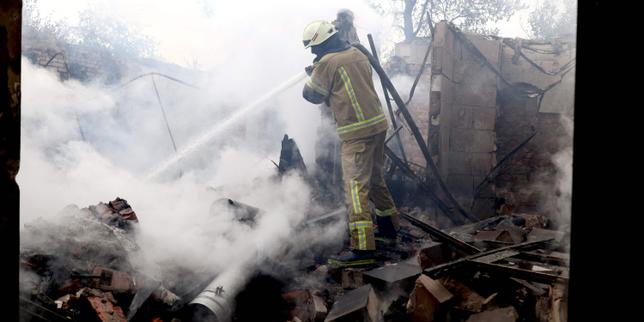
The rhetorical condemnation of "indiscriminate" kinetic strikes by international bodies frequently obscures the calculated military logic driving modern attritional warfare. When NATO Secretary General Mark Rutte denounces systematic missile and drone campaigns targeting localized infrastructure, the political objective is to reinforce normative constraints against state aggression. However, a cold strategic assessment reveals these actions are rarely random or disorganized. Instead, they represent a highly structured application of asymmetric cost-imposition, designed to exploit the physical and economic bottlenecks inherent in Western defensive doctrines. Understanding the current trajectory of the conflict in Ukraine requires moving past surface-level condemnation and analyzing the precise mechanics of infrastructure degradation, supply-chain depletion, and deterrence failure.
The Triad of Infrastructure Degradation
The deployment of long-range strike assets against non-military targets operates on three distinct strategic axes. Rather than serving as aimless terror tactics, these campaigns target the structural foundational layers that sustain a nation's capacity to wage prolonged defensive war. For a closer look into this area, we recommend: this related article.
1. Grid De-synchronization and Industrial Asphyxiation
Modern defense production and military logistics rely entirely on stable, high-voltage electrical distribution. By targeting critical transmission substations rather than generation facilities themselves, an attacking force creates systemic instability across the entire energy network. Autotransformers, which step down voltage for regional distribution, represent a profound single point of failure. These units are highly complex, require months to manufacture, and cannot be easily bypassed. Striking these nodes isolates power generation plants, rendering them incapable of delivering energy to localized defense industries, repair depots, and railway networks. The objective is not instantaneous collapse, but the cumulative throttling of industrial throughput.
2. Air Defense Depletion Mechanics
An attacking force utilizes low-cost loitering munitions to force an asymmetrical economic choice upon the defender. A single localized strike package may consist of dozens of cheap, slow-moving drones layered alongside sophisticated cruise missiles. For broader background on this development, detailed reporting is available at NBC News.
- Defensive forces face a mathematical trap: ignore the low-tier threats and risk localized destruction of critical infrastructure, or engage them using highly sophisticated surface-to-air missiles (SAMs).
- The cost ratio inherently favors the aggressor, often stretching to 1:10 or 1:50 per engagement.
- The ultimate bottleneck is not financial, but industrial capacity. Western production lines for interceptor missiles cannot match the consumption rate dictated by multi-axis drone waves.
3. Political Friction and Coalition Fatigue
The third axis targets the domestic political cohesion of supporting alliances. By systematically degrading the civilian living standards of the defending nation, the attacking force generates predictable outward migration flows and compounding economic stabilization costs. This places a continuous, non-military financial burden on coalition partners, who must fund baseline humanitarian survival budgets alongside direct military assistance. The strategic goal is to trigger political fragmentation within the supporting alliance as domestic electorates question the long-term viability of indefinite financial subsidization.
The Cost Function of Asymmetric Air Defense
To quantify the operational crisis facing NATO and its partners, one must analyze the mathematical reality of current air defense doctrines. Total area defense against low-signature, low-altitude threats is a physical impossibility given the current inventory of interceptor platforms.
The defensive equation can be modeled by analyzing the relationship between interceptor inventory ($I$), target saturation volume ($V$), and the probability of kill ($P_k$).
$$I_{required} = \frac{V}{P_k}$$
When $V$ is artificially inflated using mass-produced loitering munitions, the inventory required to maintain a comprehensive defense umbrella exceeds total global production capacity. This forces a transition from area defense to point defense, leaving large swaths of territory vulnerable to kinetic penetration.
Furthermore, Western defensive architecture was built around the assumption of air superiority or rapidly established air dominance. The current conflict presents a environment of contested airspace where neither side can achieve operational dominance. This reality exposes the limitation of relying heavily on expensive, multi-mission platform systems. A billion-dollar patriot battery utilizing multi-million dollar missiles to down a twenty-thousand dollar drone is an unsustainable defensive posture over a multi-year horizon.
The strategic alternative—close-in weapon systems (CIWS) and mobile anti-aircraft artillery—offers a far superior cost-to-kill ratio. However, these systems possess limited engagement ranges, meaning they must be physically distributed in massive numbers to protect a distributed target set. The logistical challenge of deploying tens of thousands of localized point-defense nodes across a vast geographic landmass presents its own severe bottlenecks in personnel training and ammunition supply chains.
NATO Counter-Escalation Dynamics
The statements originating from Brussels reflect a deeper institutional paralysis regarding the management of escalation thresholds. The alliance operates under a consensus-driven model that inherently slows response times and produces compromised strategic outputs. This structural reality creates a predictable cycle of reactive policy shifts rather than proactive deterrence.
The primary constraint on Western strategic efficacy is the self-imposed limitation on the geographic employment of delivered weapon systems. By restricting the ability of defensive forces to conduct deep-theater interdiction strikes against the launch platforms and manufacturing hubs located deep within the aggressor's sovereign territory, coalition partners inadvertently grant the attacker a sanctuary. This sanctuary status allows the attacking force to mass assets, program strike trajectories, and conduct maintenance free from the threat of pre-emptive or retaliatory disruption.
This structural imbalance transforms the conflict into an asymmetrical exercise where the defender must achieve a near-perfect interception rate to survive, while the attacker only needs occasional successes to degrade the defender's foundational infrastructure. The policy of containment via defensive denial fails when the economic and material capacity to deny strikes is depleted faster than the attacker's capacity to launch them.
The Material Supply Bottleneck
The structural vulnerability of Western defense manufacturing is a critical vulnerability in the current geopolitical landscape. Decades of post-Cold War demobilization transformed military production from a high-capacity, continuous operation into a highly specialized, just-in-time assembly model.
- Chemical Feedstocks: The production of solid rocket motors and artillery propellants relies on specialized chemical precursors, many of which are sourced from global supply chains vulnerable to geopolitical disruption or outright embargo.
- Specialized Tooling: Modern precision-guided munitions require highly advanced CNC machinery, cleanroom assembly environments, and specialized personnel. Scaling these facilities cannot be accomplished via emergency funding allocations alone; it requires years of infrastructure development.
- Rare Earth Elements: Sensor suites, guidance systems, and advanced radar arrays depend heavily on materials like neodymium, dysprosium, and samarium. Global processing capacity for these elements remains highly concentrated, giving potential adversaries significant leverage over the production timelines of Western defense contractors.
This industrial reality means that financial commitments from political leaders do not instantly translate into kinetic capabilities on the battlefield. The lag time between appropriation and delivery creates a window of vulnerability that the opposing force can actively exploit through intensified strike campaigns.
Strategic Realignment Requirements
To break the current deadlock and counter the systematic degradation of defensive capabilities, a fundamental shift in operational doctrine is required. Relying on continuous diplomatic condemnation and reactive aid packages will result in a slow, mathematically predictable defeat via industrial attrition.
First, the concept of sanctuary must be systematically dismantled. Deterrence cannot function when the platforms launching indiscriminate strikes operate with impunity from within recognized geographic boundaries. Tactical logic dictates that the most efficient method to defeat a missile or drone threat is to destroy the launch platform, the storage depot, or the manufacturing facility before deployment. Shifting the operational focus from terminal interception to pre-emptive interdiction changes the cost equation, forcing the aggressor to divert valuable assets toward protecting their own interior lines of communication and production hubs.
Second, defense production must transition from low-volume, high-complexity platforms to high-volume, low-cost autonomous systems. Western industrial strategy must prioritize the mass fabrication of counter-drone munitions, automated electronic warfare nodes, and localized kinetic interceptors that can be deployed at scale without relying on specialized personnel networks.
Finally, coalition partners must establish long-term, legally binding procurement contracts that signal to private defense contractors that demand will remain elevated for decades. Without these structural market guarantees, private enterprise will not commit the capital necessary to build new manufacturing lines, leaving the alliance permanently bottlenecked by just-in-time inventory limitations. The conflict has moved beyond a test of tactical proficiency; it is an industrial endurance race where the side that successfully optimizes its production supply chains and cost-imposition frameworks will ultimately dictate the terms of the settlement.