The physical security of critical municipal infrastructure operates on a baseline assumption of low-tactical asymmetry. When a decentralized, potentially state-sponsored proxy network shifts its targeting matrix from hard political assets to soft community-entrenched emergency medical services, standard civil defense frameworks fail. The arson attack on four Hatzola Northwest ambulances in Golders Green, North London, exposes a critical vulnerability in urban defense: the intersection of ideological radicalization, asymmetric tactical targeting, and the exploitation of localized logistics.
By analyzing the operational mechanics of the attack, the structural recruitment pipeline revealed by the subsequent Metropolitan Police Counter Terrorism Policing investigation, and the geopolitical nexus driving these incidents, we can establish a predictive model for infrastructure protection. The charging of an fifth individual, 18-year-old Subhan Ahmed for assisting an offender, alongside co-defendants Hamza Iqbal, Rehan Khan, Judex Atshatshi, and a 17-year-old minor, provides the dataset required to deconstruct this evolving security threat.
The Tri-Stage Operational Arson Vector
Evaluating the Golders Green incident through an operational security lens reveals a calculated sequence engineered to maximize structural failure while minimizing perpetrator exposure. Standard media narratives categorize such events as spontaneous vandalism; systemic analysis reveals a highly replicable three-phase execution model.
[Phase 1: Reconnaissance & Asset Selection]
       │
       ▼
[Phase 2: Accelerant Dispersion & Thermal Cascading (Exploiting O2 Canisters)]
       │
       ▼
[Phase 3: Exfiltration & Network Shielding]
Phase 1: Reconnaissance and Asset Selection
The target selection targeted an operational bottleneck. Hatzola Northwest operates as a volunteer-led emergency medical provider servicing the North London community. By anchoring assets in a centralized, semi-public parking lot on Highfield Road—adjacent to the Machzike Hadath Synagogue—the service maintained rapid response capabilities but concentrated its physical assets. Perpetrators conducted reconnaissance to exploit the gap between midnight civil policing patrols and early-morning deployment windows, identifying a high-value, low-kinetic-defense node.
Phase 2: Accelerant Dispersion and Thermal Cascading
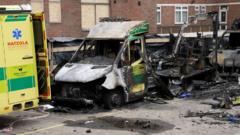
CCTV data indicates a multi-actor cell deploying liquid accelerants across multiple vehicle points simultaneously. This parallel ignition strategy prevents localized containment by single-operator intervention. The tactical execution deliberately leveraged the internal payload of the targets: medical oxygen cylinders.
By initiating external thermal energy transfer to the vehicles, the perpetrators triggered a secondary pressure-vessel failure sequence. The resulting pressurized oxygen releases accelerated the combustion rate, expanding the thermal footprint to damage adjacent residential structures and completely destroy three out of four vehicles.
Phase 3: Exfiltration and Network Shielding
The execution phase concluded with a coordinated dispersal strategy into high-density urban corridors, designed to break the immediate visual chain of custody for responding law enforcement. The structural involvement of peripheral actors, specifically categorized under Section 4 of the Criminal Law Act 1967 as assisting an offender, indicates that post-incident exfiltration was not ad-hoc. It relied on pre-arranged secondary networks to disrupt the kinetic tracking phase of the police response.
The Demographic and Operational Pipeline
The demographic matrix of the apprehended suspect cell presents a distinct pattern for modern counter-terrorism analytics. The age distribution and geographic concentration of the cell point to a specific vulnerability in domestic security: the weaponization of adolescent cohorts for high-consequence infrastructure disruption.
| Suspect | Age | National Identity | Primary Legal Charge |
|---|---|---|---|
| Hamza Iqbal | 20 | British | Arson with intent to endanger life |
| Rehan Khan | 19 | British | Arson with intent to endanger life |
| Judex Atshatshi | 18 | British | Arson with intent to endanger life |
| Anonymous Minor | 17 | Dual British / Pakistani | Arson with intent to endanger life |
| Subhan Ahmed | 18 | British | Assisting an offender |
This cell architecture demonstrates several operational characteristics:
- Geographic Clustering: The concentration of suspects within the East London municipalities of Walthamstow and Leyton indicates a localized radicalization or recruitment cell. This proximity lowers communication barriers and facilitates physical rehearsal without triggering regional transit monitoring anomalies.
- Tactical Asymmetry via Demographics: Utilizing individuals aged 17 to 20 serves a dual purpose for coordinating networks. Younger operatives possess high digital mobility across encrypted platforms while frequently operating below the historical threshold of hard counter-terrorism surveillance tracking.
- The Logistical Footprint of the Support Node: The inclusion of a dedicated secondary tier for non-kinetic support (assisting an offender) indicates that the cell understood the inevitability of forensic and digital tracking. They integrated redundancy into their survival strategy.
Geopolitical Proxy Dynamics and the Attribution Matrix
The Golders Green incident cannot be evaluated solely as a localized hate crime. The operational involvement of Counter Terrorism Policing London, working in parallel with global monitoring entities such as the SITE Intelligence Group, points to a broader structural framework: the convergence of digital proxy movements with state-aligned strategic objectives.
Shortly after the deployment of the kinetic vector, a digital claim of responsibility emerged via the Telegram channel of Harakat Ashab al-Yamin al-Islamia (The Islamic Movement of the Companions of the Righteous). This entity explicitly linked the destruction of medical infrastructure in London to wider geopolitical friction points involving Israeli, American, and Iranian state interests.
[State Sponsor / Strategic Directives]
                 │
                 ▼
[Digital Command Nodes (Telegram / Encrypted Apps)]
                 │
                 ▼
[Localized Proxy Cells (Ad-Hoc / Radicalized Youth)]
                 │
                 ▼
[Kinetic Output (Infrastructure Arson)]
This structural connection highlights a fundamental shift in proxy warfare. Rather than deploying highly trained, state-directed agents to execute hard sabotage sabotage targets, state-aligned actors leverage distributed digital networks to inspire or direct ad-hoc domestic cells. This mechanism provides state sponsors with absolute deniability while achieving high-visibility disruption.
The strategy relies on a low-cost, high-yield cost function: the sponsor invests minimal digital capital, while the host nation bears the localized socio-economic strain, emergency response costs, and community destabilization.
Technical Vulnerabilities in Civil Protection Frameworks
The structural failure leading to the destruction of the emergency vehicles stems from a mismatch between defensive postures and kinetic threats. Municipal emergency assets are typically protected against opportunistic theft or vandalism, not coordinated, multi-point incendiary strikes.
The first vulnerability is spatial concentration. Clustering the entire regional fleet of emergency vehicles within a single unfortified perimeter creates a single point of failure. If the perimeter is breached, the entire asset inventory is exposed simultaneously.
The second limitation lies in passive fire suppression standards. Standard automotive fire suppression systems are designed to contain internal engine compartment failures, not external, accelerant-driven thermal assaults. When combined with onboard hazardous payloads like compressed medical oxygen, the vehicle itself becomes a force multiplier for the destructive vector.
Finally, there is a clear surveillance-to-intervention latency. While CCTV assets successfully captured the visual signatures of the perpetrators, the lack of real-time automated threat-detection algorithms meant that law enforcement and fire services could only respond post-ignition. In kinetic arson operations, any intervention delay longer than 180 seconds guarantees total asset destruction.
Hardening Soft Targets Against Asymmetric Disruption
To mitigate the vulnerability of community infrastructure to these evolving hybrid threats, security directors and municipal planners must transition from reactive policing models to proactive architectural engineering.
First, logistics networks must implement decentralized asset positioning. Spreading emergency response vehicles across multiple discrete, secure locations prevents a single cell from neutralizing regional response capabilities in a single operation.
Second, perimeters must be retrofitted with active threat detection systems. Integrating AI-driven thermal imaging and predictive behavioral analytics into existing CCTV networks allows security infrastructure to flag pre-incident anomalies—such as loitering or fluid container deployment—before ignition occurs.
Finally, physical barriers must be upgraded to include intumescent passive shielding and reinforced access controls. Hardening parking facilities with flame-retardant barriers and automated physical blockades forces attackers into prolonged exposure windows, significantly increasing their risk of detection and failure. Civil protection frameworks must evolve to treat community medical services not merely as civic utilities, but as high-value targets within a broader landscape of asymmetric conflict.