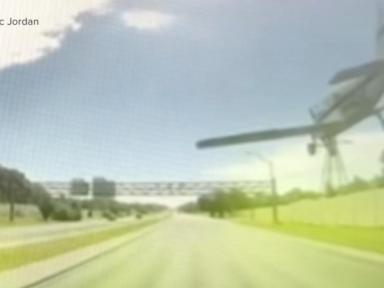
When a single-engine aircraft drops out of cruising altitude and successfully intercepts a multi-lane interstate for an impromptu touchdown, public fascination fixates on the pilot's raw coordination. Observers see a miracle of human reflexes avoiding catastrophe amid moving traffic. Operational risk management, however, sees a deterministic sequence of structural failures, kinetic equations, and systemic human factors that can be mapped, measured, and mitigated. Emergency landings on public thoroughfares are not random acts of divine intervention; they are high-stress crisis management events governed by strict aerodynamic parameters and fluid dynamic constraints.
Evaluating an event where a small plane touches down on a Florida highway requires stripping away the narrative gloss of standard media reports. Standard coverage typically recycles boilerplate shock value about the terror of motorists and the audacity of the aviator. A rigorous breakdown replaces that ambiguity with functional mechanics. The core anatomy of an impromptu arterial road landing breaks down into three distinct operational vectors: the energy management gradient, the spatial constraint matrix, and the human behavioral variable among civilian drivers.
The Energy Management Gradient
Every forced off-field landing is fundamentally an exercise in kinetic and potential energy dissipation. When an engine fails or suffers catastrophic power loss at altitude, the aircraft transitions immediately from a powered propulsion system to an unpowered glider. The pilot's primary task is managing the aircraft's total energy state, which consists of altitude (potential energy) and airspeed (kinetic energy).
The physics of this transition leave zero margin for error. A standard light aircraft, such as a Cessna or Piper single-engine variant, possesses a specific best-glide speed. Deviating above or below this velocity reduces the distance the aircraft can travel before ground contact. The glide ratio acts as the governing mathematical constraint. If a plane loses power at 3,000 feet with a glide ratio of 9 to 1, the theoretical maximum lateral distance it can cover is approximately 27,000 feet under zero-wind conditions.
When a highway enters the pilot's visual field, it represents a linear concentration of flat, cleared terrain cutting through obstacles like trees, power lines, and housing developments. Choosing a highway over a suburban tree canopy is an optimization problem solved under extreme time pressure. The highway provides a predictable surface texture and lacks vertical obstructions along its primary axis.
Yet, this energy management gradient introduces severe trade-offs. Highways are engineered with crowned surfaces to facilitate rainwater runoff, subtle curves to manage driver fatigue, and elevation changes. Furthermore, the descent profile must match the vertical clearance envelope. If the aircraft approaches too steeply, the kinetic energy cannot be shed quickly enough, resulting in a high-speed overshoot or a hard impact. If the approach is too shallow, induced drag and stall mechanics risk dropping the aircraft short of the pavement, inviting a collision with highway infrastructure such as overpass abutments, light poles, or concrete retaining walls.
The Spatial Constraint Matrix
A standard interstate highway lane measures roughly 12 feet in width. A typical single-engine general aviation aircraft has a wingspan ranging from 30 to 36 feet. This structural reality creates an immediate geometric conflict. The aircraft cannot fit within a single lane while maintaining lateral clearance buffers.
Consequently, the execution of the landing requires the pilot to occupy multiple lanes simultaneously or align the fuselage precisely over lane dividers to distribute the wing clearance evenly across the shoulder and adjacent lanes. This introduces the spatial constraint matrix, which involves three compounding friction points:
- Lateral Obstruction Density: Overhead sign bridges, toll gantries, light poles, and high-tension wire crossings create vertical boundaries that restrict the flare window. A pilot cannot initiate a normal round-out if an overhead sign bridge bisects the final descent path.
- Dynamic Surface Traffic: Unlike a sterile runway equipped with clearance protocols, lighting aids, and air traffic control isolation, a highway is populated by moving vehicular traffic traveling at varying velocities. The relative closing speed between a car moving at 70 miles per hour and an aircraft descending at 90 miles per hour creates a complex moving-target matrix.
- Infrastructure Boundaries: Concrete Jersey barriers and steep grass embankments replace standard runway safety areas. Striking a concrete barrier at a minor lateral angle transfers massive shear forces directly into the landing gear struts, frequently triggering structural folding, fuel cell rupture, and subsequent post-impact ignition risks.
The structural integrity of the aircraft depends heavily on the surface composition. Asphalt and concrete highways are engineered to support heavy freight loads, meaning the structural strength of the pavement easily exceeds the load-bearing requirements of a 2,500-pound light aircraft. The hazard lies not in the weight distribution, but in surface irregularities, expansion joints, and vehicular debris such as tire treads or spilled cargo that can snag a nose wheel and induce directional loss of control.
The Human Behavioral Variable
Systemic safety analyses of off-field landings consistently underestimate the behavioral unpredictability of civilian motorists. When an aircraft descends onto a major roadway, the operating environment introduces severe sensory overload for drivers who possess zero training in aviation interception or emergency yielding protocols.
The response from civilian drivers generally bifurcates into two dangerous extremes: panic braking and rubbernecking. Panic braking creates an immediate compression of stopping distances behind the aircraft, risking multi-vehicle pileups that can scatter debris across the landing path. Conversely, rubbernecking distracts drivers from maintaining lane discipline, leading to lateral drift into the path of the decelerating aircraft.
Communication during this phase is entirely asymmetric. The pilot is broadcasting intentions on a localized common traffic advisory frequency or squawking emergency transponder codes, none of which register on the audio systems of standard passenger vehicles. The motorists rely entirely on visual cues. Because fixed-wing aircraft exhibit unique perspective distortion during head-on or rear-end approaches—appearing stationary while rapidly expanding in size—drivers frequently miscalculate the aircraft's closing speed.
This human element introduces a high degree of stochastic variance into the incident. The success of the landing relies not only on the pilot's technical execution of flight controls but also on the collective behavioral restraint of dozens of civilian operators who must independently realize that maintaining a predictable, constant velocity or pulling onto the shoulder is safer than erratic evasive maneuvers.
Systemic Precursors and Operational Failures
Tracing the causal chain backward from the highway touchdown reveals the upstream mechanical and operational triggers that forced the pilot into an off-field emergency profile. Single-engine reliability statistics indicate that power loss events stem from three primary categories: fuel starvation or mismanagement, induction system icing or blockages, and internal mechanical failure of the powerplant.
Fuel management errors represent a persistent vulnerability in general aviation. Cross-feeding tanks improperly, miscalculating fuel burn rates, or failing to switch to a functioning tank prior to fuel exhaustion account for a significant percentage of forced landings. When fuel starvation occurs at low altitude, the time available to troubleshoot, cycle magnetos, or switch fuel selectors is measured in single-digit seconds.
Induction system failures, such as carburetor ice forming in high-humidity environments even at warm ambient temperatures, choke the engine's air supply, causing a gradual or sudden loss of RPM. If the pilot fails to apply carburetor heat immediately upon noting performance degradation, the engine transitions to total power loss before the underlying cause can be diagnosed.
When these mechanical or procedural failures cascade, they leave the pilot with a binary choice: attempt a return to the departure airfield via a low-altitude 180-degree turn—widely known as the base-to-final stall hazard—or commit to a straight-ahead landing site visible directly beneath the flight path. Choosing the highway is historically the safer tactical decision, provided the pilot possesses the situational awareness to evaluate the wind vector, traffic density, and glide performance accurately.
Risk Mitigation Protocols for Arterial Landings
Mitigating the risks inherent in highway emergency landings requires examining both pilot training paradigms and transportation infrastructure management. Current flight training syllabi emphasize engine-out procedures, but practical execution is frequently limited to simulated altitudes over controlled airport environments. Integrating mandatory spatial awareness modules regarding linear infrastructure into recurrent training cycles would enhance pilot preparedness.
From a civil engineering perspective, modern smart highways increasingly incorporate real-time sensor arrays, automated traffic management systems, and variable message signs. In an optimal integration framework, an emergency aircraft transponder signal interacting with local airspace monitoring could trigger automated warning sequences on overhead highway gantries, instantly reducing speed limits, shifting variable lane indicators, and alerting motorists miles upstream of an impending obstruction.
The operational takeaway for aviation safety boards and highway authorities is clear. Emergency roadway landings will remain a persistent reality of general aviation telemetry as long as single-engine aircraft operate over densely populated and heavily paved corridors. Elevating the safety outcomes of these events requires treating the highway not as a fortunate accident of geography, but as a temporary, high-friction landing zone demanding standardized inter-agency coordination between aviation authorities, emergency medical services, and ground traffic controllers. The margin between a catastrophic structural breakup and a textbook emergency arrival is defined entirely by the discipline of the descent profile and the rapid mitigation of downstream vehicular chaos.