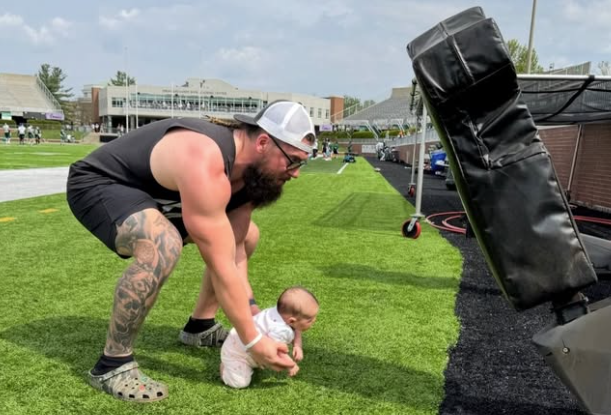
An elite athlete's performance output is a direct function of biological recovery, neurological optimization, and psychological motivation. Traditional sports journalism routinely framing a professional athlete’s transition into parenthood as a simple, heartwarming narrative failure to account for the severe physiological volatility it introduces. When Saskatchewan Roughriders running back A.J. Ouellette enters the Canadian Football League (CFL) season as a new father following the birth of his daughter, Isla Jo, on March 6, he faces a delicate optimization problem. He must balance the acute physical toll of sleep deprivation against an altered psychological utility curve that can systematically elevate performance metrics.
To analyze how this lifestyle shift impacts a tier-one running back coming off a 1,222-yard, nine-touchdown championship campaign, we must move past abstract idioms like "dad strength." Instead, the phenomenon must be deconstructed using precise structural frameworks: the Sleep Deprivation Deficit, the Biological Recovery Matrix, and the Modified Professional Utility Function.
The Sleep Deprivation Deficit and Kinetic Output
A professional running back’s role relies heavily on rapid acceleration, vertical force production, and neurological processing to read blocking schemes. The primary threat to these metrics during early parenthood is sleep fragmentation.
[Sleep Fragmentation] ---> [Decreased SWS & REM] ---> [Attenuated Glycogen Synthesis & Decreased Reaction Time] ---> [Elevated Micro-Cut Margin of Error]
Sleep loss systematically degrades athletic execution through distinct physiological pathways:
- Metabolic Depression: Sleep restriction decreases glucose tolerance and downregulates glycogen synthesis within skeletal muscle tissue. For a 5-foot-10, 210-pound high-volume rusher whose playing style is defined by physical impact, a decrease in baseline glycogen storage directly limits late-game anaerobic endurance.
- Neurological Delay and Decision Efficiency: Professional running backs rely on fast-twitch motor unit recruitment and rapid visual processing. Offseason film analysis alongside running backs coach Andrew Harris revealed that minor errors, such as a half-step misalignment or over-cutting by a fraction of a yard, separate stopped plays from explosive gains. Sleep fragmentation primarily impairs the prefrontal cortex, which increases visual processing latency and causes players to predetermine running lanes rather than waiting for structural openings to develop.
- Cortisol-to-Testosterone Ratio Shifting: Extended sleep disruption elevates baseline systemic cortisol levels while suppressing nocturnal testosterone release. This hormonal imbalance creates a catabolic state that accelerates muscle tissue breakdown and impairs daily myofibrillar repair during high-stress training blocks.
To offset this sleep deficit, Ouellette adjusted his living logistics, moving from an uninsulated travel trailer to a dedicated residence on Regina’s south side. This change stabilized environmental variables like ambient noise and temperature, optimizing his remaining recovery windows.
The Recovery Optimization Matrix
Because sleep volume is compromised, maintaining elite physical output requires maximizing alternative recovery methods. To sustain an average of 4.9 yards per carry under increased personal stress, Ouellette updated his training regimen to include data-driven recovery technology.
The core of this strategy centers on a direct-current (DC) muscle-stimulation machine, a protocol adopted from veteran quarterback Trevor Harris. Standard alternating-current (AC) electrical stimulation causes tetanic muscle contractions that can exacerbate structural soreness. In contrast, targeted DC stimulation alters the cellular membrane potential of damaged muscle tissue, accelerating localized blood flow and promoting rapid amino acid transport without extra mechanical stress.
High-Velocity Recovery Protocol Comparison
| Recovery Modality | Primary Physiological Mechanism | Targeted Performance Metric | Limitations in High-Stress Phases |
|---|---|---|---|
| Direct-Current (DC) Stimulation | Alters cell membrane potential; accelerates localized blood flow. | Myofibrillar repair; reduction in delayed onset muscle soreness (DOMS). | Requires strict adherence to placement protocols; induces localized neurological fatigue if overused. |
| Traditional Sleep Architecture | Natural growth hormone release during slow-wave sleep (SWS). | Systemic neural restoration; cellular tissue regeneration. | Subject to unpredictable disruptions from infant waking cycles. |
| Active Myofascial Release | Mechanical breakdown of fascial adhesions; fluid drainage. | Joint mobility; preservation of lateral cutting angles. | Adds minor mechanical stress to localized tissues; high immediate metabolic cost. |
This systematic approach to recovery directly addresses the structural demands of Ouellette’s physical style. By neutralizing localized inflammation through technological intervention, an athlete can maintain target output levels even when their foundational recovery system—sleep—is compromised.
The Modified Professional Utility Function
While parenthood introduces clear physiological challenges, it also fundamentally reshapes an athlete's psychological framework. Traditional economic models define professional utility through internal metrics like personal accolades, competitive enjoyment, and baseline financial compensation. The birth of a dependent restructures this equation by introducing an external, non-negotiable financial responsibility.
$$U = f(P_{\text{enjoyment}}, A_{\text{accolades}}, S_{\text{security}}) \longrightarrow U_{\text{parent}} = f(P_{\text{enjoyment}}, A_{\text{accolades}}, \mathbf{S_{\text{security}} \times D_{\text{dependent}}})$$
This model explains the real-world shift in professional motivation. When an athlete transitions from playing purely for personal fulfillment to playing to secure long-term resources for a dependent, their risk tolerance and focus undergo a distinct adjustment.
Initial State: Risk-tolerant, intrinsic motivation (Play for love of game)
               │
               ▼
Incentive Shift: Introduction of dependent (Isla Jo)
               │
               ▼
Adjusted State: Hyper-focused execution, risk mitigation via structural preparation (Play for long-term contract security)
This psychological shifts manifests as a measurable change in on-field execution:
- Elevated Pain Tolerance via Adrenergic Regulation: The high-stress responsibility of providing for a family alters baseline sympathetic nervous system activation. This shift can increase adrenaline release during high-stress moments, temporarily masking peripheral fatigue and minor soft-tissue discomfort during games.
- Career Preservation and Efficient Resource Management: The need for long-term career stability encourages a more analytical approach to play. For a running back, this means shifting away from unnecessary post-whistle contact and focusing on strict tactical execution. This includes staying tight to blocking paths and avoiding wasted steps that expose the body to clean hits from defenders.
- Reduced Extrinsic Distractions: The lifestyle adjustments required by parenthood eliminate unstructured time, channeling an athlete's focus down to two main areas: family care and professional execution. This reduction in outside distractions creates a highly focused routine, making daily preparation more efficient.
Strategic Forecast for the Title Defense Campaign
The Saskatchewan Roughriders' defensive and offensive continuity heading into the season—supported by veteran quarterback Trevor Harris—provides a stable system that should help insulate Ouellette from sudden drops in efficiency. However, maintaining his previous production of 1,222 rushing yards depends on a clear operational strategy.
The coaching staff must closely manage Ouellette's weekly volume early in the season to prevent cumulative fatigue from overlapping stressors. This means using a secondary back in low-leverage situations to limit Ouellette's touches during early standard-down series. This approach keeps his high-impact running style effective for late-game situations, maximizing his value while protecting his long-term recovery.
Ultimately, the impact of parenthood on elite athletic performance is not a simple narrative of distraction or inspiration. It is a complex balance of physiological challenges and psychological benefits. The athletes who succeed under these conditions are those who treat these lifestyle changes as technical variables to be managed, using targeted recovery and disciplined execution to turn personal motivation into consistent on-field results.