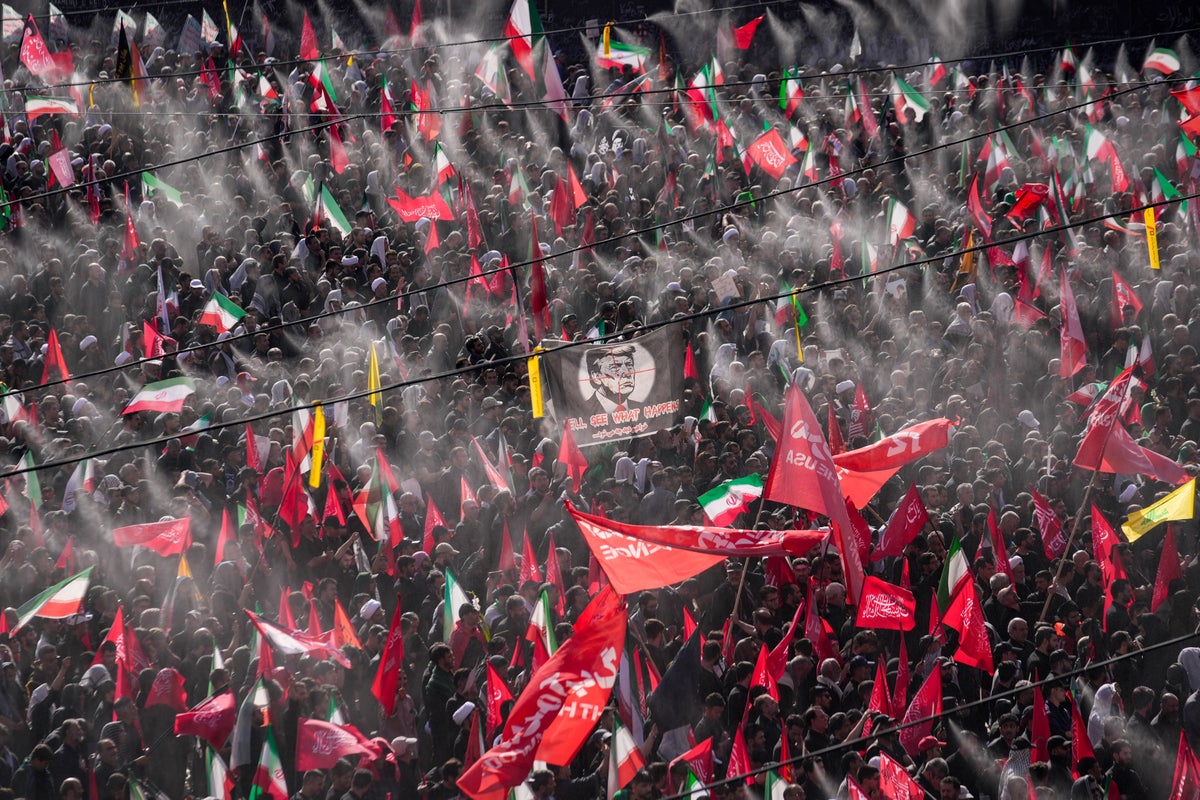
The delayed state funeral of Ayatollah Ali Khamenei in July 2026 represents far more than an exercise in state-mandated grief. Coming four months after the February 28 joint U.S.-Israeli airstrike that killed the 86-year-old supreme leader, the multi-day, five-city procession functions as a calculated projection of systemic survival and military deterrence. For an Iranian leadership navigating a highly fragile April ceasefire, the physical re-emergence of high-value targets into the public eye serves as a precise counter-signal to Western intelligence and a critical bargaining chip in active negotiations over the Strait of Hormuz.
Mass public gatherings of high-value targets (HVTs) in urban centers normally present a catastrophic security vulnerability, particularly against adversaries with proven real-time kinetic strike capabilities. By deliberately executing this event, Tehran is executing a high-stakes geopolitical calculus structured around specific operational frameworks.
The Operational Shielding Framework
The physical presence of senior leadership—including President Masoud Pezeshkian, Parliament Speaker Mohammad Bagher Qalibaf, Revolutionary Guard chief Gen. Ahmad Vahidi, and Quds Force commander Esmail Qaani—at Tehran's Grand Mosalla establishes an overt demonstration of asymmetric risk management. The logic behind this exposure operates on three distinct levels.
The Ceasefire Enforcement Mechanism
During the kinetic phase of the war, Israel consistently utilized public indicators to fix the geolocation of senior Iranian officials for targeted strikes. The decision to gather the remaining upper echelons of the state apparatus in a known, static venue signals absolute confidence in the structural integrity of the April ceasefire agreement. It presents Washington and Tel Aviv with a binary choice: respect the diplomatic pause or initiate an escalatory cycle by executing a decapitation strike in front of hundreds of thousands of civilians and visiting foreign delegations from Russia, China, and regional partners.
Passive Air Defense and Counter-Surveillance Architecture
The multi-month delay in burying the late supreme leader was structurally mandated by air defense vulnerability. Initiating a mass funeral while airspace remained contested would have invited operational disaster. The execution of the ceremony in July signals that Iran’s electronic warfare networks and surface-to-air missile batteries have been re-baselined. Security protocols observed at the Grand Mosalla indicate a dense, multi-layered passive defense strategy:
- Asymmetric Signal Jamming: Localized GPS spoofing and radio-frequency degradation to disrupt precision-guided munition (PGM) targeting.
- Kinetic Countermeasures: Short-range air defense systems (SHORADS) deployed around high-density zones to intercept loitering munitions or low-altitude drone incursions.
- Physical Deception and Camouflage: The use of plainclothes security cordons, low-profile tactical gear (such as Gen. Vahidi’s uncharacteristic black baseball cap), and irregular movement vectors to complicate real-time human intelligence (HUMINT) verification.
The Missing Variable: Posture of the Successor
The strategic display features a glaring asymmetry: the total absence of the new supreme leader, Ayatollah Mojtaba Khamenei. Having sustained injuries in the initial February 28 strike that killed his father, the younger Khamenei’s continued isolation represents a strict continuity-of-government protocol. While secondary and tertiary officials absorb the exposure risk to project institutional normalcy, the ultimate executive authority remains decoupled from the physical venue. This insulates the regime against total command-and-control liquidation while allowing lower-tier entities to leverage public visibility.
The Strategic Cost Function of the Strait of Hormuz
The primary audience for this calculated display is not the domestic populace, but the U.S. diplomatic delegation currently negotiating terms for a permanent end to the war. The state funeral directly intersects with Tehran’s primary economic and military lever: the maritime choke point of the Strait of Hormuz.
The economic model underpinning Iran's postwar negotiation strategy relies on a distinct escalation matrix.
[Domestic Resource Mobilization] -> [Choke Point Control (Hormuz)] -> [Global Energy Risk Premium] -> [Western Diplomatic Concessions]
Tehran closed the Strait during the peak of hostilities, choking off global energy supplies and introducing a massive risk premium into international markets. By pairing the mass mobilization of the funeral with rigid rhetoric regarding maritime sovereignty, Iran is communicating that its capacity to disrupt global shipping remains structurally intact despite the losses suffered in the war.
The U.S. demand vector requires a full, unconditional reopening of the shipping lanes alongside a verifiable rollback of Iran's disputed nuclear program. Conversely, the Iranian counter-demand seeks the preservation of partial maritime oversight and the unfreezing of sanctioned sovereign assets. The visual evidence of hundreds of thousands of disciplined, state-aligned citizens marching through Tehran provides Qalibaf, the chief Iranian negotiator, with the domestic mandate required to resist Western pressure. It signals that the regime is not negotiating from a position of systemic collapse, but rather from a position of consolidated, postwar stabilization.
Rhetorical Mobilization as a Deterrence Vector
The state-directed rhetoric permeating the funeral ceremonies—specifically the targeted focus on U.S. President Donald Trump and Israeli Prime Minister Benjamin Netanyahu—serves an explicit defensive purpose. The calls for asymmetric retaliation and targeted assassinations are not mere emotional outbursts; they are calculated components of a cost-imposition strategy.
By continuously highlighting the 2020 killing of Qasem Soleimani alongside the February 28 assassination of Khamenei, Iranian state media seeks to establish a permanent psychological and financial burden on Western leadership. The strategic intent is to force the U.S. security apparatus to permanently allocate significant defensive resources, intelligence assets, and tactical personnel to protect current and former executive officials. This creates an ongoing operational friction point for the adversary, making the long-term cost of targeted assassination policies unsustainably high.
Limitations of the Postwar Consolidation Strategy
While the regime has successfully demonstrated its capacity to manage massive logistical events—facilitating the movement, security, and provisioning of millions across five cities—the structural vulnerabilities facing the Islamic Republic remain acute.
First, the mass mobilization achieved during state funerals relies on a highly subsidized, ideologically committed core. It does not automatically translate into broad-based economic resilience. The domestic economy remains severely constrained by the physical destruction incurred during the war and the compounding weight of international sanctions.
Second, the dual-track strategy of projecting absolute defiance while simultaneously seeking a diplomatic off-ramp via U.S. talks creates an internal contradiction. Hard-line elements within the Revolutionary Guard and the domestic populace, highly visible during the funeral chanting for immediate kinetic revenge, may view prolonged diplomatic compromise over the Strait of Hormuz or the nuclear program as a betrayal of the late supreme leader's legacy. This friction exposes a clear vulnerability: the regime risks locking itself into an escalatory rhetorical posture that its damaged conventional military infrastructure cannot safely sustain if negotiations break down.
The final strategic play dictates that Iran will maintain this hyper-nationalist, high-risk public posture until the formal conclusion of the mourning period on Thursday, when Khamenei is buried at the Imam Reza shrine in Mashhad. Once the domestic ideological mobilization concludes, the regime will likely pivot back to quiet, pragmatic backchannel diplomacy, leveraging the illusion of total domestic unity to extract maximal sanctions relief from Washington before the ceasefire window expires.