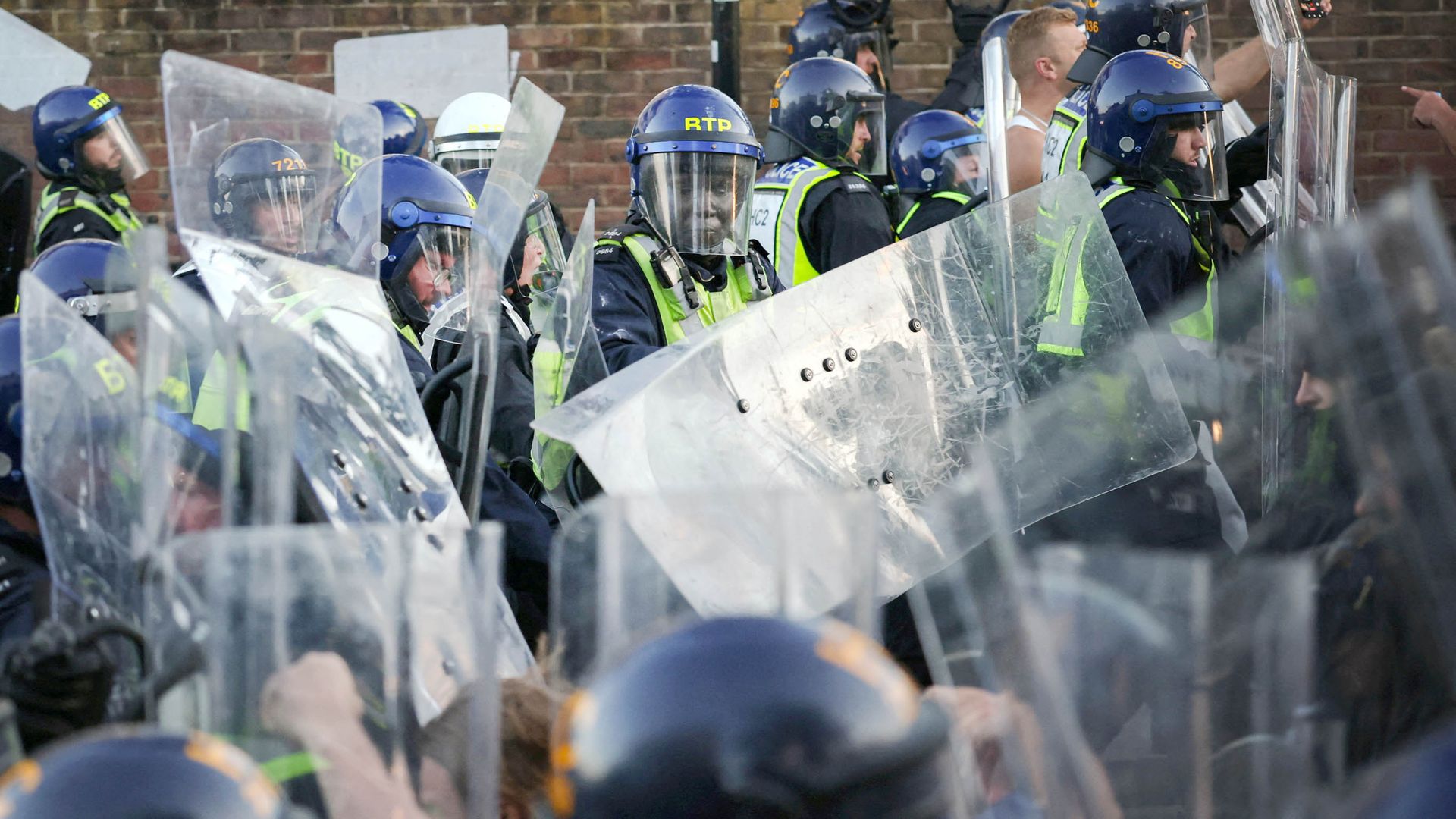
The escalation of civil unrest following the sentencing of Vickrum Digwa for the murder of 18-year-old student Henry Nowak highlights a predictable, structural failure in public order maintenance and information management. On June 6, 2026, Hampshire Police announced that six additional individuals—Kevin Reeves, Andrew Riddett, Harry Varney, Taylor Grundy, Dillon Crawford, and Andrew Summerhayes—were charged with violent disorder, bringing the total number of individuals facing prosecution to 11. Summerhayes faces additional charges for the possession of offensive weapons in a public place.
This development is not an isolated outbreak of lawlessness. It is the direct output of a multi-variable escalation mechanism where systemic friction points intersect: operational law enforcement protocol, digital information dissemination lag, and organized external political mobilization. Analyzing these variables reveals how localized tragedies transform into large-scale urban disorder.
The Tri-Component Escalation Framework
Civil unrest of this velocity requires three distinct structural inputs to transition from a localized grievance into an operational crisis for law enforcement.
[Systemic Friction Point: Arrest Protocol]
               │
               ▼
[Information Asymmetry: Video Release Delay]
               │
               ▼
[External Influx: Boundary Crossings]
               │
               ▼
[Systemic Failure: Urban Riot Operations]
1. The Perceptual Asymmetry of Law Enforcement Protocols
The initial catalyst for the civil unrest was the discrepancy between the physical reality of a fatally wounded individual and the application of standard police restraint mechanisms. Vickrum Digwa stabbed Henry Nowak five times in December 2025. Upon arrival, responding officers acted on an unverified, contemporaneous claim by Digwa that he had been the victim of a racially motivated assault. Acting under standard operating procedures governing active physical altercations, officers prioritized immediate containment by handcuffing Nowak.
This creates a critical operational vulnerability. The rigid adherence to a containment-first protocol, while ignoring Nowak’s physiological distress and verbal declarations of respiratory failure, created an immediate deficit in public institutional trust. When body-worn video (BWV) footage documenting these final moments was released to the public post-sentencing, the visual data conflicted violently with the public's baseline expectation of emergency medical prioritization. The lag between the initial event in December 2025 and the visual revelation in June 2026 served as a compression chamber for public resentment.
2. Digital Dissemination and Information Cascades
The velocity of the escalation in Southampton was dictated by the structural mechanics of digital information cascades. The release of the BWV footage functioned as a high-affinity catalyst on digital platforms.
- The Distribution Velocity: Raw video footage bypasses institutional editorial filters, maximizing emotional resonance and algorithmic amplification.
- The Contextual Vacuum: The digital audience processes the visual data (a dying teenager in handcuffs) faster than the judicial system can provide contextual framing (the complex realities of a chaotic crime scene and immediate misdirection by the perpetrator).
This information asymmetry ensures that by the time a legal outcome is reached—such as Digwa’s life sentence with a 21-year minimum term—the public narrative has already shifted away from the perpetrator's guilt and onto the state's perceived institutional failure. The chant "prison for police on scene" exemplifies this displacement of the core grievance.
3. Spatial Aggregation and External Mobilization Dynamics
Data from the initial geography of the protests demonstrates a clear, two-phase tactical shift executed by the crowds. The assembly began as a static demonstration outside Southampton Central Police Station, serving as a symbolic challenge to state authority. The transformation into violent disorder occurred during a secondary, kinetic phase: a synchronized march across the city toward the Portswood neighborhood where Digwa resided and the murder occurred.
The geography of this march highlights a strategic bottleneck.
Hampshire Police deployed a physical blockade on St Denys Road to prevent the crowd from entering the residential zone of the perpetrator's family. This containment boundary became the primary locus of violence. Denied physical access to their secondary geographic objective, elements within the crowd converted available urban infrastructure into improvised projectiles, throwing bricks, beer cans, wheelie bins, and glass bottles at police lines and vehicles.
This operational environment was further complicated by an influx of external actors. Observations by local governance officials, including Southampton City Council representatives, indicated that a significant percentage of the active rioters crossed municipal boundaries to participate. This external influx alters the risk calculus of the crowd; non-local participants possess lower stakes in the long-term social cohesion of the targeted neighborhood, lowering their barrier to property destruction and acute violence.
Quantifying the Operational Cost Function
The consequences of this disorder extend beyond structural property damage to local vehicles and roadways. The strain on law enforcement assets can be calculated through a strict resource-allocation matrix.
| Operational Resource | Direct Impact Metric | Systemic Consequence |
|---|---|---|
| Human Capital | 11 Officers & 1 Police Dog Injured | Temporary reduction in active duty force strength; escalation in tactical gear requirements. |
| Asset Depreciation | Smashed Police Vehicles & Inflicted Civil Property Damage | Diversion of municipal budgets from proactive services to reactive infrastructure repair. |
| Tactical Displacement | Mutual Aid & Specialized Riot Unit Deployment | Depletion of geographic coverage for routine emergency response calls across Hampshire. |
The deployment of specialized public order units, aerial surveillance assets (including police helicopters), and physical containment shields represents a total diversion of finite municipal resources. Every unit deployed to maintain the boundary line on St Denys Road represents a complete extraction of policing capacity from standard domestic, commercial, and preventative operations across the wider region.
The Strategic Limits of De-escalation Rhetoric
State and community leaders responded to the crisis by deploying defensive rhetoric, explicitly leveraging statements from the victim's family. Mark Nowak, the father of the deceased, issued an explicit directive requesting that his son’s death not be utilized as a mechanism for further division, hatred, or tension.
While strategically sound from an ethical standpoint, the operational utility of such appeals is structurally limited when confronting highly coordinated political mobilization. Ideological entrepreneurs—including figures such as Stephen Yaxley-Lennon (Tommy Robinson) and political leaders from Reform UK and UKIP—rapidly integrated the local event into broader national narratives regarding "two-tier policing" and institutional bias.
The structural flaw in relying on family appeals to suppress riots lies in the decoupling of the crowd's motivation from the original tragedy. Once a localized grievance is successfully integrated into a broader ideological framework, the crowd no longer operates as an agent of the victim's memory; it operates as an execution mechanism for pre-existing political friction. Consequently, top-down calls for calm from the Prime Minister or local councilors fail to engage with the structural drivers of the rioters' behavior.
Future Tactical Forecast
The legal processing of the 11 individuals charged with violent disorder at Southampton Magistrates' Court signals the transition into a state-dominated judicial containment phase. To mitigate future operational failures of this nature, law enforcement agencies must restructure their approach to high-friction incidents through three specific procedural adjustments:
- Restraint Protocol Re-engineering: Integrating mandatory, immediate medical assessments into active containment procedures, ensuring that respiratory distress declarations trigger an automatic shift from a criminal containment posture to an emergency triage posture, regardless of circumstantial verbal claims by third parties.
- Accelerated Counter-Information Protocols: Establishing a rapid-response informational framework that releases objective, preliminary factual timelines simultaneously with or immediately following the digital leak of raw body-worn video to minimize the information asymmetry window.
- Geographic Interdiction Mapping: Utilizing predictive transit mapping to establish containment boundaries far earlier in the progression of a protest march, preventing crowds from advancing from symbolic targets (police stations) into highly vulnerable residential zones.
The structural stability of urban environments relies entirely on the minimized latency between an inflammatory event and an objective, transparent institutional response. Failing to compress this window guarantees that the urban infrastructure will continue to serve as the default arena for displaced political violence.