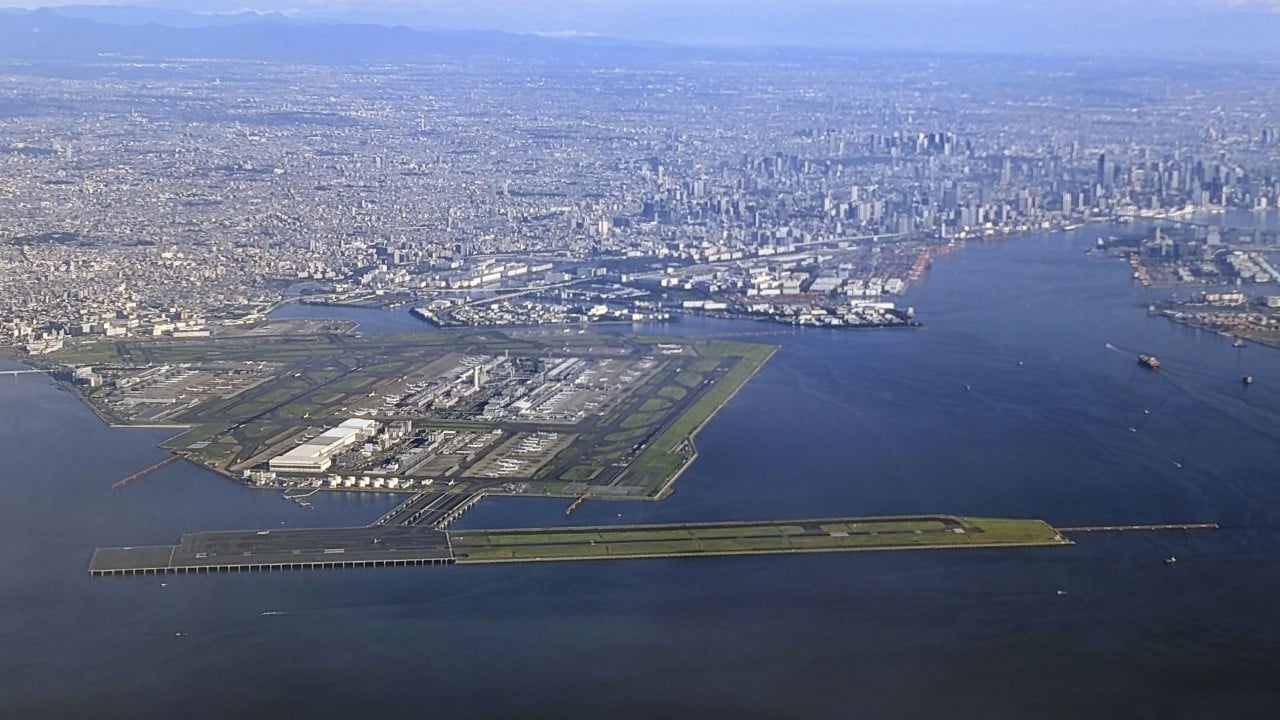
High-density terminal airspace operates on narrow margins where human supervision and automated safety backups interact under strict time constraints. When All Nippon Airways Flight 968, a Boeing 767-300 carrying 197 occupants from Shanghai Pudong International Airport, approached Tokyo Haneda Airport, those margins collapsed. An intersecting trajectory with a Japan Civil Aviation Bureau inspection aircraft triggered an onboard emergency protocol. Examining this event requires stripping away narrative descriptions of panic and analyzing the exact structural mechanics of the failure, the operational parameters of the technology involved, and the systemic vulnerabilities of high-frequency airport management.
The Kinematics of Convergence
At approximately 5:44 a.m. local time, Flight 968 was descending toward Runway 34R over Tokyo Bay. Concurrently, a JCAB Cessna Citation CJ4 flight inspection aircraft, callsign CKSTR10, departed from Haneda to perform navigational aid calibrations. The departure vector of the inspection jet and the final approach corridor of the heavy commercial widebody intersected at an acute angle during a climb-and-descent phase.
Flight tracking telemetry and air traffic control data established the proximity metrics at the closest point of approach:
- Vertical separation diminished to approximately 100 feet.
- Horizontal separation compressed to between 0.7 and 1.0 nautical miles.
- Convergence velocity vectors meant the aircraft were fraction-of-a-second intervals away from physical impact.
This geometry highlights a structural hazard in terminal airspace design. Arrival streams and departure or calibration tracks must be segregated by altitude blocks or lateral buffers. When an active inspection flight—which often executes non-standard routing, low-speed climbs, and deliberate holding patterns to test radio and lighting equipment—shares airspace with heavy arrival banks, the predictability index of the sector drops significantly.
The Automated Safety Net and the Cost of Override
The primary barrier preventing a catastrophic collision was not air traffic control intervention, but automated avionics. The Boeing 767's Traffic Collision Avoidance System Version 7.1 generated a Resolution Advisory.
TCAS II functions independently of ground infrastructure by interrogating the transponders of surrounding aircraft, calculating their relative trajectories, and issuing direct vertical maneuvers to flight crews. When the system triggered the Resolution Advisory, it commanded an immediate climb override.
Operational protocol during a Resolution Advisory supersedes air traffic control instructions. The flight crew executed the climb mandate, initiating an immediate go-around. The systemic dependency on this automated safety net reveals a distinct trade-off:
- Autonomy vs. Authority: When TCAS issues an RA, pilots must react instantly, sometimes creating short-term disorder in tightly sequenced arrival flows.
- Cascading Sequence Disruption: The mandatory go-around forced Flight 968 back into the sequencing queue, requiring additional pattern management before a successful landing on a subsequent approach.
The reliance on a reactive last-line-of-defense mechanism underscores a vulnerability in human-controlled separation management. Air traffic control audio from the incident revealed acute stress from sector controllers, demonstrating that the cognitive load in high-density sectors can saturate before visual or radar confirmation of a conflict is processed by human operators.
Systemic Vulnerabilities in Haneda Sector Management
Analyzing why the separation failed demands an examination of operational variables unique to major hubs like Haneda. The airport operates multiple intersecting runways under punishing scheduling pressure to maximize hourly slot utilization.
Flight inspection aircraft introduce a systemic variable. Unlike commercial flights that follow fixed Standard Terminal Arrival Routes or Standard Instrument Departures, inspection aircraft operate on dynamic task profiles dictated by maintenance and regulatory calibration requirements. Integrating these non-linear flight paths into a linear arrival stream requires rigid lateral or temporal spacing buffers.
The failure of these buffers points to three contributing vectors:
- Sector Coordination Lags: Communication or hand-off friction between departure controllers handling the calibration aircraft and approach controllers managing incoming international flights.
- Trajectory Prediction Errors: The difficulty of anticipating the exact climb profile of a light jet performing low-altitude instrument checks compared to standard commercial traffic.
- Cumulative Fatigue and Hyper-Density: Operating within airspace that remains under intense scrutiny following historical incidents increases operational friction and cognitive strain on front-line personnel.
Strategic Adjustments for Terminal Airspace Defense
Preventing future degradations of separation minimums requires structural modifications to air traffic management protocols rather than superficial reprimands.
First, terminal control automation must integrate predictive conflict-detection software that flags non-standard aircraft trajectories—such as calibration or test flights—long before they penetrate commercial arrival corridors. Traditional radar alerts often trigger only when separation breaches statutory minimums, leaving too little time for error correction.
Second, scheduling windows for non-revenue flight inspections must be strictly decoupled from peak commercial arrival banks. Confining calibration activities to off-peak operational lulls eliminates the concurrency risk between dynamic flight paths and dense traffic flows.
Third, air navigation service providers must enforce mandatory procedural buffers around active calibration aircraft, treating them as mobile restricted zones rather than standard targets in the radar picture.
Safety in high-density aviation is maintained not by the excellence of recovery mechanisms like TCAS, but by the elimination of conditions that force those mechanisms to act as the primary barrier against disaster.