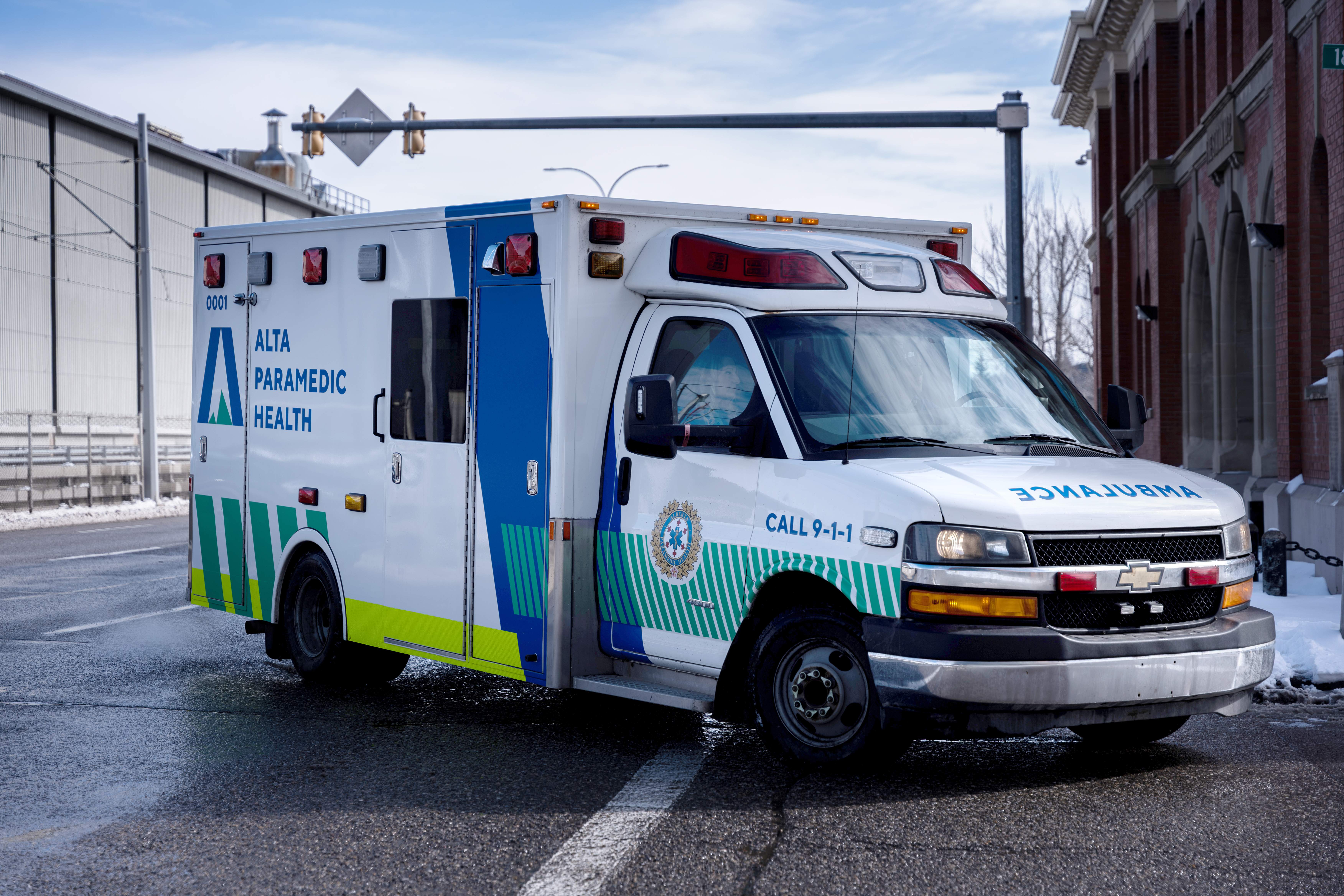
When public infrastructure strains under operational deficits, institutional leadership frequently defaults to symbolic restructuring rather than structural reform. The recent intervention by Alberta's Minister of Hospital and Surgical Health Services, Adriana LaGrange, to halt the rebranding of Emergency Health Services (EHS) Alberta into ALTA Paramedic Health serves as a textbook case study in administrative misalignment. The friction between Acute Care Alberta's top-down corporate identity shift and the frontline operational reality illustrates a broader systemic failure: the misallocation of executive focus during a supply-side capacity crisis.
Analyzing this intervention requires looking past the political rhetoric to evaluate the underlying economic, organizational, and operational friction points that triggered the policy reversal.
The Strategic Asymmetry: Symbolism vs. Capacity
The fundamental error in the ALTA Paramedic Health initiative lies in a total mismatch between executive utility functions and frontline constraints. Organizational transformation theories dictate that structural rebranding is effective only when it signals a corresponding evolution in operational capabilities or resource allocation. When executed in a resource-constrained environment, it produces institutional friction.
To understand why this initiative failed so rapidly, we can map the operational bottlenecks using a basic public health capacity framework.
[Systemic Deficits: Vacancy Rates & Vehicle Shortages]
                       │
                       ▼
         [Frontline Burnout & Attrion]
                       │
                       ▼
 [Executive Response: Brand Modernization ($25K Prototypes)]
                       │
                       ▼
[Institutional Friction: Union Resistance & Loss of Public Trust]
                       │
                       ▼
     [Policy Reversal: Government Stop-Order]
The Frontline Cost Function
For the 3,500 paramedics represented by the Health Sciences Association of Alberta (HSAA), the utility of a brand transformation is zero—or negative, if it introduces frictional transition costs. The operational reality is governed by hard resource constraints:
- Labor Supply Deficits: Record-high vacancy rates create a reliance on mandatory overtime, which spiked 81% in major metropolitan regions like Edmonton between 2021 and 2024.
- Wage Compression: Alberta’s paramedic compensation structures have fallen relative to national benchmarks, undermining retention and recruitment metrics.
- Asset Deprivation: Chronic ambulance availability shortages directly drive up response latencies and exacerbate offload delays at emergency departments.
When leadership introduces a capital expenditure program for aesthetic updates—even one capped at an initial $25,000 for prototypes—while the core operational variables are degrading, it creates a psychological decoupling. Frontline staff perceive the initiative not as modernization, but as administrative vanity that ignores the true cost drivers of the system.
The Corporate Identity Premise
Acute Care Alberta framed the transition to ALTA Paramedic Health as a mechanism to signal accountability, modernization, and a renewed commitment to high-quality care. This logic operates on the assumption that public perception and organizational pride are highly correlated with visual identity.
The strategy failed because it overlooked a fundamental principle of public service design: trust is a function of system reliability, not brand equity. A citizen experiencing a medical emergency evaluates the service based on response time and clinical competency, entirely independent of the decal affixed to the vehicle.
The Economics of Cosmetic Friction
While the ministry noted that no operational funding was diverted and that the prototype development costs were under $25,000, this figure vastly understates the true economic liability of the proposed change. Outside estimates from the Alberta Professional Fire Fighters and Paramedic Association (AFRA) pegged the total system-wide implementation costs between $5 million and $12 million.
An analytical breakdown of the projected capital deployment reveals three major categories of waste:
1. Asset Modification Sunk Costs
Transitioning an entire provincial fleet requires stripping and replacing high-visibility reflective decals on hundreds of emergency vehicles. Beyond the material costs, this process requires taking critical emergency vehicles out of active rotation. In a system already suffering from acute vehicle shortages, the opportunity cost of asset downtime threatens service delivery metrics far more than the direct cash expenditure.
2. Supply Chain and Uniform Upgrades
Replacing uniforms for thousands of active first responders introduces complex logistics and procurement costs. Fabric specifications, localized sizing distribution, and inventory management add layers of administrative overhead. This capital deployment yields no improvement in thermal efficiency, safety compliance, or clinical utility for the worker.
3. Destruction of Existing Brand Equity
The emergency response ecosystem relies on immediate, low-cognitive-load identification. The standard block lettering and the globally recognized "Star of Life" emblem are universal symbols of clinical authority. Replacing these established markers with localized corporate branding creates a distinct operational risk. In multi-jurisdictional or high-stress environments, any ambiguity in identifying a first responder introduces unnecessary risk to the scene.
The Failure of Consultative Governance
The rapid collapse of the ALTA Paramedic Health rebrand points to a failure in internal stakeholder management. Top-down mandates that alter the daily identity of frontline professionals without meaningful consultation invariably trigger strong pushback.
Reports from frontline representatives indicate that the engagement sessions hosted by Acute Care Alberta were purely informational rather than consultative. Decisions regarding color palettes, geometric logos, and corporate messaging were locked in prior to gathering workforce feedback. This approach ignores a core tenet of change management: operational compliance requires psychological co-ownership.
When the workforce is excluded from the design phase of an identity shift, the brand itself becomes a symbol of executive disconnect. The union’s swift public pushback gave the government a clear choice: force through an aesthetic change at the cost of catastrophic workforce morale, or execute an immediate policy reversal to preserve labor stability. Minister LaGrange's intervention indicates that the political and operational costs of the rebrand far outweighed any perceived administrative upside.
Deconstructing the Broader Structural Agenda
The rebranding initiative cannot be analyzed in a vacuum; it was part of a broader, highly contentious restructuring of the provincial healthcare architecture. The transition from a centralized entity (Alberta Health Services) toward specialized provincial boards like Acute Care Alberta has driven ongoing friction between the government, municipalities, and labor groups.
Critics and policy analysts have highlighted a distinct tactical pattern: using structural reorganization and cosmetic rebranding as a substitute for—or a distraction from—systemic policy shifts.
The Municipal Fire-EMS Fracture
A critical intersection occurs within integrated municipal services. The provincial government’s broader contract reviews, such as those expiring in September 2026, aim to decouple fire and ambulance responses across several municipalities. This model forces local governments into an operational bottleneck: they must either absorb the funding shortfall using municipal tax bases or abandon localized emergency medical models entirely.
Within this context, the introduction of a distinct corporate brand like ALTA Paramedic Health serves an ideological purpose. It strips away the shared municipal identity of integrated first responders, visually isolating the provincial paramedic service from local fire departments. This separation makes it easier to systematically transition components of emergency transportation over to alternative, potentially privatized delivery models, such as commercial transport providers.
The Strategic Playbook for System Stabilization
The cancellation of the ALTA Paramedic Health rebrand and the return to the EHS Alberta identity provides an opportunity to reset institutional priorities. To stabilize the emergency medical framework, executive leadership must abandon cosmetic initiatives and focus entirely on resource capacity and operational efficiency.
The following data-driven interventions are required to resolve the systemic deficits:
- Implement Asset Allocation Parity: Divert all capital budgets previously earmarked for design, decal fabrication, and uniform replacement directly into vehicle procurement and fleet maintenance pipelines. Minimizing vehicle downtime must take absolute priority over visual uniformity.
- Execute Structural Wage Adjustments: Reallocate executive planning resources to design a competitive, market-indexed compensation framework for paramedics. Addressing national wage disparities is the primary lever for reversing current vacancy trends and reducing the system's reliance on costly overtime.
- Establish a Formal Operational Advisory Council: Future organizational changes must run through a structured, bottom-up feedback loop. Frontline paramedics and municipal fire engineers must hold binding seats on committees that dictate uniform design, equipment procurement, and deployment logistics. This structural adjustment ensures clinical utility and logistical viability guide administrative decisions, preventing future capital misallocation on vanity projects.